Gold’s 23% annual gain faces new pressure as the Federal Reserve signals a tougher stance on rates. Bernstein’s revised forecast highlights how central bank demand and Fed policy could reshape the metal’s path for U.S. investors
Gold investors have spent much of 2026 watching for signs that the Federal Reserve’s next move could derail one of the year’s strongest trades. After a sharp rally that pushed gold above $4,100 an ounce—up 23% over the past year—recent weeks have brought a pullback as real interest rates climbed and the dollar strengthened. The question now is whether the Fed’s evolving stance will keep gold under pressure or set the stage for another leg higher.
Bernstein’s New Gold Outlook
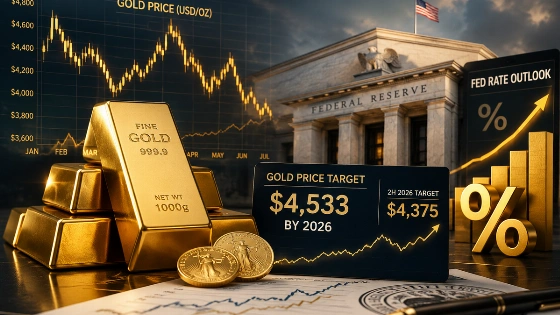
Bernstein has updated its gold price targets, reflecting a more nuanced view of how Fed policy may affect bullion. According to Investing.com, the firm now expects gold to reach $4,533 an ounce by 2026, with a second-half 2026 target of $4,375. This revision comes after gold’s drop from $4,650 in early April to around $4,000 in late June, a period when real yields rose from 2% to 2.28%. Bernstein’s analysts argue that central bank demand remains robust and that the Fed is less likely to launch an aggressive rate-hike cycle than markets previously feared.
Earlier in the year, Bernstein’s 2026 gold forecast ranged from $4,180 to $4,800, reflecting shifting expectations as economic data and Fed communications evolved. The firm’s current view stands in contrast to more cautious forecasts from other major banks, some of which have trimmed their gold targets in response to a stronger dollar and persistent inflation risks.
Fed Policy and Market Tension
The Federal Reserve’s latest signals have complicated the outlook for gold. Minutes from the June meeting, the first under Chair Kevin Warsh, revealed a divided central bank, with half of policymakers favoring rate hikes by year-end and the other half leaning toward holding steady or cutting. The Fed held its benchmark rate at 3.6% in June, but market-implied odds of a 2026 hike have climbed to nearly 87% as inflation and oil prices remain elevated.
Bernstein’s economists do not expect more than one or two additional hikes over the next year, putting them at odds with Wall Street firms like Bank of America and Deutsche Bank, which now anticipate multiple increases before year-end. This divergence in expectations has contributed to volatility in gold prices and left investors weighing the risk that higher real rates could further erode the metal’s appeal.
Central Bank Demand and Inflation Risks
One of the key supports for gold, according to Bernstein, is sustained central bank buying. The World Gold Council’s 2026 Central Bank Gold Reserves survey found that 89% of central banks expect global gold reserves to rise over the next year, with a record 45% planning to increase their own holdings. Central banks tend to be less sensitive to short-term price swings than retail investors or ETF traders, often buying gold for diversification, geopolitical risk management, and long-term balance sheet protection.
Still, inflation remains a critical risk. If price pressures persist, the Fed may be forced to maintain or even accelerate rate hikes, pushing real yields higher and strengthening the dollar—both of which typically weigh on gold. This dynamic has already played out in the second quarter, when rising real rates coincided with gold’s retreat from its highs.
Competing Wall Street Forecasts
Major banks remain divided on gold’s prospects. Morgan Stanley projects $5,200 an ounce in the second half of 2026, but warns that stronger ETF inflows are needed to reach that level. Deutsche Bank sees gold at $4,300 in the third quarter before a rebound to $4,800 by year-end, citing ongoing Fed repricing and U.S. macroeconomic pressures. Goldman Sachs has set a $4,900 target for the end of 2026, pointing to sovereign and emerging-market central bank demand. Bank of America and UBS have also revised their forecasts, with UBS expecting $5,200 over the next 12 months as markets digest Fed policy and central bank buying trends.
For U.S. investors, these competing forecasts underscore the uncertainty surrounding gold’s path. The interplay between Fed policy, inflation, and global central bank demand will likely remain the dominant forces shaping the market in the months ahead.
According to the World Gold Council, global central bank gold purchases reached a record 1,082 metric tons in 2023, up 9% from the previous year. The U.S. dollar index, which measures the greenback against a basket of major currencies, rose nearly 3% in the second quarter of 2026, while the yield on 10-year Treasury Inflation-Protected Securities (TIPS) climbed from 2% to 2.28% over the same period. These shifts have contributed to gold’s recent volatility and highlight the sensitivity of the metal to both monetary policy and currency movements.
Gold’s relationship with real interest rates is a central factor for investors. Unlike stocks or bonds, gold does not pay interest or dividends, so its relative appeal often declines when real yields rise. Central banks, however, may continue to accumulate gold for reasons that go beyond short-term returns, including diversification away from the dollar and hedging against geopolitical or financial instability. For individual investors, understanding these drivers—and the risks posed by shifting Fed policy—remains essential when considering gold as part of a diversified portfolio.