
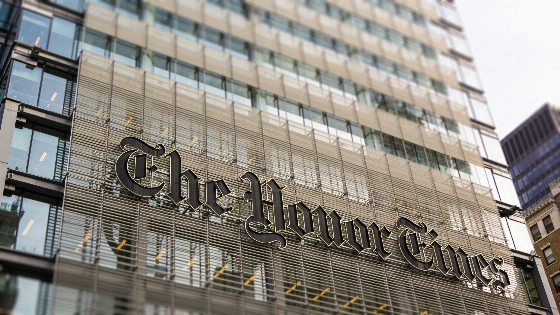
Berkshire Hathaway has quietly expanded its position in The New York Times, signaling rare conviction in legacy media as digital subscriptions and advertising revenue reach record highs and outpace industry peers.
Berkshire Hathaway's latest move in the media sector stands out against prevailing market trends: Warren Buffett's conglomerate has increased its stake in The New York Times for a second consecutive quarter, now holding nearly 10% of the publisher's outstanding shares. According to Q2 2026 13F filings, Berkshire added approximately 553,500 shares, bringing its total to 15.7 million-an investment valued at about $1.1 billion as of June 30, 2026. This 3.65% quarter-over-quarter increase reflects a calculated bet on the Times' digital transformation, as tracked by the IBFUTU Manager Tracker.
In the first half of 2026, The New York Times generated $266 million in free cash flow and returned $160 million to shareholders through buybacks and dividends.
Berkshire's investment approach emphasizes companies with strong brands, recurring revenue, and pricing power. The Times' digital strategy extends beyond paywalls, with management investing in original video content, new app features, and a diversified product suite. On the Q2 2026 earnings call, executives highlighted news, games, and sports as key engagement drivers, noting that growth was broad-based across the portfolio. With 150 million registered users but only 13 million paying customers, the company has a significant opportunity to convert and retain more subscribers.
In the broader context of Q2 2026, Berkshire Hathaway was a net buyer of equities, with purchases totaling about $23.5 billion versus $3.7 billion in sales. As of June 30, 2026, Berkshire's cash and treasury holdings stood at approximately $364.7 billion, reflecting its ongoing capacity for large-scale investments.
Analyst sentiment on NYT stock remains cautiously optimistic. Of seven analysts, four rate it a "Buy" and three a "Hold," with an average price target of $78-about 17% above current trading levels. Consensus forecasts from Tikr.com project revenue rising from $2.82 billion in 2025 to $3.52 billion by 2028, and adjusted EPS increasing from $2.46 to $3.38. Despite this, NYT accounts for just 0.32% of Berkshire's portfolio, far less than its positions in Apple, Alphabet, and Japanese trading houses. The steady accumulation suggests a long-term strategy rather than a short-term trade.
For investors, Berkshire's move represents a rare endorsement of a legacy media company at a time when capital is flowing into technology and AI disruptors. The Times' ability to grow digital revenue, maintain pricing power, and return capital to shareholders stands in contrast to the challenges faced by many peers. Berkshire's capital allocation has historically favored sustainable cash generation and shareholder returns-Apple's buybacks, for example, have been a key attraction for Buffett. The same rationale appears to support the Times investment: a focus on recurring digital revenue and disciplined capital returns, not merely brand prestige.
Federal Reserve data indicates that U.S. household net worth reached a record $160 trillion in June 2026, with equities comprising over $45 trillion. However, the media sector's share of that wealth has declined as digital platforms and technology giants capture more advertising and subscription revenue. The Times' recent performance runs counter to this trend, but the risks posed by AI-driven content and platform gatekeepers remain significant.
Berkshire's increasing stake in The New York Times reflects a belief that a legacy publisher can still achieve digital profitability-if it can convert its large audience into paying subscribers and keep them engaged with original content. The Times faces the same structural challenges as its peers, but its financial discipline and investment in new formats distinguish it. If digital revenue growth and capital returns continue, Berkshire's investment could prove prescient. If not, it will underscore the reality that even established brands must continually adapt to deliver shareholder value.
Digital subscriptions now underpin the economics of modern media, replacing the former reliance on print advertising and newsstand sales. For investors, the key distinction is between companies that can build direct, recurring relationships with their audience and those still dependent on volatile third-party platforms. The New York Times' strategy of bundling news, games, and lifestyle content under a single subscription is designed to maximize customer lifetime value and reduce churn. As competition for attention intensifies and AI-driven aggregators reshape news discovery, even the strongest brands must continue to innovate to justify their valuations and sustain investor confidence.