BYD seized over a third of China's electric vehicle exports in August while Tesla China fell to fourth place. The shift signals a deeper change in the global EV market and raises new questions for investors watching both companies' next moves
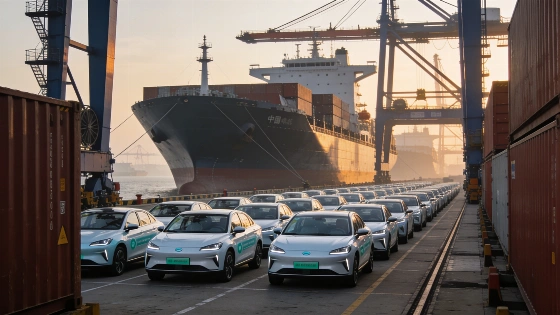
BYD has delivered a clear signal to Tesla and investors focused on the established electric vehicle landscape. In August, BYD accounted for 35.4% of China's passenger new energy vehicle exports, shipping 183,746 units abroad-over five times more than Tesla China's 36,119. Tesla, previously the leading exporter, dropped to fourth place behind Geely and Chery, according to the China Passenger Car Association. This marks a significant realignment in the global EV hierarchy.
In August 2026, China exported a total of 518,000 passenger new energy vehicles, marking a 154.7% year-on-year increase and accounting for 58.4% of all passenger car exports.
BYD distinguishes itself through the scale and pace of its international expansion. In the first eight months of 2026, BYD exported 1,126,797 new energy vehicles, representing a 33.9% share of China's total NEV exports. Tesla China exported 331,443 vehicles, or 10%. The gap between the two is widening. BYD's own reported overseas sales for August-189,466 vehicles-surpass the official export figures, as they include vehicles produced at new plants outside China. Each new foreign facility further increases this divergence.
BYD's global ambitions are explicit. Management now targets over 2.5 million overseas sales in 2027, raising its 2026 goal for the third time this year. The company attributes its current constraints to shipping capacity rather than demand. To address this, BYD is expanding its dedicated carrier fleet and accelerating local assembly in markets such as Indonesia, Brazil, and Hungary. Vehicles produced in Hungary, for example, are classified as European and are not counted as exports, allowing BYD to avoid tariffs aimed at Chinese imports.
According to CPCA data, China exported approximately 894,000 passenger vehicles in August 2026, representing a 77.5% year-on-year increase. This robust export performance occurred even as domestic demand weakened, highlighting a strategic shift by automakers toward international markets.
BYD's overseas sales have grown rapidly: 242,765 in 2023, 417,204 in 2024, 1,046,083 in 2025, and already 1,162,260 through August 2026. The company is scaling up in Europe, where battery-electric vehicles accounted for 20.7% of new car sales in the first half of 2026, up from 15.6% a year earlier. While Tesla is increasingly focusing on autonomy, energy storage, and robotics, BYD is intensifying its efforts to deliver more vehicles to more regions.
This shift does not invalidate Tesla's core strategy, which has long relied on technology initiatives beyond vehicle sales. However, as BYD expands its export lead, Tesla's narrative of leading in vehicle sales becomes less convincing. Each month, the data becomes more definitive: BYD is gaining time and market share, while Tesla faces increasing pressure to maintain its position.
Both companies face ongoing risks. BYD must navigate European tariffs, local-content requirements, and political scrutiny in various markets. Battery supply remains a constraint, with shortages of its second-generation Blade Battery expected to continue until early 2027. An order backlog of 250,000 flash-charging-compatible vehicles is pending as supply catches up. For Tesla, the challenges include intensified competition, the loss of its export advantage, and the need to support its premium valuation with more than just sales volume.
Investors monitoring this sector should prioritize monthly export rankings from the China Passenger Car Association over quarterly delivery figures. These rankings provide a clearer view of global market dynamics, filtering out the effects of domestic price competition. As previously reported, regulatory and market changes can disrupt even the most established players when conditions shift.
The competition in China's EV export market has moved beyond a two-company race. BYD's aggressive expansion, increasing overseas profitability, and focus on local assembly have altered the competitive landscape for Tesla and sector investors. The next stage will be determined not by domestic sales in Shanghai, but by the ability to build, ship, and profit from vehicles across multiple continents. BYD is not only outpacing Tesla-it is redefining the global EV market, and those relying on previous assumptions may already be lagging behind.
According to the U.S. Bureau of Economic Analysis, U.S. imports of electric vehicles and parts from China reached $7.5 billion in the first half of 2026, a 38% increase over the same period in 2025. This growth reflects both rising demand and the expanding role of Chinese automakers in global supply chains, despite ongoing U.S. tariffs and regulatory scrutiny.
Export figures represent only one aspect of the electric vehicle sector. Local assembly enables automakers to bypass tariffs, comply with regional regulations, and respond more effectively to consumer preferences. For investors, distinguishing between export volume and genuine overseas market presence is essential. Companies that manufacture vehicles where they are sold gain not only cost advantages but also a more secure strategic position. As the global EV race intensifies, success will depend on mastering both the logistics and the regulatory complexities of international expansion.