
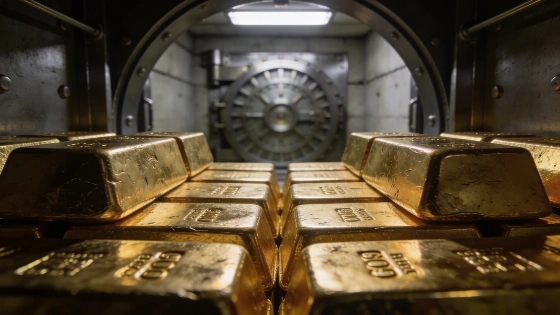
Gold prices slipped after a sharp rally, as investors reacted to a U.S. Treasury liquidity move, rising oil prices, and renewed signals that the Federal Reserve may keep rates higher for longer
Gold prices pulled back Thursday after hitting their highest level in over two months, as a mix of profit-taking, rising oil prices, and hawkish signals from the Federal Reserve weighed on the precious metal. The retreat followed a surge driven by the U.S. Treasury Department's unexpected decision to double the size of its buyback operations for longer-term government bonds, a move that temporarily weakened the dollar and pushed Treasury yields lower. As a result, spot gold fell 0.9% to $4,479.12 an ounce, while U.S. gold futures slipped 0.2% to $4,535.70. The previous session had seen gold climb more than 4%, peaking at $4,525.79, according to reporting by Bloomberg.
Investors who had benefited from the rally moved to lock in gains, especially as oil prices climbed to three-week highs. The jump in oil was fueled by concerns that ongoing tensions between the U.S. and Iran could disrupt Middle East energy supplies, after President Donald Trump warned of economic consequences for countries supporting Iran. Higher oil prices can stoke inflation fears, which in turn influence expectations for Federal Reserve policy. Minutes from the Fed's latest meeting revealed that several policymakers remain concerned about persistent inflation and are prepared to raise interest rates if necessary. While gold is often seen as a hedge against inflation, higher rates tend to make non-yielding assets like gold less attractive compared to interest-bearing alternatives.
The U.S. Treasury's expanded buyback program aims to improve liquidity in the market for longer-dated government bonds, which has faced bouts of volatility in recent months. The announcement pushed the U.S. dollar near a three-month low, briefly supporting gold prices before the market reversed. Meanwhile, the total outstanding U.S. federal debt surpassed $40 trillion for the first time, raising fresh concerns about long-term fiscal sustainability and the potential for future market disruptions.
Market participants are now closely watching for further signals from the Federal Reserve. According to the CME FedWatch Tool, traders are pricing in a roughly 67% chance that the Fed will hold rates steady at its September meeting. However, the outlook remains highly sensitive to upcoming inflation data and geopolitical developments. Morgan Stanley has forecast that gold could exceed $5,000 an ounce by 2027, but cautions that volatility is likely as inflation readings and positioning in the futures market shift. In the short term, low levels of short positions on the COMEX exchange may limit the potential for further short-covering rallies.
Other precious metals also lost ground Thursday. Spot silver declined 0.4% to $66.63 per ounce, platinum dropped 0.5% to $1,815.57, and palladium edged down 0.1% to $1,331.00. These moves reflect broader uncertainty across commodity markets as investors weigh the impact of central bank policy, energy prices, and global political risks.
According to the U.S. Treasury Department, the federal government's total outstanding debt reached $40.1 trillion as of June 2026, up from $33.2 trillion at the end of 2023. The CME FedWatch Tool showed that as of Thursday, market participants assigned a 67% probability to the Federal Reserve maintaining its current target range for the federal funds rate at the September 2026 meeting. Spot gold's intraday high of $4,525.79 marked its strongest level since April, while the U.S. Dollar Index hovered near its lowest point since March.
Gold's role as an inflation hedge is often debated, especially during periods of rising interest rates. While the metal can help preserve purchasing power over the long term, its price tends to be sensitive to shifts in real yields and the strength of the U.S. dollar. When interest rates rise, the opportunity cost of holding gold increases, as investors can earn more from bonds and other interest-bearing assets. Conversely, when inflation outpaces rate hikes or geopolitical risks intensify, gold may regain appeal as a safe-haven asset. For individual investors, understanding these dynamics is crucial before making decisions about adding gold or other precious metals to a diversified portfolio.