A weak June jobs report triggered a sharp rotation out of defensive stocks, pushing down shares of Johnson & Johnson, PepsiCo, Starbucks, Constellation Brands, and TJX. Here’s why some investors see opportunity—and what could go wrong next
On July 6, 2026, a disappointing U.S. jobs report set off a wave of selling across Wall Street, with large investment funds shifting money out of steady, defensive stocks and into high-growth sectors. According to reporting by CNBC, this broad rotation left several fundamentally strong companies trading at lower prices, creating what some investors view as a rare entry point—if the underlying businesses remain resilient.
Rotation Fallout
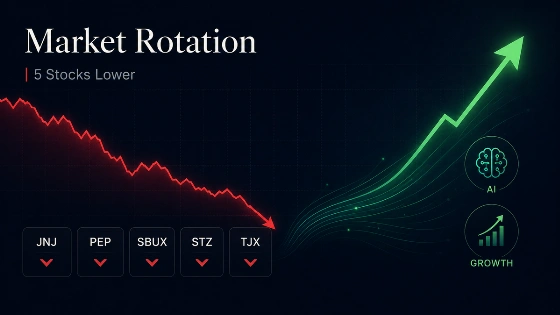
The June employment data, released the prior week, showed hiring slowing more than expected. That signaled to many institutional investors that the Federal Reserve might keep interest rates steady or even consider cuts sooner than previously thought. In response, money managers moved capital out of traditional defensive names—companies that tend to hold up during economic uncertainty—and back into stocks tied to artificial intelligence and other growth themes. This kind of sector rotation can drag down even healthy companies, not because of their own results, but because they share a sector with weaker peers.
Jim Cramer, host of CNBC's Mad Money, identified five stocks he believes were caught in this rotation: Johnson & Johnson (JNJ), PepsiCo (PEP), Starbucks (SBUX), Constellation Brands (STZ), and TJX Companies (TJX). He argues that these companies suffered collateral damage from indiscriminate selling, not from any deterioration in their business fundamentals.
Earnings in Focus
For Johnson & Johnson and PepsiCo, the next test comes quickly. Johnson & Johnson, now focused solely on pharmaceuticals after spinning off its consumer health division Kenvue and exiting orthopedics, is set to report earnings on July 15. PepsiCo, which recently gave up much of its post-earnings rally, will announce its second-quarter results on July 9. Wall Street analysts expect PepsiCo to report earnings of about $2.21 per share on $23.96 billion in revenue, according to AlphaStreet. For investors considering a buy-the-dip approach, these earnings reports will be critical checkpoints: if the companies deliver steady results, the recent price declines may look like an opportunity. If not, the stocks could fall further.
Market data from the week of July 6 showed defensive sectors underperforming the broader S&P 500, while technology and AI-related stocks continued to attract inflows. This divergence highlights how sector rotations can create short-term mispricings, but also increase risk for investors who buy before company fundamentals are confirmed by earnings.
Longer-Term Stories
The other three names on Cramer's list—Starbucks, Constellation Brands, and TJX Companies—present different cases. Starbucks is in the midst of a turnaround under CEO Brian Niccol, and the recent pullback may offer a more attractive entry for investors willing to wait for operational improvements. Constellation Brands, which owns beer brands like Corona and Modelo, has seen its core beer business stabilize even as the broader alcohol market faces headwinds. In its latest quarter, Constellation reported continued gains in both dollar and volume share for its beer division, based on its SEC filings. TJX Companies, which operates off-price retailers such as T.J. Maxx and Marshalls, tends to benefit when consumers trade down during periods of economic stress. If the consumer remains cautious but not severely weakened, TJX could see increased traffic and access to high-quality inventory at lower costs.
Still, each of these stocks faces its own risks. Starbucks must prove its turnaround is gaining traction, Constellation needs to maintain beer momentum despite softness in spirits, and TJX depends on a delicate balance: a weak enough consumer to drive bargain hunting, but not so weak that overall spending collapses.
Risks and Skepticism
Sector rotations can create opportunities, but they also carry real risks. If the market’s enthusiasm for AI and growth stocks continues, more money could flow out of defensive sectors, putting further pressure on names like Johnson & Johnson and PepsiCo. There’s also no guarantee that recent declines represent true bargains—especially if upcoming earnings disappoint or if the economic slowdown proves deeper than expected. Investors should also be aware that Jim Cramer’s stock picks are frequently debated, and some market participants even track his recommendations to bet against them.
For those watching these five stocks, the next few weeks will be telling. Earnings results from Johnson & Johnson and PepsiCo will provide early signals about whether the recent selloff was an overreaction or a warning sign. Meanwhile, the performance of Starbucks, Constellation Brands, and TJX will depend on longer-term trends in consumer behavior and sector dynamics.
Sector rotation is a recurring feature of U.S. equity markets. When large investors move money between sectors in response to economic data, interest rate expectations, or shifting risk appetite, entire groups of stocks can rise or fall together—regardless of individual company performance. For individual investors, understanding the difference between a stock falling due to sector pressure versus company-specific problems is crucial. While rotation-driven declines can create opportunities, they also require careful analysis of fundamentals, earnings trends, and broader economic signals before making new investments.