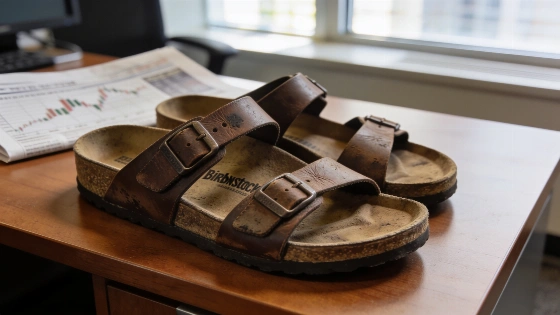
Michael Burry has taken a 5.2% stake in Birkenstock after shares fell 17 percent this year despite rising sales and a bullish outlook. His move tests whether durability and brand loyalty can outlast market skepticism.
Michael Burry is known for his contrarian approach, and his latest move underscores that reputation. As Birkenstock shares declined 17% year-to-date, Burry quietly acquired a 5.2% stake, making him one of the German shoemaker's largest outside shareholders. This investment reflects both personal conviction and financial analysis-Burry has worn Birkenstocks since the 1980s and maintains that the brand's quality has remained consistent. In public statements, Burry noted he has worn Birkenstock since 1987 and described the brand as his preferred footwear since his school years, emphasizing its enduring quality, according to Reuters.
In the third quarter of fiscal 2026, Birkenstock achieved double-digit revenue growth across all regions: Americas +11%, EMEA +15%, and APAC +18%.
Burry's thesis is that the market is overlooking the company's broader strengths. Birkenstock has raised its full-year sales forecast and now expects to reach the upper end of its €2.3 billion to €2.35 billion range by 2026, with adjusted EBITDA projected at a minimum of €710 million. Growth is evident across regions: revenue increased 11% in the Americas, 15% in Europe, the Middle East and Africa, and 18% in Asia-Pacific. The company's direct-to-consumer strategy is gaining momentum, and management has demonstrated confidence by returning capital to shareholders, even as the stock trades well below its highs. According to a Reuters financial review, Birkenstock's constant currency revenue growth reached 15% in the third quarter, prompting the company to raise its fiscal 2026 outlook.
For U.S. investors, Birkenstock represents a test of whether brand durability and consumer loyalty can outweigh short-term market concerns. The company, with roots dating back to 1774, continues to manufacture over 95% of its products in Germany. Burry's investment thesis centers on the belief that consistency and product quality are more significant than quarterly margin fluctuations. He increased his stake when shares fell below $35, a contrarian move reminiscent of his earlier bets against the U.S. housing market. Following the quarterly report, Birkenstock shares declined approximately 7.9%, but interest in the stock rose after Burry's position became public, as reported by Reuters.
Birkenstock's management has emphasized that direct-to-consumer sales are growing faster than wholesale, reflecting a strategic shift to deepen customer relationships and improve margins. The company's accelerated €230 million buyback in the latest quarter reduced the share count by nearly 6 million, underscoring management's confidence in long-term value.
Investors familiar with Burry's prescient call on the housing bubble may question whether this is another instance of the market overlooking a slow-developing story. However, risks remain: fashion trends can shift rapidly, and ongoing margin pressure from tariffs and currency movements could persist. Birkenstock's ability to sustain pricing power and consumer demand will be challenged if economic conditions deteriorate or if competitors intensify their direct-to-consumer strategies.
For context, the S&P 500 Consumer Discretionary sector has returned 8.7% year-to-date as of August 2026, significantly outperforming Birkenstock. While U.S. consumer spending remains resilient, inflation and higher interest rates have begun to impact discretionary purchases, particularly in apparel and footwear. Investors are monitoring whether premium brands can maintain their position as household budgets tighten.
Burry's investment in Birkenstock is grounded in decades of personal experience but also represents a calculated challenge to Wall Street's short-term focus. The company's fundamentals-double-digit revenue growth, an increasing direct-to-consumer share, and substantial buybacks-indicate a business with greater resilience than its current stock price suggests. As with his previous market calls, Burry is wagering that patience and a long-term perspective will be rewarded. If Birkenstock's brand strength endures, this could be another example of the market underestimating a company's staying power. Conversely, if margin pressures intensify or consumer preferences shift, even loyal supporters may find market skepticism justified. Ultimately, Birkenstock's ability to deliver returns will depend on whether its traditional strengths can translate into sustained performance for investors willing to weather volatility. For those observing how renowned investors identify overlooked value, Burry's move highlights that conviction often requires standing apart-especially when financial results and market sentiment diverge. As reported earlier, even leading players can find themselves out of sync with prevailing sentiment, but such moments often present the most compelling opportunities.
Birkenstock's business model is characterized by a combination of heritage, manufacturing control, and direct customer engagement. Unlike many consumer brands that outsource production or pursue transient trends, Birkenstock emphasizes product consistency and vertical integration. This strategy can provide some insulation from supply chain disruptions and enable tighter quality control, but it also exposes the company to European labor costs and currency risks. For investors, the central question is whether this traditional approach can continue to drive growth and profitability in a global market that favors speed and scale. The outcome will depend on Birkenstock's ability to balance tradition with innovation-and on whether investors like Burry are correct in believing that durability remains a valuable asset in a market focused on the next trend.