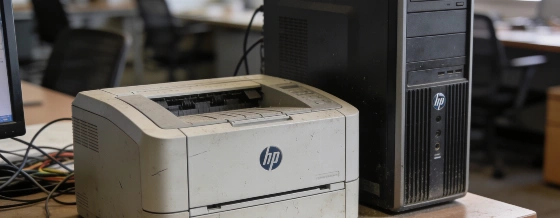
HP's 38% rally in 2026 faces a sharp reversal risk as Morgan Stanley warns that rising component costs and persistent PC shipment declines could drive shares down by nearly a third, despite headline revenue growth and an earnings beat.
HP Inc. stock, which has climbed nearly 38% year-to-date, now faces a significant warning from Morgan Stanley: the rally could reverse, with shares potentially falling 30% from current levels. This bearish outlook follows HP's fiscal Q3 2026 earnings beat and double-digit revenue growth, but Morgan Stanley contends that profit headwinds and ongoing declines in PC shipments could offset these gains.
After HP reported record Q3 2026 revenue of $15.7 billion, the company raised its full-year non-GAAP EPS guidance to $3.19-$3.29, up from $2.90-$3.10 previously.
Margins Under Pressure Despite Revenue Gains
The core of Morgan Stanley's thesis is that HP's revenue growth is concealing a profit squeeze. In Q3, revenue increased 12.5% year over year to $15.7 billion, but this was driven almost entirely by higher average selling prices rather than increased unit sales. According to Morgan Stanley, HP shipped 16% fewer PCs compared to the prior year but compensated by raising prices per device. This pricing power may not be sustainable as memory and component costs rise, potentially forcing HP to offer discounts to maintain market share, which would directly pressure margins.
HP's official filings show that part of the Q3 2026 EPS improvement was due to a one-time $0.11 benefit from tariff refunds. Even without this, the non-GAAP EPS would have exceeded the previous guidance, but the effect notably boosted the reported figure. The company also highlighted that Personal Systems revenue rose to about $11.8 billion (+18% year over year), driven by demand for commercial and premium AI-enabled PCs, even as total PC shipments declined.
AI PCs: Upgrade Cycle or Mirage?
HP is positioning AI-enabled PCs as a growth driver, stating that these models now account for nearly half of all shipments. However, Morgan Stanley remains skeptical that this will trigger a true upgrade cycle. The firm argues that most buyers are simply replacing aging commercial PCs with AI-capable versions, rather than expanding the overall market. Without a significant increase in incremental demand, the expected boost to sales and profits may not materialize.
Bank of America shares this cautious view, maintaining an Underperform rating and an $18 price target on HP. Both banks caution that revenue growth alone will not lead to higher earnings if HP must reduce prices or increase promotional spending to defend its market position.
Printing Segment Faces Global Competition
HP's Imaging and Printing business, traditionally a profit center, is also under pressure. Morgan Stanley forecasts low-single-digit revenue declines as demand for both hardware and supplies contracts. Japanese competitors, benefiting from a weaker yen, are undercutting HP on price in international markets. As a result, Print operating margins are expected to move toward the lower end of HP's 16%-19% long-term target range.
Taking these factors into account, Morgan Stanley estimates HP's earnings per share could decline 16% year over year in fiscal 2027, even if revenue remains stable. The $19 price target is based on a 7x P/E multiple applied to a projected $2.75 in 2027 EPS-approximately 9% below the current Wall Street consensus.
Key Metrics and Macro Risks for Investors
Investors should monitor operating margins in both Personal Systems and Print, as well as trends in memory and component costs. A prolonged supply crunch could intensify HP's margin pressures. The dividend yield, currently near 4%, may provide some downside protection but is unlikely to offset a major price correction.
HP's outlook is also influenced by broader consumer and credit trends. According to the Federal Reserve, U.S. consumer credit card balances reached a record $1.13 trillion in Q2 2026, with average new card interest rates at 22.8%. Elevated consumer debt and higher borrowing costs could further limit discretionary spending on big-ticket items like PCs and printers, increasing risks for HP and its peers.
While a stronger-than-expected PC recovery, deeper cost reductions, or aggressive share buybacks could challenge Morgan Stanley's bearish scenario, the firm's base case is that HP's profit engine is slowing. For investors, distinguishing between revenue growth and sustainable earnings is crucial: headline sales can rise even as margins contract. HP's ability to maintain profitability amid rising costs and intensifying competition will determine whether its 2026 rally endures or proves short-lived.