Rivian's Q2 results topped Wall Street forecasts, but the EV maker is tightening its capital spending outlook as it ramps up production of its lower-priced R2 model and faces ongoing competition from Tesla
Rivian, the electric vehicle manufacturer with a $22 billion market cap, is taking a more cautious approach to spending even as it delivered better-than-expected revenue in the second quarter. The company, which has seen its stock price fall roughly 80% from its all-time high, reported Q2 revenue of $1.66 billion-outpacing analyst estimates of $1.51 billion, according to CNBC. Adjusted losses also narrowed, with a per-share loss of $0.47 versus the expected $0.63.
In a notable shift, Rivian lowered its 2026 capital expenditure guidance to a range of $1.7 billion to $1.8 billion, down from its previous forecast of $1.95 billion to $2.05 billion. Management attributed the $250 million reduction at the midpoint to improved project efficiency and more disciplined timing of investments. The company also tightened its expected adjusted loss range for the year, now projecting between $1.8 billion and $2 billion.
R2 Launch and Production Ramp
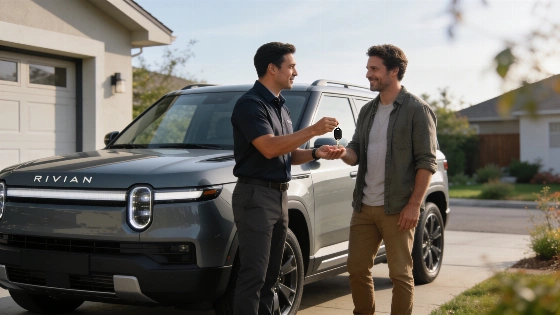
The company's decision to trim spending comes as it begins deliveries of its new R2 model, a lower-priced SUV aimed at attracting first-time EV buyers. Rivian started shipping the R2 in June, and early demand has exceeded internal expectations, with a higher-than-anticipated rate of reservation conversions to orders for the launch edition. The R2 is positioned below the R1 series in price, broadening Rivian's potential customer base at a time when affordability is a key concern in the EV market.
Rivian produced 12,613 vehicles and delivered 12,194 in the quarter, surpassing its own guidance. Automotive revenue rose 23% year over year, helped by a 14% increase in deliveries and a $103 million boost from regulatory credit sales. The company reported a gross profit of $179 million for the quarter, a sharp turnaround from a $206 million loss in the same period last year. This included a $36 million loss from the automotive segment and a $215 million profit from software and services.
Balancing Growth and Capital Discipline
Despite the spending cuts, Rivian reaffirmed its full-year delivery target of 65,000 to 70,000 vehicles, a figure it had already raised earlier in the summer. The company ended the quarter with more than $5.3 billion in cash and short-term investments, bolstered by a $1.3 billion stock sale in July. This liquidity, along with a Department of Energy loan tied to its Georgia factory, gives Rivian some flexibility to continue investing in technology and production capacity even as it reins in other expenses.
Chief Financial Officer Claire McDonough noted that the second quarter only reflected about two-thirds of a quarter's worth of R2 production costs, since the model only recently transitioned from preproduction to full manufacturing. She cautioned that the third quarter will show a full quarter's impact of the production ramp, including higher labor costs from a second shift, before scale efficiencies are expected to materialize in the fourth quarter.
Competitive Position and Technology Strategy
While Tesla remains the dominant player in the U.S. EV market, Rivian is carving out a distinct niche. Its R1 trucks and SUVs target adventure-oriented buyers, and its partnership with Amazon has resulted in more than 40,000 Rivian delivery vans now operating in Amazon's network-a commercial fleet business that Tesla largely lacks. On the technology front, Rivian is developing its own RAP1 chip and using LiDAR sensors for its self-driving systems, diverging from Tesla's approach.
Rivian aims to introduce point-to-point hands-off driving by the end of this year, with more advanced hands-off and eyes-off features planned for 2027, and full Level 4 autonomy targeted for 2028 through a partnership with Uber. The company's ability to balance ambitious technology investments with tighter capital discipline will be closely watched as R2 production ramps up in the second half of the year.
For investors, the company's approach echoes a broader trend among growth companies that are under pressure to show a path to profitability while still investing in future capabilities. As seen in other sectors, such as when Charles Schwab posted record earnings but saw its stock slip as investors focused on business mix and positioning, according to this analysis, the market is increasingly rewarding companies that can demonstrate both growth and financial discipline.
Analyst Outlook and Valuation
Consensus estimates from TIKR project Rivian's revenue to rise from $5.39 billion in 2025 to $32 billion by 2030, with free cash flow expected to swing from a $1.64 billion outflow last year to a $2 billion inflow in 2030. If Rivian's stock were to trade at 25 times forward free cash flow, its share price could more than double over the next four years, though such projections depend on execution and market conditions. Among 16 analysts covering the stock, five rate it a "Buy," seven a "Hold," and four a "Sell," with an average price target of $17.56-about 15% above recent trading levels.
Rivian's ability to deliver on its production, cost, and technology goals will likely determine whether it can close the gap with larger rivals and justify a higher valuation in the years ahead.
Electric vehicle manufacturers face a complex balancing act between scaling production, managing costs, and investing in new technology. Capital discipline has become a central theme for both established automakers and newer entrants as they navigate uncertain demand, evolving regulations, and intense competition. For consumers, the arrival of lower-priced models like the R2 could expand access to EVs, but long-term adoption will depend on affordability, charging infrastructure, and ongoing improvements in battery technology. Investors should weigh not only headline growth figures but also the underlying path to sustainable profitability and the risks associated with rapid industry change.