Rivian delivered strong Q2 revenue growth and raised its delivery outlook, but shares tumbled as investors focused on ongoing losses in its core auto business and the risk of further dilution
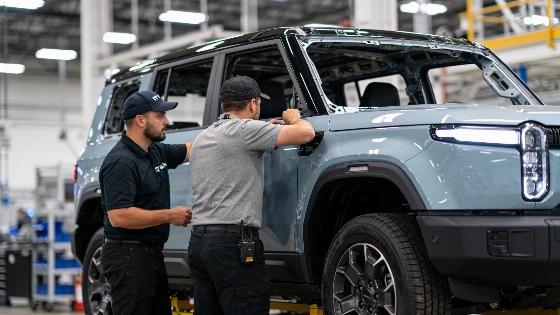
Nine years after Tesla's infamous "production hell," Rivian is facing its own high-stakes test as it tries to scale up the R2, its new lower-priced SUV. The company's latest quarterly results show progress on several fronts, but Wall Street's reaction highlights the challenges that come with trying to move from niche player to mass-market contender in the electric vehicle space.
Strong Revenue, But Underlying Losses Remain
For the second quarter, Rivian reported $1.658 billion in revenue, a 27% increase from the same period last year, according to CNBC. The company posted a gross profit of $179 million, a sharp turnaround from a loss a year ago. Deliveries of the R2 began in June, and Rivian hosted a record 57,000 demo drives during the quarter. Management also raised its full-year delivery guidance to 65,000-70,000 vehicles and trimmed planned capital spending by $250 million at the midpoint.
Yet a closer look at the numbers reveals that Rivian's core auto business is still losing money on every vehicle sold. Of the $179 million gross profit, $215 million came from software and services-primarily from a joint venture with Volkswagen-while the automotive segment posted a $36 million gross loss. The Volkswagen partnership alone contributed $308 million to software revenue, helping to offset losses elsewhere.
Market Reaction: Dilution and Margin Risks
Despite beating most Wall Street expectations, Rivian's stock fell more than 9% on Friday, closing at $15.22 and erasing gains from after-hours trading the previous day, according to The Motley Fool. Investors appear to be reacting less to the headline numbers and more to concerns about future dilution from a $1.3 billion equity sale completed in July, as well as rising component costs that could pressure margins as R2 production ramps up.
This dynamic-where strong results are met with skepticism-reflects a broader shift in how investors view electric vehicle makers. Good quarters no longer guarantee a positive market response. Instead, the focus is on whether companies can sustain growth and profitability as they scale, especially when capital needs remain high and cost pressures are mounting.
Analyst Divide: Execution Risk vs. Demand
Morgan Stanley raised its price target for Rivian to $14 from $13, citing stronger-than-expected demand for the R2. However, the firm maintained its underweight rating, splitting its valuation between $8 per share for the auto business and $6 for software and services. This approach assumes Rivian can eventually monetize data and software in a way similar to Tesla's driver-assistance offerings.
Other analysts are more optimistic. TD Cowen raised its target to $21 with a buy rating, and Needham kept its buy rating and $23 target, according to TipRanks. The wide range of targets-$14 to $23 on the same earnings report-shows that while there is consensus on demand, there is significant disagreement about Rivian's ability to execute and manage costs as it scales up production.
Key Milestones Ahead
Morgan Stanley is watching three main signposts: whether Rivian can launch point-to-point autonomy in select markets by year-end (a milestone tied to its in-house RAP1 chip and LiDAR hardware), whether the company can meet its raised delivery guidance by nearly doubling output in the second half of 2026, and whether the R2 can achieve a positive gross margin as cheaper trims arrive in 2027. Failure to hit these targets could push back Rivian's path to profitability even further.
Rivian is not alone in betting that software and autonomy can help bridge the gap to profitability. In March, Uber agreed to invest up to $1.25 billion in Rivian and purchase up to 50,000 autonomous R2s for its ride-hailing network, according to CNBC. This mirrors Tesla's strategy of using software-driven revenue to support a valuation that car sales alone might not justify.
Friday's selloff suggests investors are no longer willing to give EV startups the benefit of the doubt based on future promises alone. The next major test will come with Rivian's third-quarter results, when R2 production is expected to shift from one shift to two. Until then, the stock is likely to trade on execution risk rather than product appeal.
This pattern of strong results met with market skepticism is not unique to Rivian. As seen when Charles Schwab posted record earnings but still saw its stock fall, investors are increasingly focused on business mix and future risks rather than just headline numbers. For more on how analyst sentiment can diverge from market moves, see this analysis of Schwab's recent quarter: Morgan Stanley's view on Schwab after a record quarter.
For the second quarter of 2026, Rivian's $1.658 billion in revenue and $179 million gross profit marked a significant improvement from the prior year, but the company's automotive segment still posted a $36 million gross loss. The $1.3 billion equity sale in July added to investor concerns about dilution, while the raised delivery guidance to 65,000-70,000 vehicles signals management's confidence in scaling production.
Electric vehicle makers face a unique set of challenges as they try to scale from early adopters to mainstream buyers. Unlike traditional automakers, EV startups often rely on software and data-driven services to supplement thin or negative margins on vehicle sales. This business model can offer upside if autonomy and connected services take off, but it also exposes companies to execution risk and the need for ongoing capital. For investors, understanding the interplay between hardware, software, and capital markets is essential to evaluating the long-term prospects of companies like Rivian.