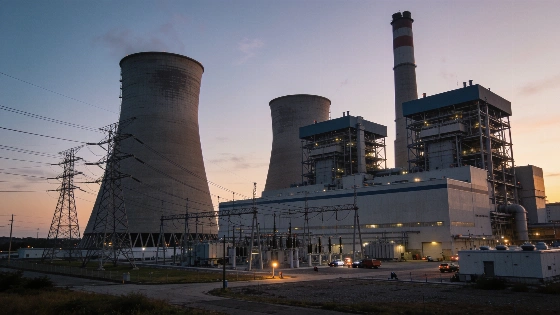
Talen Energy secured $1.2 billion in future revenue by winning a major PJM capacity auction, but the price per megawatt fell. Investors are betting on AI-driven demand, yet risks remain as the company expands and takes on more debt.
Artificial intelligence is driving a surge in electricity demand, and power producers are racing to secure their place in the market. Talen Energy, a Houston-based utility, recently announced it has locked in approximately $1.2 billion in revenue for the 2028-2029 period by clearing 10,180 megawatts in PJM's latest capacity auction. This figure represents a significant jump from previous years, but the underlying price per megawatt-day actually declined, raising questions about the sustainability of future gains.
Capacity Auction Mechanics
The PJM capacity auction is not a direct sale of electricity. Instead, it pays power generators to guarantee their plants will be available when demand peaks, regardless of whether the plants are ultimately called upon. For Talen, this means a minimum level of revenue is secured, providing a rare degree of predictability in an industry often subject to volatile spot prices. The $1.2 billion covers the period from June 1, 2028, through May 31, 2029, and is based on a clearing price of $325 per megawatt-day-down 1.3% from the previous auction's $329.17, according to company filings.
While Talen's capacity revenue jumped roughly 50% from the $805 million it secured for 2026-2027, the increase was driven by the company bringing 52% more megawatts to the auction, not by higher prices. This expansion came after Talen acquired additional gas plants, boosting its portfolio and positioning it to serve the growing needs of AI data centers.
AI Demand and Market Position
The rapid buildout of AI infrastructure is reshaping the U.S. electric grid. PJM, which operates the grid across 13 states and Washington, D.C., projects that data centers will account for 30 of the next 32 gigawatts of load growth by 2030. Talen's nearly all-in PJM capacity puts it at the center of this trend. The company's Susquehanna nuclear plant, for example, is under a 17-year contract to supply up to 1,920 megawatts to Amazon Web Services through 2042.
Wall Street has taken notice. Talen shares closed at $400.12 on July 15, up 6.1% over five days. Analyst targets are mixed: Morgan Stanley rates the stock overweight with a $508 target, Goldman Sachs is at $499 with a buy rating, Scotiabank is neutral at $470, and Jefferies recently downgraded to hold with a $453 target. The stock trades 56.6% above its 52-week low and 11.3% below its high of $451.28, based on Google Finance data.
Risks Behind the Revenue
Despite the headline revenue, several risks could affect Talen's outlook before the payments arrive in 2028. The company must close its Cornerstone acquisition on schedule, reduce leverage to below 3.5x adjusted EBITDA by the end of 2026, and navigate potential regulatory changes if high capacity prices draw political scrutiny. Near-term earnings remain tied to natural gas margins, and the company is absorbing about $2.6 billion in new debt as it expands.
Internationally, the AI data center boom is spreading beyond the U.S. Caribbean nations like Guyana and Trinidad are building large-scale facilities, often powered by domestic energy sources. This global expansion could eventually introduce new competition and affect long-term demand dynamics for U.S. power producers.
What Investors Are Really Betting On
Investors in Talen are making two distinct bets: that AI-driven electricity demand will remain strong through 2028, and that the company will successfully integrate its acquisitions and manage its debt load. The Energy Information Administration forecasts the strongest four-year stretch of U.S. electricity demand growth since 2000, but the two-year wait for contracted revenue and the risks of regulatory intervention or market shifts remain significant.
For those seeking exposure to the AI power trend without Talen's acquisition risk, other companies like Vistra and Constellation also own PJM nuclear plants but carry less acquisition-related debt. As Microsoft's recent spending surge and analyst downgrades show, even the biggest players in the AI and energy space face shifting market expectations and valuation pressures.
Capacity auctions offer a window into future demand, but they do not guarantee rising prices or smooth execution. Investors should weigh the timing of revenue, the impact of debt, and the potential for regulatory changes before making decisions based on headline figures.
Capacity markets like PJM's are designed to ensure grid reliability by paying power plants to be available during peak demand, not just when electricity is actually generated. This system helps stabilize revenue for utilities but can also lead to higher consumer bills if capacity prices rise sharply. Regulatory oversight, such as from the Federal Energy Regulatory Commission, can influence how these markets operate and whether high prices are allowed to persist. For investors, understanding the mechanics of capacity auctions and the risks of regulatory intervention is crucial when evaluating power sector stocks tied to the AI boom.