Applied Materials has steadily increased its dividend for 16 years, but its yield remains well below the S&P 500 average. Here's how its payout ratio, dividend history, and institutional ownership stack up for investors watching the AI chip boom.
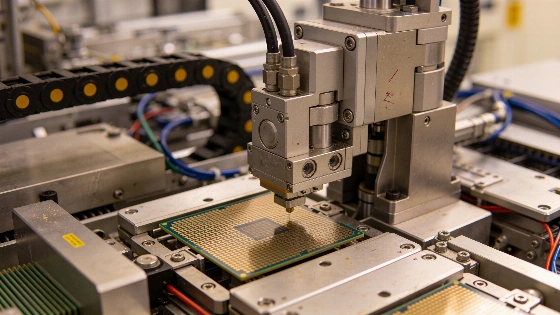
Applied Materials has emerged as a major beneficiary of the artificial intelligence surge, with its semiconductor equipment powering the production of advanced AI chips for data centers. The company's stock has climbed sharply in recent years, reflecting robust demand and record financial results. In fiscal 2025, Applied Materials reported nearly $7 billion in net income on $28.4 billion in revenue, according to company filings. A portion of those profits has been returned to shareholders through a steadily rising dividend.
For investors tracking income from technology stocks, Applied Materials stands out for its consistent dividend growth. The company has increased its dividend for 16 consecutive years, with the most recent hike in June 2026 raising the quarterly payout to $0.53 per share. That brings the estimated annual dividend to $2.05 per share for fiscal 2026, based on current rates. Dividend payments are made quarterly, typically in March, June, September, and December, following the company's fiscal calendar that ends in late October.
Dividend Yield and Payout Ratio
Despite its long record of increases, Applied Materials' dividend yield remains modest by large-cap standards. As of August 6, 2026, the trailing 12-month dividend yield was 0.36%, calculated using a total dividend payment of $1.91 over the prior four quarters and a closing share price of $527.48. This yield is significantly lower than the S&P 500's average dividend yield of 1.04% for the same period, based on data from multpl.com. The company's payout ratio-dividends as a percentage of earnings-stood at about 20% in fiscal 2025, with $1.72 per share paid out against $8.66 in earnings per share. By comparison, the average payout ratio for S&P 500 companies was 32.28% at year-end 2025, according to Hartford Funds.
Applied Materials' relatively low payout ratio suggests the company retains a large share of its profits for reinvestment, research, and capital expenditures. This approach is common among technology firms, which often prioritize growth and innovation over high dividend distributions. For income-focused investors, the trade-off is a lower yield but potentially greater long-term capital appreciation if the company continues to expand its earnings base.
Dividend History and Increases
Although Applied Materials was founded in 1967 and went public in 1972, it did not begin paying dividends until 2006. Before that, the company returned value to shareholders primarily through stock splits, with the last split occurring in April 2002. The first quarterly cash dividend was paid in June 2005 at $0.03 per share. Since then, the dividend has grown steadily, reaching $0.05 per share in 2006, $0.10 by 2013, and $0.83 annually by 2019. The annual payout nearly doubled to $1.78 by 2025, reflecting the company's strong earnings growth and commitment to returning capital to shareholders.
The most recent dividend increase came in June 2026, when the quarterly payout rose from $0.46 to $0.53 per share. This pattern of regular increases has helped Applied Materials build a reputation for reliability among dividend investors, even as its yield remains below the broader market average.
Who Benefits from the Dividend?
Institutional investors are the largest beneficiaries of Applied Materials' dividend policy. As of the end of 2025, BlackRock and The Vanguard Group held 76.8 million and 74.1 million shares, respectively, according to the company's 2026 proxy statement. Among company insiders, CEO Gary E. Dickerson was the largest individual shareholder, with nearly 1.4 million shares. For retail investors, the dividend provides a modest but growing stream of income, while the company's capital allocation strategy may appeal to those seeking both income and growth potential.
Applied Materials' approach to dividends is part of a broader trend among technology companies, which often balance shareholder returns with aggressive investment in innovation. For a look at how Wall Street is rethinking its approach to AI-related stocks and the importance of clear financial payback, see this analysis of recent shifts in investor expectations: how the AI stock landscape is being redrawn.
In fiscal 2025, Applied Materials generated $28.4 billion in revenue and nearly $7 billion in net income, according to its annual report. The company's market capitalization has grown substantially alongside the AI chip boom, and its dividend payout has increased in tandem with earnings. The stock's closing price of $527.48 on August 6, 2026, reflects investor optimism about continued demand for semiconductor manufacturing equipment.
Dividend yield is a key metric for income investors, but it's important to understand how it fits into a company's overall financial strategy. A low yield may indicate that a company is reinvesting heavily in its business, which can support future growth but may not satisfy those seeking immediate income. The payout ratio offers additional insight, showing how much of a company's earnings are distributed to shareholders versus retained for expansion. For technology firms like Applied Materials, a conservative payout ratio can signal financial discipline and a focus on long-term value creation, though it also means investors must weigh the trade-off between current income and potential capital gains.