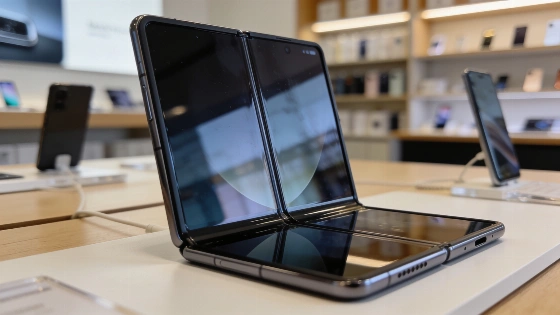
Apple's $1999 iPhone Duo faces skepticism from AT&T's CEO who doubts the foldable will break out of its high-priced niche despite Apple's brand power and a new leadership team
Apple's $1,999 iPhone Duo was met with skepticism from U.S. wireless executives, as AT&T CEO John Stankey publicly questioned the device's potential to reach the mass market shortly after its debut. As the nation's third-largest carrier, AT&T anticipates that Apple's first foldable phone will remain a luxury product for tech enthusiasts rather than a mainstream choice for typical consumers.
Apple's September 9, 2026 event was the first major product showcase led by new CEO John Ternus, marking a leadership transition at the tech giant.
Apple's September 9 event in San Francisco, the first under new CEO John Ternus, was intended to highlight both innovation and pricing power. The company introduced the iPhone 18 Pro, AirPods 5, and Apple Watch Series 12 before unveiling the iPhone Duo. The Duo features a 5.4-inch external screen and a 7.6-inch display when unfolded, aiming to serve as both a phone and a tablet. However, the central question remains: who is prepared to pay $1,999 for a foldable phone?
At the Goldman Sachs Communacopia and Technology Conference, held the same day as Apple's event, Stankey reiterated his stance. He noted that while Android users have had access to advanced foldables for years, these devices have not moved beyond a niche audience. Although iOS dominates the U.S. smartphone market, Stankey is skeptical that Apple's brand alone will shift this dynamic. He expects the Duo to attract primarily users who already own multiple Apple devices and are willing to pay a premium for consolidation.
Reuters noted that analysts expect Apple's foldable phone to cost more than $2,500, reinforcing the premium positioning of the category versus standard flagship iPhones. This price point places the iPhone Duo well above the average smartphone cost and highlights Apple's strategy to target the high-end segment of the market.
Apple's strategy comes as the company faces pressure to maintain growth in a mature smartphone market. Incremental updates like the iPhone 18 Pro are unlikely to drive significant sales increases. The Duo, with its premium price, represents a calculated risk on a new form factor and a different customer segment. Even optimistic analysts expect foldables to comprise only 3.1% of global smartphone shipments by 2030, according to IDC. The greater financial impact may be in revenue share: foldables are projected to account for nearly 7% of global smartphone revenue in 2026, reflecting their higher price points.
Stankey's own evaluation of the Duo is straightforward: if it can replace both his iPhone and iPad, he might consider it. If it simply adds another device to his daily routine, he is not interested. This is likely the same consideration for many potential buyers. For those who already use both a phone and a tablet, the Duo could offer value through consolidation. For others, the $1,999 price is a significant barrier for a device that may not fundamentally alter their technology usage.
As preorder data emerges, Apple and its carrier partners will soon see whether the iPhone Duo can succeed where Android foldables have struggled. Early sales figures will indicate if Apple's brand strength can overcome the price and niche positioning that have limited foldables' mainstream adoption. At present, expectations are that the Duo will remain a high-margin specialty product rather than a disruptive force in the mass market.
Recent device launches have demonstrated that even high-profile innovation does not guarantee widespread adoption. As previously reported, investor enthusiasm can quickly turn to caution when a market is unproven or pricing is inaccessible for most buyers. Apple's iPhone Duo faces a similar test.
According to recent data from Counterpoint Research, the average selling price of a smartphone in the U.S. was $528 in Q2 2026, with premium models above $1,000 representing less than 15% of total unit sales. Devices priced near $2,000 are rare, and most buyers rely on installment plans to spread payments over two or three years. This pricing structure places the iPhone Duo in an exclusive category, limiting its potential for broad adoption.
Device economics
Foldable phones are a high-stakes experiment in consumer electronics. Their advanced engineering and premium materials increase manufacturing costs, which are passed on to consumers. While carriers and manufacturers may benefit from higher average revenue per user and longer upgrade cycles, the risk remains that only a small segment of buyers will pay for these features. For most consumers, the balance between novelty and price is difficult to justify, especially when conventional smartphones already meet their needs at a much lower cost.