Bank of America projects Csquare stock could more than double, but most analysts remain cautious as the data center operator faces heavy debt and industry risks after its recent IPO
Bank of America Securities has set off a heated discussion on Wall Street by initiating coverage of Csquare (CSQR) with a price target that implies the stock could more than double. The data center operator, which went public on the New York Stock Exchange on July 16, 2026, has quickly become one of the most closely watched names in the sector. On August 10, Bank of America assigned Csquare a Buy rating and a $46 price target, suggesting a potential 114% gain from its trading price of $21.52 at the time, according to CNBC. This aggressive forecast stands out sharply against more conservative targets from other major banks.
Bank of America's optimism is rooted in three main arguments. First, the firm sees demand for data center capacity outpacing supply, driven by the rapid growth of artificial intelligence and cloud computing workloads. Second, Csquare is viewed as having an edge in expanding capacity quickly and at lower cost than many competitors, positioning it to capture a larger share of this demand. Third, Bank of America expects the company's valuation multiple to rise as its growth accelerates. The analysis uses a projected 2027 enterprise value to EBITDA multiple of 22x, a level that assumes investors will pay a premium for Csquare's earnings if growth materializes as expected.
Mixed Analyst Views
Despite Bank of America's bullish stance, most other analysts are far less optimistic. On the same day Bank of America released its target, Jefferies, Scotiabank, Bernstein, Morgan Stanley, Wells Fargo, and JPMorgan all initiated coverage with price targets ranging from $24 to $30. The average target among these banks is $26.56, which would represent a much more modest 16% upside from the IPO price. Several analysts cited Csquare's heavy debt load as a key risk, noting that high leverage could limit the company's flexibility to expand and increase its vulnerability to rising interest rates or operational setbacks.
Csquare's financials reflect both strong growth and significant challenges. In its second-quarter results, released August 6, 2026, the company reported revenue of $280.4 million, up 14.5% from a year earlier. Colocation revenue, which comes from renting space and services to enterprise customers, rose 17.5% to $210.6 million. Bookings reached a record $64.7 million, marking the 13th consecutive quarter of record bookings. Adjusted EBITDA grew 21% to $120.3 million, with margins widening to 46.2%. However, Csquare also posted a net loss of $48.8 million for the quarter, up from a $13.9 million loss a year earlier, largely due to interest expenses on pre-IPO debt and one-time listing costs. As of June 30, 2026, the company reported $4.89 billion in long-term debt.
Growth Drivers and Risks
Csquare operates 62 enterprise colocation data centers across 21 metropolitan areas in North America and the UK, with a total sellable capacity of about 385 megawatts as of June 30, 2026, according to its SEC filings. The company's strategy focuses on expanding and modernizing existing sites rather than building entirely new facilities, a plan supported by its majority owner, investment firm Brookfield, which controls about 67% of voting power post-IPO. This backing is seen as a stabilizing factor, but it also means Brookfield retains significant influence over Csquare's direction.
While the company's growth prospects are tied to surging demand for AI and cloud infrastructure, there are notable risks. Wells Fargo and other analysts have flagged Csquare's leverage as a primary concern, warning that high debt levels could constrain expansion and leave the company exposed if market conditions shift. Policy risk is also in play: New York has recently paused approvals for large new data centers to study the impact on the power grid and utility bills, highlighting the potential for regulatory delays or cost increases. Investors are watching closely to see if Csquare can continue setting booking records, reduce its debt burden, and convert its expansion pipeline into revenue-generating capacity.
Valuation and Market Context
Bank of America's $46 target is based on the assumption that Csquare will deliver strong earnings growth and that the market will reward it with a higher valuation multiple. But this scenario depends on both robust operational performance and favorable investor sentiment. Some valuation models, such as those from InvestingPro, currently flag Csquare as overvalued relative to its estimated fair value, even with the bullish coverage. The company used proceeds from its IPO to pay down debt and expects to cut annual interest expense by about $63 million, but its overall leverage remains high.
For context, Bank of America's research division participated as an underwriter in Csquare's IPO, alongside Morgan Stanley, TD Securities, and Wells Fargo Securities. This connection is not unusual in the industry but is worth noting when evaluating the range of analyst opinions. The debate over Csquare's outlook echoes broader questions about how Wall Street's biggest banks interpret growth, risk, and valuation in rapidly evolving sectors. As Bank of America's own consumer data has shown in other contexts, such as shifting household spending patterns, market narratives can change quickly as new information emerges. For example, recent analysis of spending trends has challenged assumptions about the durability of economic gains for lower-income Americans, as discussed in this report on changing consumer behavior.
Ultimately, Bank of America's high target for Csquare is a projection, not a guarantee. Investors considering the stock should focus on whether the company can deliver the earnings growth and valuation expansion that underpin the $46 scenario, while also managing its debt and navigating regulatory headwinds. The wide gap between Bank of America's forecast and the consensus among other banks highlights the uncertainty-and the stakes-facing both the company and its shareholders.
According to Csquare's most recent SEC filing, the company operated 62 data centers with a total of 385 megawatts of sellable capacity as of June 30, 2026. In the second quarter of 2026, Csquare reported $280.4 million in revenue, $120.3 million in adjusted EBITDA, and a net loss of $48.8 million. The company's long-term debt stood at $4.89 billion at the end of the quarter.
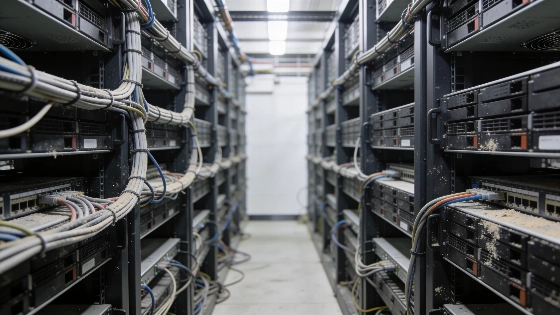
Enterprise colocation data centers like those run by Csquare play a critical role in the digital economy by providing secure, reliable infrastructure for businesses to house their servers and support cloud and AI workloads. These facilities require significant upfront investment and ongoing maintenance, making capital structure and access to financing key factors in long-term success. As demand for data processing and storage continues to rise, operators must balance aggressive expansion with prudent risk management, especially in an environment where interest rates and regulatory scrutiny can shift rapidly. For investors, understanding the interplay between growth potential, leverage, and market expectations is essential when evaluating companies in this sector.