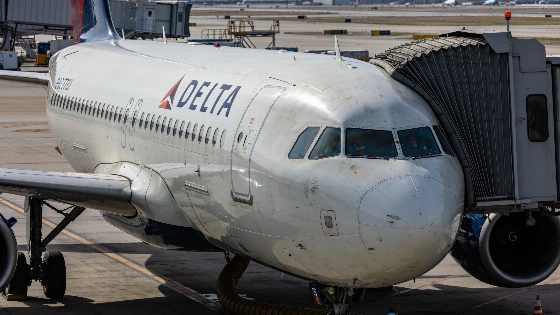
After years of skepticism, Berkshire Hathaway has sharply increased its stake in Delta Air Lines, signaling renewed confidence as the carrier posts record revenue and diversifies beyond ticket sales
For decades, Warren Buffett was one of the most vocal critics of airline stocks, warning that the industry's high costs and unpredictable demand made it a poor long-term investment. In 2020, as the pandemic devastated air travel, Berkshire Hathaway exited its airline holdings entirely, cementing losses and reinforcing Buffett's reputation for caution in the sector. But recent filings show a dramatic reversal: Berkshire has rebuilt and expanded its position in Delta Air Lines, now holding 57.3 million shares valued at $5.4 billion as of June 2026, according to the company's latest 13F disclosure.
This move comes after Berkshire's initial reentry into Delta earlier in 2026, when the conglomerate acquired a $2.6 billion stake during Greg Abel's first quarter as CEO. Abel, who succeeded Buffett in January, has emphasized a disciplined approach to portfolio construction, focusing on concentrated bets outside Berkshire's core holdings. The decision to nearly double the Delta position within a single quarter suggests a high level of conviction in the airline's current trajectory.
Delta's Financial Turnaround
Delta's recent financial results help explain Berkshire's renewed interest. The airline reported record second-quarter revenue of $17.7 billion, a 14% increase from the prior year, while capacity grew just 1%. Unit revenue rose 12.4%, and pretax profit reached $1.4 billion, with earnings per share of $1.56 and a 9% operating margin-each surpassing management's earlier guidance. Return on invested capital stood at 11%, comfortably above Delta's cost of capital, signaling improved efficiency and profitability.
Delta's business model has also evolved. The company now generates 61% of its revenue from sources beyond basic ticket sales, including premium seating, loyalty programs, cargo, and third-party maintenance. Premium and loyalty revenue each grew nearly 20% year over year, while cargo revenue jumped 39% and maintenance services expanded by more than 30%. The airline's partnership with American Express continues to drive growth, with Delta expecting $9 billion in Amex-related revenue for 2026, up 10% from the previous year.
Balance Sheet Strength and Cash Flow
Delta's balance sheet has strengthened alongside its operating performance. Shareholders' equity rose from $15.3 billion at the end of 2024 to $21.8 billion by June 2026. Over the same period, long-term debt declined from $14 billion to $10.5 billion. Adjusted net debt fell to $13.6 billion, even as many competitors increased borrowing. The company produced $8.1 billion in operating cash flow and $3.4 billion in free cash flow on a trailing basis, after investing $4.7 billion in new aircraft and airport lounges. Delta expects to reduce gross leverage to 2x by year-end, moving toward a long-term target of 1x, and all major credit rating agencies continue to rate the airline as investment grade.
For context, Delta's stock performance has reflected this turnaround. Shares have outperformed the broader airline sector in 2026, as investors respond to the company's improved margins, diversified revenue, and disciplined capital management. The airline is guiding for full-year earnings of $6.50 to $7.50 per share, representing 20% growth from 2025, and expects $3 billion to $4 billion in free cash flow for the year.
Industry Shifts and Berkshire's Bet
Delta's management argues that structural changes in the airline industry now favor carriers with strong loyalty programs, premium offerings, and diversified revenue streams. Reduced discount capacity and higher spending by frequent flyers have helped stabilize pricing and profitability, even as fuel costs fluctuate. While risks remain-such as economic downturns, labor costs, and geopolitical disruptions-Delta's recent results suggest it is better positioned than many rivals to weather volatility.
Berkshire's decision to double its Delta stake stands out in a year when many institutional investors remain cautious about airlines. The move signals that Abel and his team see lasting improvements in Delta's business model, not just a temporary rebound from pandemic lows. This approach echoes the kind of selective, high-conviction investing that has defined Berkshire's strategy in other sectors. For investors tracking major institutional moves, the shift is reminiscent of how Bank of America maintained its position in Rocket Lab despite short-term revenue pressures, as discussed in this related analysis.
According to Delta's latest guidance, the company is targeting mid-teens operating margins and sustained returns on invested capital in the years ahead. While the airline industry remains cyclical and exposed to external shocks, Delta's financial discipline and diversified revenue base may offer a measure of resilience that was lacking in previous cycles.
Airline investing has long been fraught with risk, but Delta's recent performance and Berkshire's renewed commitment suggest that, for now, the calculus may be changing-at least for those willing to accept the sector's inherent volatility.
Airlines operate in a uniquely challenging environment, where fixed costs are high and demand can shift rapidly due to economic, geopolitical, or health-related shocks. Profitability often hinges on a carrier's ability to manage costs, optimize capacity, and build customer loyalty through differentiated services. Diversification into premium products, loyalty partnerships, and ancillary businesses can help smooth out revenue swings, but these strategies also require significant upfront investment and ongoing innovation. For investors, understanding the interplay between operating leverage, capital structure, and industry dynamics is essential when evaluating airline stocks, as even well-managed carriers remain vulnerable to factors beyond their control.