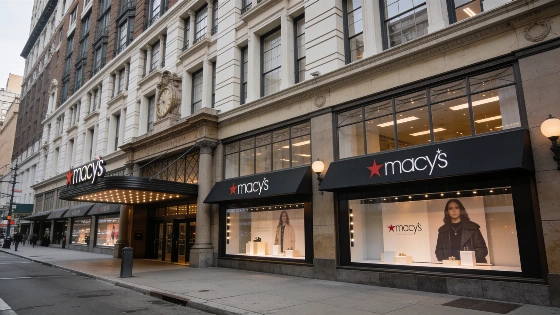
Berkshire Hathaway has taken a rare stake in Macy's, marking its first public move into department stores in decades and signaling a shift in strategy as the retailer posts stronger-than-expected results
Berkshire Hathaway's latest portfolio move has caught many market watchers off guard. The conglomerate, led by Warren Buffett, has established a significant position in Macy's, marking its first public investment in a department store chain in roughly 60 years. According to data from Tikr.com, Berkshire now owns 7.37 million shares of Macy's, valued at about $173 million as of the most recent filing. This stake represents a 141.82% increase over the previous period and gives Berkshire 2.79% ownership of Macy's outstanding shares as of June 29, 2026. While the position is small relative to Berkshire's overall portfolio-just 0.06% of total holdings-it stands out given the firm's long history of steering clear of traditional retail stocks.
Berkshire's aversion to department stores dates back to the 1960s, when an investment in Hochschild Kohn ended poorly. Since then, Buffett and his team have largely avoided retailers facing structural challenges from e-commerce and changing consumer habits. In recent years, many of Berkshire's stock picks have come from other portfolio managers, not Buffett himself, but any move into retail by the firm tends to draw attention due to its reputation for avoiding so-called value traps.
Macy's Performance and Strategy
The timing of Berkshire's investment coincides with a period of improved performance for Macy's. In its first-quarter 2026 earnings report, the company posted enterprise-wide growth and exceeded expectations across key financial metrics. Comparable sales rose 3%, outpacing Macy's own guidance of 0.5% to 1.5%. Adjusted earnings per share reached $0.13, beating the company's forecast, while net sales increased 1.8% to $4.7 billion. Macy's flagship stores delivered their fourth consecutive quarter of positive comparable sales, up 1.6%. Bloomingdale's, the company's luxury brand, posted a 10.2% gain in comparable sales-the best first-quarter result in its 154-year history. Bluemercury, Macy's specialty beauty retailer, saw comparable sales rise 6.4%.
Chief Financial Officer Tom Edwards reported that operating cash flow swung to a $292 million inflow, compared to a $64 million outflow a year earlier. Much of this improvement is attributed to Macy's "Reimagine" program, which focuses on upgrading stores with better staffing, improved product assortments, and enhanced visual presentation. These upgraded locations now account for about 60% of Macy's ongoing store base and have posted positive comparable sales in eight of the last nine quarters. The company also noted an 8.3% increase in average unit retail, driven by a shift toward premium products and reduced reliance on clearance sales. Not all categories are performing equally well, however, with big-ticket furniture and plus-size apparel showing softness, partly due to tariff-related price increases and a sluggish housing market.
Valuation and Analyst Outlook
Following its strong quarter, Macy's raised its full-year outlook, now projecting net sales between $21.5 billion and $21.75 billion and adjusted earnings per share of $2.00 to $2.20. The company returned $100 million to shareholders through dividends and buybacks in the quarter, with $1.1 billion remaining on its repurchase authorization. Macy's market capitalization stands at approximately $6.2 billion, a figure that some analysts see as low relative to its expected annual revenue. Consensus forecasts from Tikr.com suggest free cash flow could grow from $690 million in fiscal 2026 to $955 million by fiscal 2031. If the stock maintains its current valuation multiple, it could deliver a total return of more than 35% over the next three years, including dividends, though this is not guaranteed and depends on future performance and market conditions.
Among the 10 analysts covering Macy's, one rates the stock a "Buy," eight recommend "Hold," and one suggests "Sell." The average price target is $22.33, which is 4.6% below current trading levels. This cautious outlook reflects ongoing uncertainty about the long-term prospects for department stores, even as Macy's posts improved results. Whether Berkshire will expand its position remains to be seen, but the move is notable for a firm that has avoided the sector for decades.
Broader Market Context
Berkshire's investment in Macy's comes at a time when other high-profile investors are also making bold moves in the market. For example, Michael Burry has recently increased his bets against Nebius and other AI-linked stocks, raising questions about the sustainability of current valuations in technology sectors. For more on how prominent investors are positioning themselves amid shifting market dynamics, see this analysis of Burry's latest strategy: why some are betting against the AI rally.
As of June 2026, Macy's operates three main brands: its namesake department stores, Bloomingdale's, and Bluemercury. The company's recent results suggest that targeted investments in store upgrades and premium product offerings can drive growth even in a challenging retail environment. Still, the sector faces ongoing risks from changing consumer behavior, online competition, and macroeconomic headwinds.
Department stores like Macy's have historically struggled to adapt to the rise of e-commerce and shifting shopping habits. The "Reimagine" initiative represents an effort to modernize the in-store experience and differentiate Macy's from competitors. For investors, the key question is whether these changes can deliver sustainable growth and justify a higher valuation. As always, the suitability of any stock depends on an individual's risk tolerance, investment horizon, and broader financial goals.