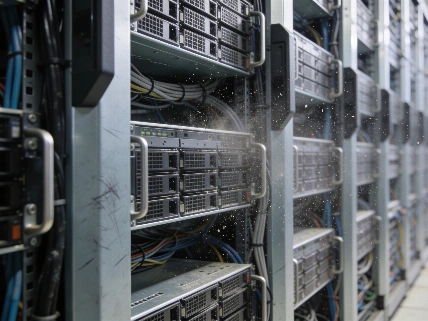
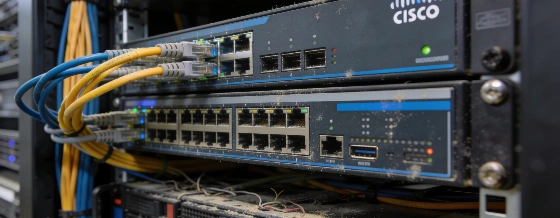
Cisco shares have jumped 46% in 2024, driven by its ability to secure critical AI hardware amid industry shortages, setting it apart from competitors and supporting a bullish Wall Street outlook.
Cisco Systems has set itself apart in the 2026 artificial intelligence infrastructure market, with its stock rising approximately 46% year to date and recently trading near $111 per share. While Cisco is widely recognized for its role in connecting AI data centers, Morgan Stanley research highlights the company's unique ability to secure scarce components-such as memory chips, pump lasers, and advanced silicon-that are currently limiting competitors' growth.
Cisco reported $9.3 billion in AI infrastructure orders for fiscal year 2026, with AI revenue for fiscal 2027 projected at around $7.5 billion.
Supply Chain Leverage
Morgan Stanley attributes Cisco's supply chain advantage to its strong balance sheet, ability to place large upfront orders, and direct partnership with Taiwan Semiconductor Manufacturing Company (TSMC). Cisco's chip orders with TSMC are expected to increase tenfold by fiscal 2027, according to the bank's analysis. This relationship benefits both companies: Cisco helps TSMC diversify its customer base and, in return, secures priority access to critical components.
In August 2026, Cisco announced an expansion of its Secure AI Factory with NVIDIA and the addition of Supermicro servers, with these new solutions set to become available through Cisco's channel starting October 2026. The market responded with a moderate 1% increase in Cisco's share price on the day of the Supermicro partnership announcement.
Product Refresh and Growth Drivers
Beyond supply chain management, Cisco's core business of network switches is positioned for further growth. The widely used Catalyst line is still early in its upgrade cycle, with only about 7% of the installed base of older Catalyst 4000 and 6000 models replaced. As end-of-life deadlines approach in 2026 and 2027, a significant volume of legacy equipment will require upgrading.
Data from Cisco's Meraki platform indicates rapid installation of new hardware, suggesting genuine demand rather than a temporary backlog. This ongoing refresh cycle is expected to provide steady revenue as organizations modernize their networks for new applications and security requirements.
AI Networking and Future Opportunities
Cisco is expanding its role as a comprehensive supplier for distributed AI infrastructure. As power constraints drive companies to spread AI workloads across multiple data centers, demand for "scale-across" technology-linking GPU clusters up to 100 kilometers apart-has increased. Cisco's portfolio, including routing, transport, and Acacia optical products, positions it across the full AI networking stack.
The company has secured three design wins for its P200 routing chip, with broader adoption expected as next-generation systems ship in the first half of 2027. Management anticipates this activity will accelerate as customers invest in distributed AI architectures.
Valuation, Margins, and Analyst Outlook
Morgan Stanley maintains an Overweight rating and a $135 price target for Cisco, about 22% above the recent share price, based on 26 times projected 2027 earnings. This follows Cisco's fiscal fourth-quarter results, which exceeded expectations with record quarterly revenue of approximately $17.3 billion, an 18% increase year over year.
Despite strong results, Cisco faces margin pressure as more business shifts to hyperscalers-large cloud providers that typically purchase hardware but fewer high-margin software services. Management has stated that a gross margin of around 64% remains a reasonable baseline and that the company will avoid low-margin deals. Cisco is also investing in its Silicon One chip designs to support margins, particularly as these chips are integrated into campus switches. Security remains a growth area, with robust demand for updated firewalls and the Hypershield product.
Stock Performance and Risks
Cisco's 46% year-to-date gain has outperformed the S&P 500, reflecting investor optimism for AI infrastructure providers. However, the stock has retreated from its June high near $129 and declined after the latest earnings report, as some analysts described forward guidance as conservative. This pattern of strong results but cautious outlook is common among AI-related stocks.
To reach Morgan Stanley's $135 target, Cisco must continue upgrading aging Catalyst equipment, expand scale-across deployments, accelerate security growth through Splunk cross-selling, and maintain stable gross margins despite a higher hyperscaler mix. The ongoing component shortage, while currently an advantage, could also constrain growth if supply tightens further.
For context, Cisco reported $17.3 billion in revenue for its fiscal fourth quarter of 2026, up 18% from the prior year, and $9.3 billion in AI infrastructure orders for fiscal 2026. The company's gross margin was reported at approximately 64%, in line with management's stated baseline. These figures are drawn from Cisco's official earnings release and Morgan Stanley's published research.
Gross margin, a key metric for hardware companies, measures the percentage of revenue remaining after direct production costs. Maintaining strong gross margins is challenging when large customers negotiate aggressively or when product mix shifts toward lower-margin offerings. Companies like Cisco invest in proprietary technology, such as custom chips and integrated security, to defend margins and differentiate their products. The ability to balance growth and profitability will be critical for Cisco's long-term leadership in AI infrastructure.