A federal appeals court has halted the Trump administration's $400 million White House ballroom project, citing lack of congressional approval and raising questions about executive authority over federal property
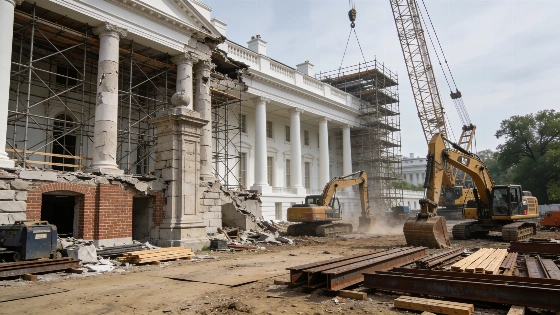
A federal appeals court in Washington, D.C. has ordered the Trump administration to halt construction of a $400 million ballroom on the White House grounds, citing the administration's failure to secure congressional authorization for the project. The decision, issued by a divided panel of the U.S. Court of Appeals for the District of Columbia Circuit, upholds a preliminary injunction sought by the National Trust for Historic Preservation. The preservation group filed suit after the East Wing was demolished and work began on a 90,000-square-foot ballroom, arguing that such a significant alteration to federal property requires explicit approval from Congress.
The court's majority opinion emphasized that the power to approve major changes to the White House rests with Congress, not the executive branch. The ruling temporarily blocks above-ground construction for 14 days, giving the Trump administration time to appeal to the U.S. Supreme Court. While the administration has argued that the ballroom is necessary for hosting large formal events and enhancing White House security, the court found no federal statute granting the president unilateral authority to proceed with the project.
According to court filings, the Trump administration had justified the project's escalating cost-now double initial estimates-by citing increased size and upgraded materials. The administration also maintained that the privately funded project was essential for national security, claiming the previous East Wing design left the president and staff vulnerable. The Justice Department argued that the courts should not intervene in what it described as an executive function, but the panel disagreed, stating that bypassing Congress on such a scale would set a troubling precedent for federal property management.
U.S. District Judge Richard Leon, who previously blocked above-ground construction while allowing underground work to continue, had earlier ruled that no existing law gives the president the authority to undertake such a project without congressional consent. The ballroom plan is the most ambitious of several efforts by the Trump administration to reshape the landscape of central Washington, D.C., including other controversial changes to federal buildings and monuments. In a separate case, a judge recently ordered the removal of Trump's name from the exterior of the Kennedy Center, finding it had been added illegally.
For context, the federal government's annual budget for the maintenance and preservation of the White House complex is typically in the range of $15 million to $20 million, according to the Office of Management and Budget. Major capital projects on federal property, especially those involving historic sites, generally require congressional approval and are subject to oversight by the National Park Service and the Advisory Council on Historic Preservation. The $400 million price tag for the proposed ballroom far exceeds routine maintenance budgets and would represent one of the largest single expenditures on White House grounds in recent history.
Disputes over executive authority and congressional oversight are not new in federal property management. The Constitution grants Congress the power of the purse, meaning that significant federal expenditures-especially those altering historic or symbolic sites-typically require legislative approval. While presidents have some discretion over routine maintenance and security upgrades, large-scale construction projects on federal property are subject to a complex web of statutes, regulations, and preservation standards. This case highlights the ongoing tension between executive ambitions and the checks imposed by Congress, with potential implications for future administrations seeking to reshape federal landmarks.