
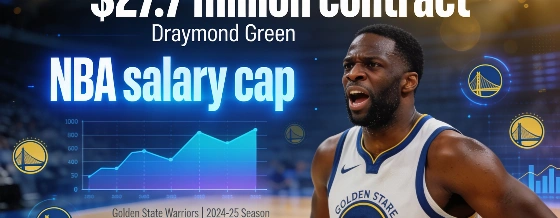
Draymond Green is returning to the Golden State Warriors on a one-year, $27.7 million contract, a move that gives the franchise new financial flexibility after missing out on LeBron James in free agency
Draymond Green will remain with the Golden State Warriors for at least one more season, agreeing to a one-year contract worth $27.7 million. The deal, confirmed by Klutch Sports to ESPN, comes after Green declined his $27.6 million player option earlier this summer-a decision that surprised many around the league and opened up new financial options for the Warriors. The move became especially significant after LeBron James chose to sign with the Philadelphia 76ers, removing Golden State from the running for the league's most high-profile free agent and shifting the team's offseason priorities.
Green's new contract does not include a no-trade clause, according to ESPN. This detail gives the Warriors additional roster flexibility as they navigate a competitive Western Conference and a tightening salary cap environment. Green, who has spent his entire 14-year NBA career with Golden State, now holds the second-longest active tenure with a single team in the league, trailing only Stephen Curry. Earlier this year, Green's future with the franchise appeared uncertain as his name surfaced in trade discussions involving Milwaukee Bucks star Giannis Antetokounmpo. While no deal materialized, the episode underscored the business realities facing even long-tenured veterans as teams seek to balance loyalty, performance, and cap management.
For the Warriors, Green's willingness to negotiate a new contract rather than exercise his player option provided a rare opportunity to adjust their payroll structure. The team has faced mounting luxury tax bills in recent seasons, and the NBA's new collective bargaining agreement has introduced stricter penalties for teams that exceed the second tax apron. By reworking Green's deal, Golden State can better manage its cap commitments while retaining a core player who remains central to its defensive identity and locker room culture-even as his on-court production has gradually declined. Last season, Green averaged 27.5 minutes over 68 games and has publicly stated he is open to a reduced role if head coach Steve Kerr deems it necessary.
According to NBA financial data, the Warriors paid an estimated $176.5 million in luxury tax penalties for the 2023-24 season, the highest in league history. The NBA's new collective bargaining agreement, which took effect in July 2024, introduced a second tax apron at $182.5 million in team salary, imposing additional restrictions on teams that exceed this threshold, including limitations on trades and free agent signings. These changes have forced high-spending franchises like Golden State to reconsider roster construction and contract negotiations to avoid further punitive measures.
Green's contract situation highlights the complex trade-offs NBA teams face under the league's evolving salary cap system. While star players can command significant salaries, teams that consistently exceed tax thresholds risk losing roster flexibility and incurring escalating penalties. The Warriors' approach-retaining a key veteran on a short-term deal without a no-trade clause-reflects a broader trend among contenders seeking to balance continuity with financial discipline. For players, the absence of long-term guarantees or trade protection can introduce new uncertainties, even for those with deep ties to a franchise. As the NBA's financial landscape continues to shift, both teams and players must adapt their strategies to navigate the intersection of loyalty, performance, and cap management.