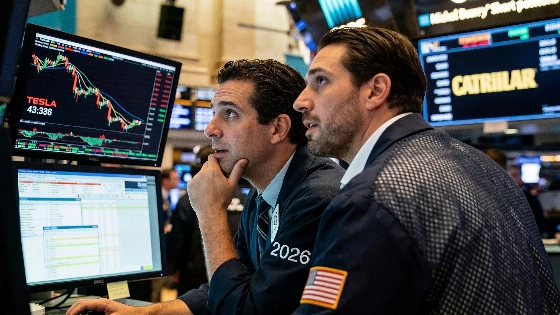
Michael Burry's bearish trades against Tesla, Caterpillar, and key semiconductor stocks are moving into the spotlight as July's market pullback tests the resilience of AI-driven rallies and investor sentiment
Michael Burry, the investor best known for predicting the 2008 housing crash, is once again drawing attention on Wall Street after a series of high-profile short positions began to move in his favor. This summer, Burry took aim at some of the market's most crowded trades, targeting companies and sectors that had surged on artificial intelligence optimism, including electric vehicles, heavy equipment, and semiconductors. As July's market pullback unfolded, several of these bearish bets started to pay off, according to reporting by CNBC and TheStreet.
Shorts on Tesla and Caterpillar
Burry's decision to short Tesla and Caterpillar has proven timely. He disclosed his Tesla short at $416.22 per share in late June, just before the company's second-quarter 2026 earnings missed analyst expectations. Tesla reported earnings per share of $0.33, well below the $0.51 consensus, sending the stock sharply lower. Burry has indicated he is maintaining his position, suggesting he sees further downside risk. Meanwhile, Caterpillar shares have dropped about 16% in July, falling from Burry's entry point of $1,060.98 to $894.54. This marks a rare move for Burry, who previously held Caterpillar as a long position and described it as a consistently profitable company.
Four out of five of Burry's publicly disclosed short trades have now moved in his favor. Alongside Tesla and Caterpillar, his shorts on a semiconductor ETF and Applied Materials have also turned positive. Nvidia remains the exception, with shares rising above Burry's entry price, highlighting the difficulty of timing short positions even when the broader thesis appears sound.
Semiconductor Bets and Market Complexity
Burry's approach to the semiconductor sector has been more complicated. He shorted the iShares Semiconductor ETF (SOXX) at $642.80, near its 52-week high, and Applied Materials at $729.40. Applied Materials has since declined to around $562.80, a drop of more than 20%. The SOXX ETF, which had posted a 113% year-to-date return as of June 30, has also pulled back. Burry's thesis centers on the idea that semiconductor valuations have outpaced the underlying fundamentals, even as companies continue to report strong results.
Nvidia, however, has defied Burry's bearish stance. After shorting the stock at $198.09, he increased his position as shares climbed past $210. Nvidia's most recent quarterly sales rose about 85% year-over-year, underscoring the risks of betting against market leaders in a sector still experiencing rapid growth. On July 24, Burry also disclosed a new short position in Micron at $933.86, after the stock's significant run-up over the past year.
Why Caterpillar Became a Target
Caterpillar's inclusion in Burry's short basket is notable because he had rarely bet against the company before. According to TheStreet, Burry cited the stock's valuation-trading at 48.1 times trailing earnings-as a key concern, especially given its new role as a supplier to the AI infrastructure boom. Caterpillar's Energy and Transportation division, which provides engines and turbines for data centers, saw sales rise 17% to $8.4 billion in a recent quarter, driven by surging electricity demand from AI computing. While the company reported strong Q1 2026 results, including $17.4 billion in sales and a record order backlog, Burry appears skeptical that the current pace of AI-driven infrastructure spending can be sustained indefinitely.
For context, Caterpillar returned $5.7 billion to shareholders through buybacks and dividends in the first quarter alone, reflecting management's confidence in ongoing demand. Yet Burry's bet suggests he believes the market has already priced in too much future growth, leaving the stock vulnerable if the AI buildout slows or margins compress.
Implications for Investors
Tesla remains the most volatile of Burry's short positions, given the company's history of surprising the market and its loyal investor base. While the recent earnings miss has pressured the stock, Tesla's ability to generate headlines-from robotaxi developments to new product launches-means that bearish bets can be quickly challenged by unexpected news. Burry's track record also shows that his calls can take time to play out; he was early in calling Tesla a bubble in 2021, and only after a long lag did the market move in his direction.
For investors, Burry's real-time disclosures-shared through his Substack newsletter rather than delayed regulatory filings-have made his trades more actionable and closely watched. The July pullback has given his thesis tangible results, but the durability of these gains will depend on upcoming earnings from Tesla, Caterpillar, and the broader AI supply chain. The sustainability of hyperscaler spending on data centers and infrastructure remains a key variable.
Market volatility has not been limited to AI and industrial names. As seen in the recent caution around quantum computing stocks, such as IonQ, which Jim Cramer has avoided due to rising interest rates and profitability concerns, investors are increasingly scrutinizing high-growth sectors for signs of overextension. Cramer's skepticism toward quantum stocks reflects a broader wariness that may also influence sentiment toward AI-linked trades.
According to company filings, Tesla's market capitalization stood at roughly $1.4 trillion as of late July 2026, while Nvidia's valuation surpassed $2.2 trillion. The SOXX ETF, which tracks major semiconductor stocks, reported a net asset value of $640.65 on June 30, near its all-time high. Caterpillar's Q1 2026 operating cash flow reached $1.9 billion, and the company maintained a record order backlog, signaling robust demand but also raising questions about how much future growth is already reflected in the stock price.
Short selling is a strategy that involves borrowing shares to sell them in the hope of buying them back at a lower price. While it can offer significant rewards if the market moves as expected, it also carries the risk of unlimited losses if prices rise. For individual investors, shorting stocks or sectors-especially those with high volatility or strong momentum-requires careful risk management and a clear understanding of the underlying business drivers. In sectors like AI and semiconductors, where valuations can swing rapidly on news or sentiment, timing and discipline are critical to avoid being caught on the wrong side of a trade.