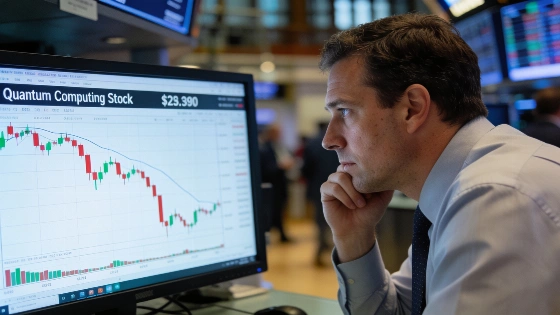
Despite a surge in quantum computing stocks after a $2 billion federal investment announcement, Jim Cramer is steering clear of IonQ, citing rising interest rates and the risks facing high-growth companies with deep losses and distant profitability.
Quantum computing has become a focal point for investors seeking exposure to next-generation technology, especially after the Trump administration announced plans in May to invest over $2 billion in the sector. The news sent shares of quantum-related companies soaring as Wall Street bet on the technology's long-term potential. Yet not everyone is buying in. Jim Cramer, host of "Mad Money," recently made it clear he's not joining the rush-at least when it comes to IonQ.
On the July 22 Lightning Round segment, Cramer responded to a caller's question about IonQ by emphasizing the impact of rising interest rates on high-growth, unprofitable companies. He argued that as rates climb, stocks like IonQ become harder to own because their valuations depend heavily on future cash flows, which are discounted more steeply in a higher-rate environment. This macroeconomic backdrop, rather than doubts about IonQ's technology or commercial prospects, is driving his caution.
Rate Sensitivity and Market Pressure
IonQ's business model is emblematic of the challenges facing many early-stage tech firms. The company is burning significant cash to build out its quantum computing capabilities, with profitability still years away. According to its first quarter 2026 financial results, IonQ expects a full-year adjusted EBITDA loss of $310 million to $330 million on projected revenue of $260 million to $270 million. This wide gap between revenue and profitability makes the stock especially sensitive to changes in interest rates, as future earnings become less valuable in present terms when rates rise.
As of the latest session, IonQ shares traded at $33.03, down 3.11% for the day and off 24.07% year to date, even as the S&P 500 has gained 8.22% over the same period, according to Yahoo Finance. The stock had surged to a high of $72 in late May following the federal investment announcement, but has since lost more than half its value in less than two months.
Strong Growth, Persistent Losses
Despite the market's volatility, IonQ's recent financial results show substantial growth. First quarter 2026 revenue reached $64.7 million, up 755% from a year earlier and 30% above the midpoint of company guidance. Remaining performance obligations-a measure of contracted future revenue-grew 554% year over year to $470 million. The company also raised its full-year revenue outlook, now expecting $260 million to $270 million, which would represent more than 100% organic growth.
Commercial momentum is evident, with about 60% of revenue coming from commercial customers, 35% from international clients, and 35% from multi-product deals. IonQ also sold its first sixth-generation, chip-based, 256-qubit system to the University of Cambridge and secured a $39 million contract under the Space Development Agency's HALO Program for advanced space communications. However, the company's adjusted earnings per share for the first quarter came in at -$0.34, and consensus estimates for the second quarter expect another loss of -$0.29 per share, according to Zacks. Profitability remains a distant goal.
Federal Investment and Market Sentiment
The sharp rally in quantum stocks in May was triggered by the Trump administration's announcement of $2.013 billion in funding under the CHIPS and Science Act, aimed at supporting quantum foundries and computing companies. Notably, IonQ was not among the nine companies named as direct recipients. Still, its stock surged alongside peers as investors treated the sector as a national priority, rather than distinguishing between individual winners and losers.
This sentiment-driven rally pushed IonQ to its May peak, but the gains quickly evaporated as reality set in. The combination of a less favorable rate environment and ongoing losses led to a swift correction. For IonQ to regain momentum from its current level, the company would likely need to deliver a significant earnings beat or benefit from a shift in the broader rate narrative that makes long-duration growth stocks more attractive. Neither scenario is assured in the near term.
For investors weighing the risks and rewards of emerging tech stocks, the IonQ story highlights the importance of macroeconomic context. As seen in other sectors-such as the AI chip industry's impact on energy costs, covered in this analysis of Nvidia's $4 trillion data center bet-market enthusiasm can quickly give way to caution when external factors shift.
Quantum computing remains a promising but speculative field. For now, Cramer's decision to stay on the sidelines reflects a broader wariness about betting on companies with high cash burn and uncertain timelines in a rising-rate environment.
Interest rates play a critical role in how investors value high-growth, unprofitable companies. When rates are low, the present value of future earnings is higher, making it easier for such firms to justify lofty valuations. As rates rise, those future cash flows are discounted more heavily, compressing valuations and increasing volatility. This dynamic is especially pronounced in sectors like quantum computing, where commercial applications and profits may be years away. Investors considering these stocks should weigh not only the technology's potential but also the macroeconomic forces that can amplify both gains and losses.