The Federal Reserve held its benchmark rate steady at 3.5%-3.75%, but a rare split vote with three officials pushing for a hike signals deepening divisions that could unsettle markets and complicate future policy decisions
The Federal Reserve's latest policy meeting ended with interest rates unchanged, but the real story was the unusually sharp split among voting members. The Federal Open Market Committee (FOMC) kept its target range for the federal funds rate at 3.5% to 3.75%, resisting calls for an immediate hike despite persistent inflation and ongoing economic uncertainty. Yet three FOMC members broke ranks, voting in favor of a quarter-point increase-a level of dissent not seen since 2016. This rare division is raising new questions about the Fed's ability to present a unified front as it navigates a complex economic landscape.
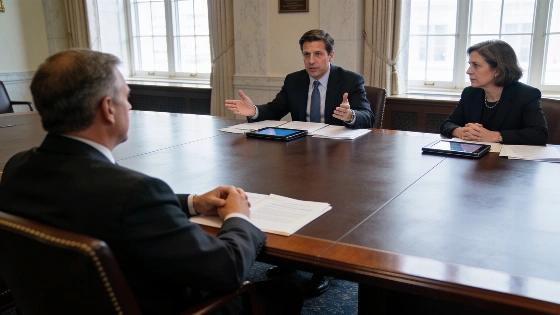
Fed Chair Kevin Warsh, who took the helm in May, has already faced a fractured committee. The July meeting's 9-3 vote marks the second time in just a few months that multiple policymakers have dissented, following a four-way split at Jerome Powell's final meeting in April. The latest dissents came from Beth Hammack, Neel Kashkari, and Lorie Logan, all of whom argued for a more aggressive stance against inflation. The lack of consensus is notable because markets have historically relied on the Fed's unity to gauge the direction of monetary policy. When policymakers are divided, it becomes harder for investors and businesses to anticipate future moves, increasing the risk of market volatility.
Market Reaction and Investor Concerns
Financial markets responded with caution. On the day of the announcement, the Dow Jones Industrial Average rose 0.44%, the S&P 500 gained 0.31%, and the Nasdaq Composite edged up 0.20%. However, these modest gains masked underlying anxiety about the Fed's internal divisions. Investors have grown accustomed to the central bank acting as a stabilizing force, even when its decisions lag behind economic data. But persistent dissension could undermine that confidence, especially as the Fed faces pressure from multiple directions-including supply chain disruptions, geopolitical tensions, and energy price shocks.
According to reporting by Financial Sumo, the current split comes at a time when the Fed has stopped providing forward guidance in its official statements, making it even more difficult for markets to interpret the central bank's next steps. This uncertainty is compounded by a series of economic shocks over the past several years, from the COVID-19 pandemic to recent energy supply disruptions linked to global conflicts. For investors, the risk is that a divided Fed may struggle to respond quickly and cohesively to new challenges, potentially amplifying market swings.
Historical Context and Policy Implications
While dissent within the FOMC is not unprecedented, the frequency and direction of recent splits are unusual. The last time three members dissented in favor of a rate hike was in September 2016, and before that, four dissents occurred in 1992. Historically, the Fed has worked to minimize public disagreement, believing that a unified message helps anchor market expectations and supports economic stability. The current pattern of division suggests that policymakers are grappling with conflicting interpretations of economic data and the appropriate response to inflationary pressures.
For households and businesses, the Fed's indecision could translate into greater uncertainty around borrowing costs, investment planning, and financial risk management. Mortgage rates, credit card APRs, and business loan terms often move in response to Fed policy signals. When those signals are muddled by internal disagreement, it becomes harder for consumers and companies to make informed financial decisions. As the FOMC weighs its next move, the stakes for the broader economy remain high.
Fed Credibility and the Path Forward
The credibility of the Federal Reserve depends in part on its ability to act decisively and speak with one voice. Persistent internal rifts risk eroding that credibility, especially if markets begin to doubt the Fed's capacity to manage inflation and support economic growth. While Chair Warsh has described the debate as healthy and constructive, Wall Street's tolerance for division has limits. If the pattern of dissent continues, it could force the Fed to clarify its policy framework or risk further market instability.
For readers tracking the Fed's evolving stance, it's worth noting that this is not the first time in recent months that the central bank's decision-making process has come under scrutiny. Earlier this year, the FOMC's approach to rate policy was the subject of intense speculation as inflation remained above target and energy prices surged-a dynamic explored in depth in Financial Sumo's coverage of the Fed's rate decision amid economic uncertainty.
Central banks like the Federal Reserve play a unique role in shaping economic expectations. Their policy decisions influence everything from short-term interest rates to long-term investment strategies. When the Fed signals unity, markets tend to respond with greater confidence, even if the policy itself is controversial. But when internal disagreements become public, the resulting uncertainty can ripple through financial markets, affecting asset prices, borrowing costs, and consumer sentiment. For investors and households alike, understanding the mechanics of Fed decision-making-and the risks posed by a divided committee-remains essential in a period of heightened economic complexity.