HSBC's new oil price outlook hinges on Gulf pipelines staying open but fresh satellite evidence of attacks exposes a fragile bet that could keep diesel and gasoline prices painfully high for U.S. consumers
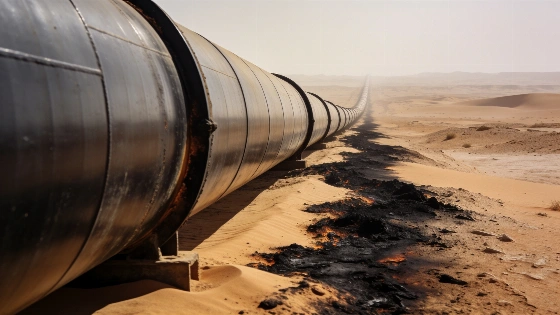
A single black plume of smoke over the Saudi desert has recalibrated global oil risk-and the outlook for every American driver facing $6 diesel. HSBC's latest $90 Brent forecast for 2026 is already under pressure, not from market swings, but from the physical vulnerability of pipelines designed to bypass the Strait of Hormuz. The bank's projection depends on these routes remaining operational, yet satellite images now reveal fire along Saudi Arabia's East-West line, the kingdom's primary alternative to the strait.
In early September 2026, total oil exports from the Persian Gulf reached about 14 million barrels per day on some days, including hidden tanker shipments and Saudi exports via the Red Sea, according to Reuters data.
Pipeline pressure
Recent NASA thermal data and satellite imagery confirm a significant incident along the Petroline, Saudi Arabia's 1,200-kilometer conduit to the Red Sea. While Saudi authorities have not officially confirmed a strike, the timing aligns with reported disruptions. The East-West line has previously operated at up to 7 million barrels a day during peak crises. HSBC's scenario now requires these pipelines to sustain near-maximum capacity for almost two more years-without further interruption.
On September 11, 2026, Saudi Arabia announced the suspension of operations on the East-West Pipeline (Petroline) as a "precautionary measure" following multiple attacks that caused fires and damage, with emergency teams providing first aid to those affected. The Saudi Ministry of Energy confirmed that the pipeline in the Riyadh and Medina regions was subjected to several attacks on the morning of September 10, and that teams are working to secure and assess the facility, as reported by CNBC and Reuters.
In August 2026, oil flows through the Strait of Hormuz averaged around 4.3 million barrels per day, rising to nearly 5 million barrels per day in the first six days of September, highlighting the market's dependence on this narrow supply corridor.
This is a demanding scenario. Market confidence in these bypass routes is being tested in real time. Should the pipelines fail, the gap between available supply and global demand could widen rapidly, driving prices well above HSBC's base case. The bank's own analysis acknowledges that the market may remain structurally tight until at least mid-2027, indicating a prolonged period of elevated prices rather than a brief spike.
Conflicting numbers
Even the fundamental data is contested. HSBC estimates current Hormuz flows at 6 million barrels a day, just 30% of pre-war levels, while other trackers suggest closer to 10 million. Saudi crude production fell to 6.24 million barrels a day in August, according to OPEC. The divergence between these figures is significant-it determines whether the market is simply tight or approaching a supply crisis. HSBC's forecast relies on the lower, more conservative estimate, heightening the risk if pipeline capacity is overestimated or further disrupted.
Tracking actual flows is complicated by tankers operating without transponders in contested waters, making official statistics unreliable. For investors and analysts, this means any single throughput figure should be viewed with caution. The difference between a $90 and $120 oil scenario could depend on which estimate proves more accurate.
Pain at the pump
For U.S. households, the effects are already apparent. Diesel prices reached a record $6.05 per gallon nationwide on September 11, up 60% from a year earlier, according to AAA. Gasoline averages $4.29. These increases affect all sectors, from groceries to logistics. As KPMG's chief economist notes, diesel impacts nearly every product Americans purchase. The longer the Gulf remains a bottleneck, the more persistent these high prices become.
HSBC's $90 projection is effectively a wager that today's triple-digit oil prices will not persist throughout the year. Brent futures fell to $103.78 on September 11 after peaking near $108, but the bank's outlook assumes a market cooldown-if, and only if, the pipelines remain operational. Otherwise, the upper limit for prices is uncertain.
Forecasts built on sand
Every bank forecast is ultimately built on a single, often unspoken, assumption. In this case, it is that Gulf pipelines can reliably substitute for the world's most critical oil chokepoint. The recent smoke plume challenges that premise. Investors who treat these forecasts as definitive risk overlooking the true vulnerability: the fragility of the infrastructure supporting the market.
HSBC is not alone in adjusting its outlook as the crisis evolves. Other banks have revised commodity targets in response to shifting supply dynamics, as seen in recent coverage of JPMorgan's silver forecast. However, oil's physical constraints are less forgiving than those of metals or financial assets. The next attack, malfunction, or diplomatic incident could invalidate months of analysis in a single event.
For now, the key date is mid-2027-the point at which HSBC expects the market might rebalance. This timeline remains uncertain, dependent on the hope that no further pipelines are disrupted. Until then, every American paying record prices at the pump is experiencing the consequences of a forecast that could unravel with the next satellite image. The core risk lies not in the price target, but in the narrow margin between Gulf supply and global demand. Betting on stability in this market means betting against the evidence now visible in the desert.
According to the U.S. Energy Information Administration, the United States consumed about 20.3 million barrels of petroleum per day in 2025, with imports from the Persian Gulf accounting for roughly 12% of total crude oil imports. Disruptions in Gulf supply routes can quickly lead to higher costs for U.S. refiners and consumers, especially when alternative sources are already strained.
Oil pipeline infrastructure forms the backbone of global energy supply, but its reliability is never assured. Pipelines traversing conflict zones or politically unstable regions are continually exposed to risks such as sabotage, cyberattacks, and shifting alliances. Unlike maritime routes, pipelines offer limited flexibility and are expensive to repair or reroute. For investors and policymakers, recognizing the physical limitations and vulnerabilities of these systems is essential for assessing real market risk-no spreadsheet can replace a pipeline that suddenly stops operating.