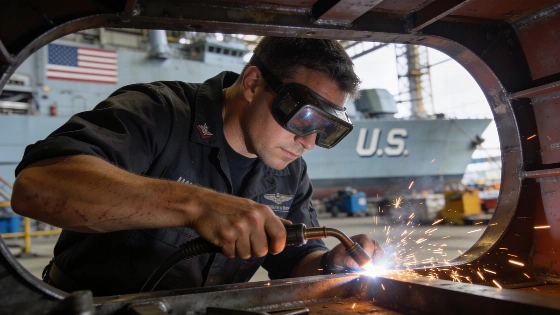
As AI reshapes white-collar jobs, JPMorgan's $24 million investment in Philadelphia shipbuilding highlights a growing crisis: the U.S. lacks enough welders and electricians to meet demand, and the existing workforce is aging fast
While much of corporate America debates the impact of artificial intelligence on office jobs, JPMorgan Chase CEO Jamie Dimon is sounding the alarm on a different workforce crisis: the U.S. is running short on skilled tradespeople, especially welders and electricians. Speaking at the Philadelphia Navy Yard, Dimon announced a $24 million commitment to support the city's shipbuilding and maritime manufacturing sector, but emphasized that money alone won't solve the underlying labor shortage.
Skilled Trades Gap
According to Dimon, the U.S. will need hundreds of thousands of new skilled workers to meet the demands of shipbuilding and related industries over the next decade. JPMorgan's research estimates a need for 250,000 additional shipbuilding workers by 2036, a figure echoed by consulting firm McKinsey. The urgency is heightened by the fact that more than a quarter of current workers in these fields are already 55 or older, with many nearing retirement. The pipeline of younger workers entering these trades is not keeping pace with those leaving, creating a widening gap that threatens both economic growth and national defense capabilities.
This shortage is not limited to shipyards. Across the country, industries that rely on skilled manual labor are struggling to fill positions, even as headlines focus on AI's impact on knowledge work. The skilled trades crisis is less visible but carries significant risks for sectors that cannot be automated or offshored.
Financial Upside Without College Debt
Dimon highlighted that skilled trades offer a path to high earnings without the burden of student loans. Many apprenticeship programs pay workers as they learn, in contrast to the traditional college model where students pay tuition and often graduate with debt. In some regions, experienced welders and electricians can earn $80,000 to $100,000 annually after just a few years of training. For young adults, this can mean reaching six-figure incomes in their twenties without a college degree.
The appeal of these careers is growing as AI and automation threaten traditional white-collar roles in programming, data analysis, and legal work. Skilled trades require hands-on expertise and physical presence-tasks that current technology cannot easily replace. As a result, these jobs are becoming more attractive to a generation that has seen the risks of student debt and job automation firsthand.
Generational Shift and Industry Response
The roots of the skilled labor shortage stretch back decades. Baby boomers filled many of these roles in the late 20th century, but younger generations were often steered toward four-year degrees and office jobs. The perception that trades were less stable or prestigious contributed to a decline in new entrants. Today, the consequences are visible: the U.S. merchant fleet has shrunk dramatically since the 1960s, and regions like Hampton Roads, Virginia, face projected shortages of tens of thousands of shipyard workers by 2030.
Major employers are investing heavily to address the gap. Huntington Ingalls Industries, the nation's largest military shipbuilder, spends over $110 million annually on workforce development and hired more than 1,600 shipbuilders in the first quarter of 2026 alone. Yet even with full apprentice schools, demand continues to outstrip supply.
JPMorgan's Investment in Philadelphia
JPMorgan's $24 million initiative includes $18 million in loans and investments and $6 million in philanthropic grants. The largest portion-a $13 million equity investment-will help Rhoads Industries build a new 95,000-square-foot manufacturing facility at the Navy Yard, supporting submarine production for General Dynamics Electric Boat. Additional grants will fund regional training collaboratives and expand non-degree workforce pathways for hundreds of local residents, aiming to strengthen the talent pipeline for maritime suppliers and related businesses.
JPMorgan executives say Philadelphia is just the starting point, with plans to expand similar support to other U.S. shipyards and even into Europe. The goal is to create sustainable, high-paying jobs while addressing a national security concern that cannot be solved by automation alone.
Changing Perceptions and Economic Stakes
The skilled trades shortage is forcing a broader rethinking of career paths in the U.S. As AI disrupts traditional office work, jobs that require manual skill and on-site presence are gaining new respect-and financial appeal. For many, a career as a welder or electrician now offers better long-term prospects than a white-collar job that may be vulnerable to automation and global competition.
According to the Bureau of Labor Statistics, employment in construction and extraction occupations is projected to grow 4% from 2022 to 2032, adding about 252,900 new jobs. Median annual wages for electricians reached $60,240 in 2023, while experienced workers in high-demand regions can earn significantly more. The skilled trades pipeline remains a critical factor in the nation's ability to maintain infrastructure, defense, and manufacturing capacity.
As the U.S. economy evolves, the value of skilled manual labor is being reassessed. For families weighing the costs and benefits of college versus apprenticeships, the financial and career trade-offs are shifting. The skilled trades offer a route to stable, well-compensated work that is less exposed to the risks of automation and student debt, but the sector's future depends on attracting a new generation of workers willing to take up the tools.