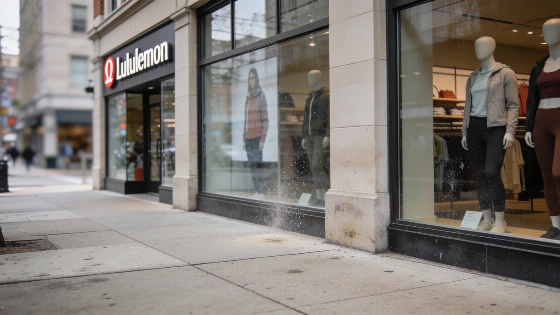
Lululemon's North American sales have dropped double digits as consumers pull back and competitors like Alo Yoga and Vuori gain ground. Wall Street analysts are slashing price targets and warning of deeper losses ahead
Lululemon's position in the athletic apparel market is weakening as Wall Street sentiment turns negative and consumers increasingly choose emerging competitors. BMO Capital Markets recently issued an underperform rating on Lululemon stock, forecasting a further 28% decline from its recent close and citing a widening disconnect between the brand and U.S. shoppers. This downgrade follows a challenging second quarter, during which Lululemon's North American comparable sales fell 12% and regional net revenue declined 8%, according to the company's latest earnings report.
Investors are now facing the reality that Lululemon's growth trajectory has stalled. The company's leggings segment, historically a key profit driver, contracted by 20% as consumer preferences shifted toward looser styles, moving away from the tight silhouettes that once defined the brand. Recent product launches have not generated significant interest, and negative sentiment on social media has contributed to reduced store traffic. As a result, Lululemon's U.S. market share dropped by 10 percentage points to 43.9% in August, while competitors Alo Yoga and Vuori recorded measurable gains, according to M Science data cited by Reuters.
After Lululemon released its Q2 2026 results, the company's shares plunged more than 17% in a single day, reaching their lowest level in nearly eight years.
Wall Street's caution is intensifying. BofA Global Research recently lowered its price objective for Lululemon from $140 to $122 and reduced its earnings-per-share forecast for fiscal 2026 by 13% and for 2027 by 31%. While maintaining a neutral rating, the firm noted that weak second-quarter results are likely to delay any substantial recovery. BMO's analyst was more direct, highlighting Lululemon's "irrelevance with the consumer" and the brand's loss of momentum in both the Americas and China.
Foot traffic data further illustrates the decline. According to Placer.ai, Lululemon's same-store visits decreased 1.9% year over year in both June and July, with the decline accelerating to 6% in August. Retail analysts attribute this trend to more cautious consumer behavior, with discretionary spending under pressure and shoppers increasingly seeking value. A spring 2026 survey by A&M Consumer and Retail Group found that approximately 30% of U.S. consumers plan to reduce spending on clothing and footwear this year, relying more on sales and promotions and making fewer impulse purchases.
Lululemon's net revenue for the second quarter of fiscal 2026 totaled $2.416 billion, representing a 4% year-over-year decline, while comparable sales dropped 9% overall and 12% in North America. The company also lowered its full-year revenue forecast to between $10.35 billion and $10.50 billion, with EPS guidance of $9.48 to $9.73.
Competition in the premium athleisure segment is intensifying. Brands such as Alo Yoga and Vuori are attracting style-focused consumers with new designs and assertive marketing. Lululemon's product pipeline, once considered innovative, is now viewed by some analysts as lacking freshness. The company's recent efforts to adapt-including introducing more relaxed fits and expanding its outerwear range-have not yet reversed the sales decline. Lululemon is also reducing its in-store assortment and increasing markdowns in an attempt to stimulate demand while maintaining its premium positioning.
Leadership changes have introduced additional uncertainty. Heidi O'Neill assumed the role of CEO on September 8, succeeding Calvin McDonald. The new chief executive is expected to review Lululemon's strategy and set a revised direction, but the company has already indicated that U.S. revenue is likely to decline by low double digits for the full year 2026 compared to 2025. As Lululemon works to re-engage consumers, it faces the same challenges affecting other retailers targeting aspirational shoppers-a trend also seen in recent coverage of Kohl's efforts to regain traffic.
For investors, the financial data is significant. Lululemon's North American revenue for the second quarter of 2026 fell to $1.2 billion, down from $1.3 billion a year earlier. The company's global market share losses reflect a broader reduction in discretionary retail spending, as U.S. inflation remains elevated and wage growth slows. The S&P 500 Consumer Discretionary sector has underperformed the broader index in recent months, highlighting investor concerns about household budget resilience and the durability of premium brands.
Lululemon's current challenges serve as a cautionary example for retailers that depend on brand prestige and full-price sales for growth. The company's rapid decline underscores how quickly consumer preferences can change and how unforgiving the market can be when innovation lags. Without a substantial product refresh and renewed consumer engagement, Lululemon's premium status-and its stock price-are likely to remain under pressure.
Market share is a key metric in the apparel industry, reflecting not only sales volume but also brand relevance and pricing power. When a company like Lululemon loses ground to smaller competitors, it signals a shift in consumer loyalty and potential pressure on profit margins. Both investors and executives monitor these figures closely, as ongoing market share losses can lead to further downgrades, inventory write-downs, and, if the trend continues, possible store closures.