A federal appeals court has ordered President Donald Trump to pause construction on his controversial White House ballroom, raising questions about legal authority, taxpayer costs, and the project's future as it heads toward the Supreme Court
President Donald Trump's ambitious plan to add a massive ballroom to the White House East Wing is now in limbo after a federal appeals court ruled the project unlawful, forcing a halt to above-ground construction unless Congress gives explicit approval. The decision, which Trump has vowed to challenge at the Supreme Court, leaves the future of the $600 million project uncertain and exposes the administration to both legal and political risk as the 2026 election cycle intensifies.
The ballroom, which began as a $200 million privately funded initiative, has ballooned in scope and cost. According to a project summary obtained by the Washington Post, more than half of the estimated $600 million price tag would now be covered by taxpayers. The project's evolution-from a presidential showpiece to a purported national security necessity-has drawn criticism from preservationists, lawmakers, and the public, especially after the historic East Wing was demolished in late 2025 to make way for the new structure.
Legal and Political Roadblocks
The core of the legal dispute centers on Trump's decision to bypass congressional approval and required federal reviews before breaking ground. The National Trust for Historic Preservation filed suit in December 2025, arguing that the administration ignored established oversight processes. The appeals court agreed, ordering a pause on construction for at least two weeks to allow for a Supreme Court appeal. If the high court declines to intervene, the ruling could stand, forcing Trump to seek congressional authorization-a process complicated by partisan divisions and public skepticism.
While the court's order halts above-ground work, it allows construction to continue on the underground bunker complex, which the administration claims is essential for modernizing White House security infrastructure. Experts note that the administration could, if necessary, complete the bunker and restore the East Wing above it, rather than finishing the ballroom as originally planned. This alternative could address both security and preservation concerns, but would require a significant redesign and further delay.
Escalating Costs and Funding Controversy
As the project's scope expanded, so did its price. Initial estimates of $200 million-promised as privately funded-rose to $400 million, and then to $600 million, with a failed Senate Republican effort this spring to secure $1 billion in federal funds for security upgrades tied to the project. The shifting funding mix has fueled bipartisan criticism, with some lawmakers questioning the optics of spending hundreds of millions on a ballroom while Americans face economic pressures. According to a recent CNN poll, 58% of Americans expressed dissatisfaction or anger over Trump's construction projects in Washington, DC, including the ballroom and other renovations.
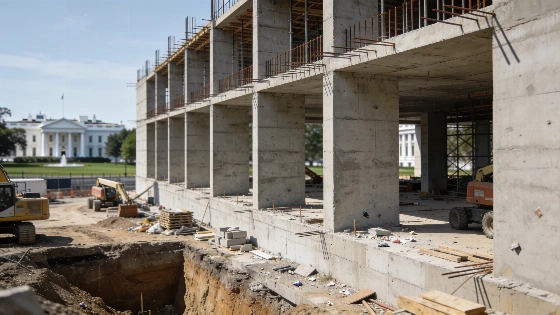
Despite the legal and financial hurdles, construction has moved quickly. By late February 2026, crews had completed excavation and begun pouring reinforced concrete for the foundation and lower levels, including new offices and kitchen space. Above ground, four towering concrete walls have been erected, but the structure remains far from usable. The administration maintains that much of the material is already on site or in transit, underscoring the financial risk of a prolonged pause or forced redesign.
What Happens Next
If the Supreme Court takes up the case, the outcome is far from certain. Recent divisions among the court's conservative justices mean a Trump victory is not guaranteed. Should the court require congressional approval, the project's fate would hinge on the political makeup of Congress after the November midterms. If Democrats gain control of either chamber, approval for the ballroom is unlikely. Even if construction resumes, Trump's timeline for completion-summer 2028-would leave little margin for further delays.
For now, the administration is permitted to continue work on the underground bunker, provided the site is secured against safety and security risks. Some experts suggest that finishing the bunker and restoring the East Wing above it could be a practical compromise, but the administration has shown little interest in alternatives that do not include the ballroom centerpiece. The legal battle highlights the risks of bypassing established oversight, as well as the financial and political costs of large-scale federal construction projects undertaken without broad support.
According to the Congressional Budget Office, federal discretionary spending on public buildings and infrastructure totaled $120 billion in fiscal year 2025, with major projects often facing delays and cost overruns due to regulatory, legal, and political challenges. The White House ballroom controversy underscores how high-profile projects can become flashpoints for broader debates over government spending, transparency, and executive authority.
Large federal construction projects, especially those involving historic sites or national landmarks, are subject to a complex web of legal, regulatory, and political requirements. Congressional approval is often needed for major changes to federal property, and projects must typically undergo environmental and historic preservation reviews before work begins. Skipping these steps can lead to costly legal battles, construction delays, and reputational damage. For taxpayers, the stakes include not only the direct cost of construction but also the risk of sunk costs if projects are halted or redesigned midstream. For policymakers, the episode serves as a reminder that even well-intentioned initiatives can falter without broad consensus and careful adherence to established rules.