
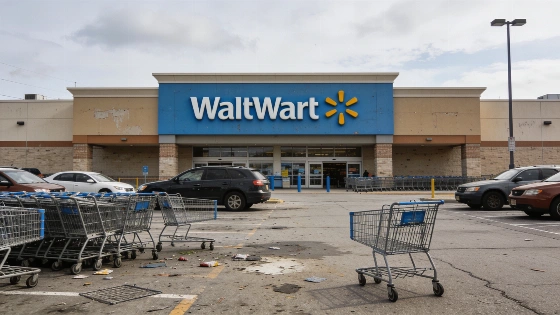
Walmart raised its full-year outlook after beating revenue and profit forecasts, but slower U.S. sales growth and reliance on a one-time tariff refund rattled investors, sending shares down sharply and weighing on major stock indexes
Walmart delivered stronger-than-expected revenue and profit for the latest quarter and raised its full-year guidance, but the results failed to reassure investors. Despite the headline beat, the company's U.S. comparable sales growth slowed to 2.6%, well below the 3.7% analysts had anticipated and marking the weakest pace since late 2020. The stock fell nearly 10% on the day, erasing billions in market value and dragging down the Dow, S&P 500, and Nasdaq indexes.
Much of the earnings surprise was driven by a $2.9 billion benefit from tariff refunds, rather than from Walmart's core retail operations. This one-time gain raised questions about the sustainability of future profit growth, especially as consumer spending shows signs of cooling. The company's results highlight the tension between headline financial performance and the underlying health of its U.S. retail business, which remains sensitive to shifts in household budgets and broader economic pressures.
Sales Growth Slows as Consumers Pull Back
Walmart's U.S. comparable sales-a key measure of performance at stores open at least a year-grew at their slowest rate in more than three years. This deceleration comes as many American households face higher fuel costs and persistently elevated prices for essentials, which can limit discretionary spending. While Walmart has historically benefited from shoppers trading down during periods of economic stress, the latest figures suggest even value-focused retailers are not immune to a more cautious consumer.
According to company filings, the $2.9 billion tariff refund was a significant contributor to the quarter's profit, masking weaker trends in the core business. Excluding this one-time item, Walmart's operating performance would have looked less robust. The company's management acknowledged the challenging environment, noting that shoppers are becoming more selective and price-sensitive as inflation and borrowing costs remain high.
Market Reaction and Broader Implications
The sharp drop in Walmart's stock price had an outsized impact on major indexes, given the company's large market capitalization. The decline contributed to a broader pullback in U.S. equities, as investors weighed the implications of slowing consumer demand and the potential for further earnings disappointments across the retail sector. High bond yields-now near their highest levels since before the 2008 financial crisis-have also pressured stocks, making risk-free assets more attractive relative to equities.
Despite the negative reaction to Walmart's report, some companies bucked the trend. Deere and Micron Technology, for example, posted positive earnings and saw their shares rise, suggesting that pockets of optimism remain in the market. Still, the overall tone is cautious, with investors closely monitoring consumer spending patterns and the impact of higher interest rates on both corporate profits and household budgets. As seen in a recent analysis of Dow performance amid mixed earnings, heavyweight stocks can sway the broader market even when most components are stable or rising.
Tariff Refunds and One-Time Gains
One-time items like tariff refunds can significantly affect quarterly earnings, but they do not reflect the ongoing profitability of a company's core business. Investors and analysts often adjust for these items to better assess underlying trends. In Walmart's case, the $2.9 billion refund provided a temporary boost, but it does not change the fact that organic sales growth is slowing. For long-term investors, distinguishing between sustainable earnings and one-off gains is critical when evaluating a company's outlook and valuation.
Comparable sales, sometimes called same-store sales, are a widely used metric in retail because they strip out the effects of new store openings and closures, focusing on the performance of established locations. Slower growth in this measure can signal that a retailer is struggling to attract more spending from existing customers, which may be a warning sign if broader economic conditions remain challenging. As the retail landscape evolves, investors will need to pay close attention to both headline results and the quality of earnings beneath the surface.