
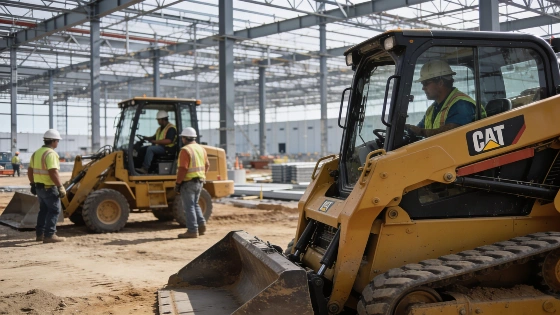
Caterpillar's stock price has soared, making it one of the most influential stocks in the Dow Jones Industrial Average. Investors are watching for a possible stock split and what it could mean for the index's balance and future changes
Caterpillar's stock has surged over the past three years, transforming the company into one of the most influential components of the Dow Jones Industrial Average. As its share price approaches $1,000, Caterpillar now accounts for more than 10% of the Dow's total weighting-a level that has prompted speculation about whether the industrial giant will move to split its stock. For investors, the prospect of a split raises questions about how the Dow's structure could shift and what it means for the broader market.
The company's recent gains have been fueled by several converging trends. Caterpillar's heavy equipment is in high demand for the construction of AI data centers, a sector experiencing rapid expansion as artificial intelligence drives new infrastructure needs. Its mining division is also benefiting from increased resource demand, while the Power & Energy segment is positioned to capitalize on the growing need for on-site power generation at data centers. As hyperscale tech companies invest heavily in AI, Caterpillar's products are seeing sustained demand, with supply struggling to keep pace.
Dow Weighting and Stock Splits
The Dow Jones Industrial Average is a price-weighted index, meaning that companies with higher share prices exert more influence over the index's movements. As Caterpillar's stock price has climbed, its impact on the Dow has grown disproportionately. Currently, Caterpillar and Goldman Sachs together make up nearly a quarter of the Dow's total weighting, according to reporting by The Motley Fool. This concentration is far higher than in the S&P 500, where the two largest stocks account for a much smaller share of the index.
Stock splits can help rebalance the Dow by reducing the price per share and, consequently, the company's weighting in the index. Recent examples include Amazon and Alphabet, which split their stocks in 2022 to bring their prices closer to the Dow's median and facilitate potential inclusion. Without such splits, high-priced stocks can skew the index, making it less representative of the broader market.
Sector Balance and Index Changes
Despite Caterpillar's outsized influence, the industrial sector as a whole still represents a smaller portion of the Dow compared to financials. Financial companies, led by Goldman Sachs, now account for nearly 29% of the index, while industrials make up just over 17%. This imbalance has led some market watchers to argue that a Goldman Sachs stock split could be more urgent for the Dow's sector balance than a Caterpillar split.
There is also speculation about potential changes to the Dow's lineup. Meta Platforms, for example, has been cited as a strong candidate for inclusion due to its robust free cash flow, dominant industry position, and recent introduction of a dividend. If Goldman Sachs were to split its stock, it could open the door for Meta to join the index, possibly replacing a company like Nike. Such changes would further alter the Dow's sector composition and influence.
Cyclical Risks and Historical Patterns
While Caterpillar's current dominance is notable, history shows that such periods of concentration in the Dow are often temporary. In 2019, Boeing's rapid price appreciation pushed its weighting above 11%, but subsequent underperformance and index adjustments reduced its influence to just 2.5%. Caterpillar, as a cyclical company, could see its weighting decline if demand for AI infrastructure slows or if broader economic conditions shift.
For now, Caterpillar may choose to wait before announcing a stock split, especially given the uncertainty around how long the current AI-driven demand will last. The company's management could prefer to see how the market evolves before making a move that would permanently alter its influence in the Dow.
Stock splits do not change a company's overall market value, but they can affect investor perception and trading activity. In a price-weighted index like the Dow, splits have an outsized impact on index composition and sector balance. Investors should understand that while a split may make shares more accessible to some buyers, it does not alter the underlying fundamentals or future prospects of the company. The decision to split often reflects both market dynamics and strategic considerations about index inclusion and sector representation.