
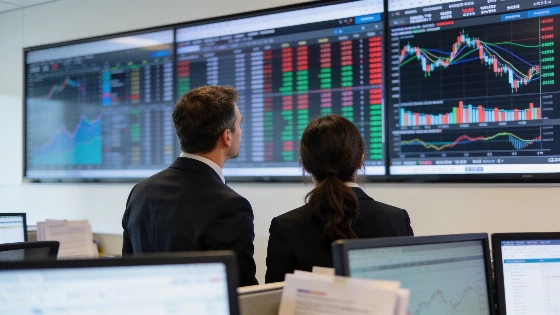
Artificial intelligence is taking on a bigger role in portfolio management, shifting from stock picking to real-time monitoring and rebalancing as firms seek to reduce human bias and improve returns
Artificial intelligence is making its mark on Wall Street, but not always in the ways investors might expect. While early AI tools focused on identifying undervalued stocks or predicting market moves, the technology is now being used to manage portfolios after the initial buy-monitoring holdings, flagging drift, and rebalancing positions as new opportunities arise. This shift is changing how asset managers approach risk, discipline, and decision-making in real time.
Behavioral Bias and Portfolio Drift
Many investors are familiar with the challenge of holding onto losing stocks too long or hesitating to trim winners. These tendencies, well documented in behavioral finance research, can erode returns over time. Institutional managers face similar pressures, often complicated by internal dynamics-such as reluctance to question a colleague's recommendation or reputation. AI, by contrast, applies the same criteria to every position daily, removing emotional attachment from the equation and acting when the data suggests a better alternative.
According to a global Mercer survey of 131 asset managers, 55% had already integrated AI into at least one investment process as of 2026, and 91% planned to expand its use within a year. Much of this growth is happening in portfolio construction and rebalancing, not just research. Traditional quarterly reviews can miss rapid changes in company fundamentals or market conditions, leaving portfolios exposed to outdated positions. AI-driven systems can respond more quickly, adjusting allocations as soon as new information shifts the risk-reward balance.
Inside an AI-Managed Fund
One example of this approach is FINQ, which launched the first SEC-registered ETFs managed entirely by AI. The firm's funds, AIUP and AINT, use an autonomous framework to continuously rank companies and rotate holdings as market conditions evolve. From inception through May 31, 2026, AIUP returned 15.30%, outpacing the S&P 500's 10.07% over the same period. The system's process was illustrated when it rotated out of ServiceNow after a 24% gain, reallocating to Expand Energy just before ServiceNow dropped nearly 17% in eight days. A similar move with Datadog saw the fund exit after a 141% gain and shift to T-Mobile US, which then outperformed Datadog during a market pullback.
These examples highlight how AI can enforce discipline by requiring every position to justify its place in the portfolio based on current data. The system does not attempt to predict individual stock moves but instead reassesses the entire opportunity set and reallocates capital when a more attractive risk-reward profile emerges. While past performance does not guarantee future results, these case studies show how AI-driven rebalancing can help avoid common behavioral pitfalls.
Limits of Automation
Despite these advances, human portfolio managers are not being replaced. Tasks that require judgment, such as interpreting political events, regulatory changes, or unexpected crises, still depend on human expertise. AI excels at monitoring, ranking, and executing routine adjustments, freeing managers to focus on strategy, client relationships, and complex decisions that fall outside algorithmic models. According to a 2026 report from BCG, agentic AI workflows could boost operational capacity by 55% to 65% and cut costs by about 40%, but the technology remains a tool rather than a substitute for human oversight.
Most investors may not realize how much of this transformation is already underway. As with many changes in financial infrastructure, the adoption of AI in portfolio management has been gradual and largely invisible to end clients. Yet the impact is growing, as more firms seek to reduce bias, improve discipline, and respond faster to shifting markets. For a look at how AI is also influencing broader market trends and company strategies, see this analysis of Nvidia's data center expansion and its potential effects on household energy costs: Nvidia's massive AI investment and its ripple effects.
According to the Investment Company Institute, U.S. ETF assets reached $8.6 trillion as of April 2026, up from $7.2 trillion a year earlier. Actively managed ETFs, including those using AI-driven strategies, accounted for a growing share of new fund launches and net inflows. While AI-managed funds remain a small segment of the overall market, their performance and operational efficiency are drawing increased attention from both institutional and retail investors.
AI's role in portfolio management is likely to expand as technology improves and more data becomes available. But the core challenge remains: balancing automation with human judgment to manage risk, seize opportunities, and avoid the behavioral traps that have long shaped investment outcomes.
Portfolio rebalancing is a critical but often overlooked aspect of long-term investing. It involves periodically adjusting a portfolio's asset mix to maintain a target allocation, which can help control risk and lock in gains. Automated rebalancing, whether through AI or traditional rules-based systems, can reduce the influence of emotion and inertia. However, the frequency and method of rebalancing should be tailored to an investor's goals, risk tolerance, and tax situation. While automation can improve discipline, it does not eliminate the need for oversight, especially when market conditions change rapidly or new risks emerge.