AMD is shifting its AI strategy from chip launches to powering real-world business applications, as major deals with Anthropic, OpenAI, and Meta reshape the competitive landscape and drive new revenue forecasts
The artificial intelligence boom has been dominated by headlines about chips, data centers, and the billions flowing into infrastructure. But as the industry moves from building to deploying, AMD is betting that the next phase-AI inference at scale-will be where the real business transformation happens. At the Advancing AI 2026 conference in San Francisco, CEO Lisa Su outlined how AMD is positioning itself for this shift, emphasizing that AI is now embedded in daily business operations, not just experimental pilots.
Su's message marks a departure from the early AI era, which focused on training massive models requiring concentrated GPU power. Now, the spotlight is on inference-the process of running those models in real-world applications, from chatbots to automated document processing. As more companies integrate AI into their workflows, the demand for compute power is expected to grow exponentially. According to AMD's internal data, monthly AI token consumption has surged to roughly 35 quadrillion, a 160-fold increase over two years. This signals a transition from technology hype to business-critical infrastructure.
AI's New Compute Demands
AMD projects that 2026 will be the first year global inference compute requirements surpass those for training. This shift is driving a reassessment of the hardware mix needed to support AI at scale. While GPUs remain essential for model execution, Su highlighted that agentic AI systems-those capable of handling complex, multi-step tasks-also require significant CPU resources for orchestration and data management. As a result, AMD has revised its estimate for the server CPU market to $220 billion by 2030, nearly doubling its previous forecast.
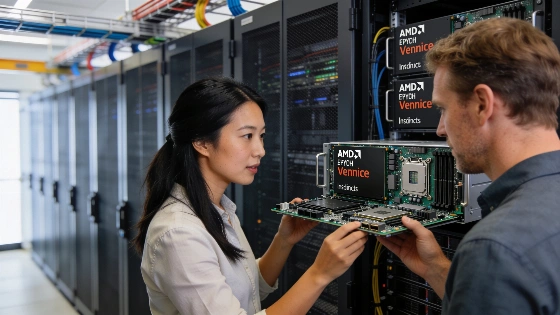
The company's new EPYC Venice processor, built on TSMC's 2nm architecture, is the first product to reflect this expanded market view. AMD's data center segment reported $5.8 billion in revenue last quarter, up 57% year over year. Wall Street is watching closely, with Q2 earnings expected to show $11.3 billion in revenue, a 47% increase from the prior year. Despite a recent 8.85% drop in AMD's stock on July 28-driven by sector-wide concerns and an SK Hynix earnings miss-the stock remains up about 115% for the year.
Major AI Partnerships
AMD's strategy is reinforced by a series of high-profile partnerships. In October 2025, the company announced a deal with OpenAI involving 6 gigawatts of GPU capacity, with the first phase deploying in late 2026. A similar agreement with Meta followed in February 2026. Most recently, AMD confirmed a partnership with Anthropic in July 2026, which includes up to 2 gigawatts of Instinct MI455X GPUs and integration with EPYC Venice CPUs and Pensando networking. The first gigawatt is scheduled for deployment in the first half of 2027, according to CNBC.
These deals go beyond hardware sales. Anthropic will use its Claude model to optimize AMD's Instinct GPU workloads and accelerate ROCm software development, directly addressing AMD's long-standing challenge in competing with Nvidia's CUDA ecosystem. AMD is also making an equity investment of up to $5 billion in Anthropic, contingent on deployment milestones. The Helios rack systems, priced between $5 million and $5.5 million per rack, reflect a shift toward selling complete AI infrastructure rather than individual components.
Such partnerships signal that leading AI developers are willing to commit significant capital to AMD's platform as an alternative to Nvidia. This trend is reshaping the competitive landscape and could influence how other hyperscalers allocate their AI infrastructure budgets. The move toward full-stack solutions is also reflected in other sectors, as seen when ServiceNow's security business surpassed $1 billion in annual contract value amid AI-driven market shifts, according to recent reporting.
Investor Focus and Market Risks
Analysts have responded to AMD's AI push by raising price targets. KeyBanc now targets $725, UBS $700, and Mizuho $625. Bank of America lifted its target to $620, citing a broader AI opportunity than previously recognized. Barclays raised its target to $665, arguing that the market is underestimating the role of CPUs in AI infrastructure. The consensus among analysts is a Strong Buy, with 28 Buy ratings and eight Holds.
Yet, the market remains volatile. Options traders are pricing in a 12.28% move in either direction around AMD's August 4 earnings report. The key questions for investors are whether AMD can sustain its revenue growth as AI demand shifts from training to inference, and whether its new partnerships will translate into higher margins and market share. The upcoming earnings release will provide the first concrete test of these expectations.
For the second quarter, investors are watching three main indicators: guidance for data center GPU revenue, the ramp-up of EPYC Venice processor sales, and updates on the Anthropic deployment timeline. Wells Fargo projects AMD's data center GPU revenue could reach $40.6 billion by 2027, but actual results will depend on execution and customer adoption. Any delays or accelerations in major deployments could have a significant impact on the stock.
AMD's evolving AI strategy highlights the growing complexity of the semiconductor market. As AI becomes more deeply embedded in business operations, the distinction between CPUs and GPUs is blurring, and the ability to deliver integrated solutions is becoming a key competitive advantage. Investors should be prepared for continued volatility as the market recalibrates around these new realities.
AI inference refers to the process of running trained machine learning models on new data to generate predictions or automate tasks. Unlike training, which is resource-intensive but episodic, inference happens continuously as users interact with AI-powered systems. This creates a steady, scalable demand for compute resources, especially as businesses embed AI into core workflows. For investors, understanding the difference between training and inference is crucial, as it affects hardware requirements, revenue models, and the long-term growth prospects of companies like AMD and its competitors.