
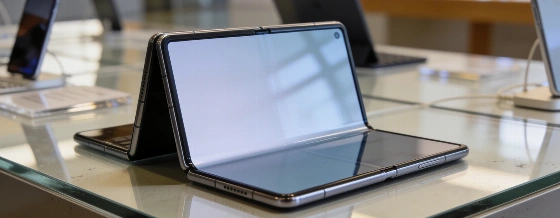
Apple's $1,999 iPhone Duo arrives as Wall Street questions if AI wearables could dethrone the smartphone. Investors now face a high-stakes test of demand and pricing power as Apple's stock trades at a premium
Apple's $1,999 iPhone Duo is more than a routine hardware update-it represents a direct commitment to the smartphone's central role in digital life, even as artificial intelligence and emerging device categories challenge the status quo. With the Duo's launch on October 23, Apple is asking consumers to pay a premium for a foldable phone that expands to a 7.6-inch display. CEO John Ternus is placing his reputation on the iPhone's continued relevance in an era increasingly shaped by AI-powered wearables. According to a Reuters report, the iPhone Duo features a 5.4-inch external screen and, when unfolded, is the thinnest iPhone Apple has produced to date.
Apple's entry into the foldable phone market is considered one of the most significant changes to the flagship iPhone lineup in years, challenging the dominance of Samsung and Chinese brands.
The stakes extend beyond the success of a single device to the resilience of Apple's core business model. The iPhone 17 series generated over $170 billion in wholesale revenue in its first year, according to Counterpoint, with China sales rising 35%. The standard iPhone 17 alone accounted for 6% of global smartphone unit sales in the June quarter, ranking first worldwide. Looking ahead, the iPhone 18 Pro and Pro Max-priced at $1,199 and $1,299-are expected to drive the upgrade cycle until the standard iPhone 18 arrives in 2027. Counterpoint Research projects that the iPhone 18 Pro and Pro Max will launch alongside the Duo, while the standard iPhone 18 and 18e are scheduled for release the following year.
AI and the smartphone's future
As AI wearables and new device formats gain momentum, some analysts have questioned whether the smartphone's dominance is under threat. In a recent TechRadar interview, Ternus dismissed the notion that AI will displace the phone, emphasizing that the smartphone remains unmatched in computing power, battery life, and display quality-capabilities that AI wearables have yet to match. Apple's strategy is to use AI to enhance its existing devices, not to replace them. According to Reuters, Ternus is positioning the iPhone as the foundation of Apple's ecosystem in the AI era, directly countering the idea that standalone AI devices or wearables could supplant the smartphone.
Counterpoint Research found that in the first year of iPhone 17 sales, revenue in China grew by 35% year-over-year, accounting for nearly a quarter of the series' global revenue. This underscores the strategic importance of the Chinese market for Apple's flagship devices.
Apple's approach to AI is to integrate it throughout its product ecosystem, with the iPhone as the central hub. Watches and AirPods are positioned as extensions of the smartphone experience, not as replacements. Ternus has also emphasized privacy and user control, indicating that Apple views trust as a competitive advantage as AI becomes more pervasive.
Investor pressure and commercial reality
Investors are currently rewarding Apple's product strategy, but expectations are high. The company has exceeded earnings and sales estimates for four consecutive quarters, yet its premium valuation means that any shortfall in iPhone 18 demand, Duo adoption, or China sales could prompt a sharp correction. Longer delivery times may signal either strong demand or supply constraints, and higher device prices must translate into improved margins without slowing upgrade cycles.
According to previous analysis, Apple's ability to sustain its stock price depends on delivering both innovation and financial results that justify its premium. The iPhone Duo's launch will test whether Apple can continue to command higher prices in a market where consumers have more options and AI is reshaping expectations.
For U.S. consumers, the Duo's price is a significant hurdle. Financing and trade-in programs may help, but the key question is whether enough buyers perceive value in a foldable phone when standard models already offer strong performance. The risk for Apple is that a misstep could erode its pricing power and brand strength, particularly if competitors succeed in making AI wearables or alternative devices essential.
Market data and competitive context
As of September 2026, Apple's market capitalization remains above $3 trillion, maintaining its position as the world's most valuable public company. The global smartphone market is projected to grow just 2% this year, with premium devices representing a larger share of profits but experiencing slower unit growth. Foldable phones account for less than 5% of total shipments, but their average selling price is more than double that of standard smartphones, according to IDC. Meanwhile, AI wearables and companion devices are expected to achieve double-digit growth, intensifying competition for consumer attention and spending.
Apple's commitment to the iPhone Duo is a calculated risk. The company is leveraging its brand and ecosystem to defend the smartphone's central role, while also raising the standard for what consumers must pay to access the latest technology. If the Duo and iPhone 18 Pro models succeed, Apple will demonstrate its continued ability to set the agenda in consumer technology. If not, the company's premium valuation could quickly become a liability, and the narrative of unassailable iPhone dominance will face its most significant test yet.
Foldable phones represent manufacturers' latest effort to reignite growth in a mature smartphone market. Unlike traditional models, foldables use flexible OLED displays and complex hinge mechanisms to provide both compactness and expanded screen space. While early versions faced durability challenges and visible creases, recent improvements have enhanced reliability and user experience. The high cost of foldables reflects both the expense of new materials and the premium consumers are willing to pay for novelty and multitasking features. As more brands enter the market and production scales up, prices may decline, but for now, foldables remain a luxury segment that tests both consumer demand and brand loyalty.