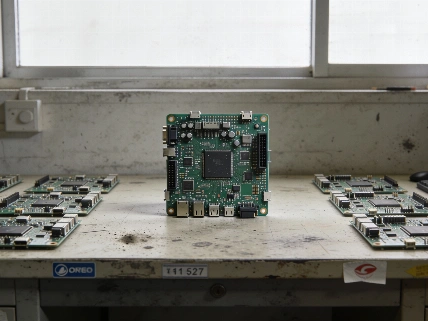
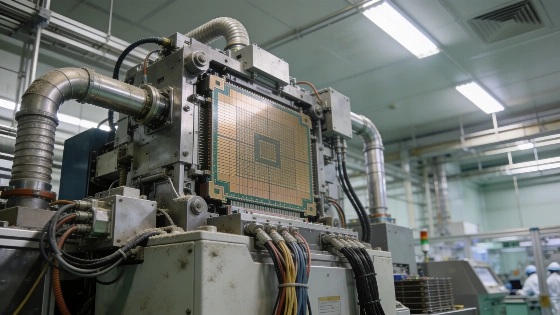
ASML's customers are seeking equipment years before delivery as record results meet a tight supply outlook. Bank earnings split, while inflation data and TSMC's results loom over markets; Klarna's forecast cut adds a valuation test.
Some ASML customers want to place orders now for machines that would not ship until 2029 or 2030. On October 14, the company reported third-quarter net income of €4.96 billion, against analysts' expectations of about €4.1 billion. Revenue reached €11.66 billion, compared with a €11.72 billion forecast. Gross margin was 57.5%, and quarterly revenue rose from €9.33 billion in the second quarter.
ASML raised the lower end of its 2025 revenue outlook from €43 billion to €44 billion. It kept the upper end at €45 billion, even as planned production increases remained short of expected demand, CNBC reported.
The supply squeeze is only one test for investors. Major U.S. banks posted mixed results, while upcoming inflation data and TSMC's earnings could shift attention to borrowing costs and AI chip demand. A market analysis of Treasury-yield pressure offers a reminder: valuation changes can move stocks even when a company's operating outlook holds steady.
Chip demand outpaces supply
ASML reported record third-quarter sales and profit. CEO Christophe Fouquet said some customers want to order equipment that would not ship until 2029 or 2030. He said customers had raised their short- and medium-term equipment-demand forecasts, primarily because they expect AI-related investment to be larger and last longer. ASML is the only manufacturer of extreme ultraviolet lithography machines used to produce leading-edge chips. Chipmakers have built factories around the technology.
The company had planned to increase production by 30% in each of 2027 and 2028. Those expansions still are not expected to meet demand. Management is weighing further capacity increases, including producing more in 2028 than previously planned. Fouquet said demand was outstripping supply, Agence France-Presse reported.
Management lifted the lower end of its sales forecast from €43 billion to €44 billion and held the upper end at €45 billion. ASML shares, up 56% this year, edged down 0.6% in early trading after the results. Investors had already priced in substantial growth, leaving less room for a strong quarter to surprise them.
Team Hidden Gems has set a five-year price prediction of $3,229.22 for the stock. That is a forecast, not a guaranteed outcome, and the source provides no assumptions behind the target. Equipment supply remains a concrete limit on how quickly chipmakers can expand capacity.
Banks send mixed signals
Third-quarter reports from major banks diverged. JPMorgan Chase posted a rare earnings miss, while Goldman Sachs beat expectations as equity-trading revenue surged. Citigroup fell 5.6% after warning that fourth-quarter trading revenue could decline about 20%. Wells Fargo also reported results, but the source material gives no specific figures for its performance.
Trading revenue can swing from one quarter to another, making it an unreliable standalone measure of a bank's recurring business. JPMorgan's net interest income rose 13% from a year earlier. Citigroup's services business, which handles payments and cash movement for corporations and governments, grew 15%. Those figures point to activity beyond market-making, though they do not remove other risks to bank earnings.
Bank of America was fined $1.2 billion for compliance and sanctions-screening failures after it failed to report $5 billion in suspicious transactions. The fine is expected to reduce net income by 17 cents per share. Morgan Stanley and Bank of America were due to report earnings today, according to the source material.
Inflation and chip earnings
Economists expected September's Consumer Price Index to rise 0.6% from the prior month and 3.6% from a year earlier. Those were forecasts, not reported results. The source linked the expected pressure partly to energy costs and the Iran war. A higher-than-expected reading could weigh on rate-sensitive growth stocks, whose valuations can shift with borrowing costs.
The source also says the Federal Reserve raised rates in September for the first time in three years and indicated that more increases were likely. Higher rates can raise borrowing costs for households and businesses. For stock investors, the impact depends on how inflation and policy expectations affect future earnings and valuations.
Before the next market open, Taiwan Semiconductor Manufacturing, or TSMC, was expected to report third-quarter net profit of about $23.4 billion, a 65% increase. AI infrastructure spending and its CoWoS packaging technology were identified as growth drivers. TSMC is spending $265 billion in Arizona. It could also sublease part of the Terafab AI chip complex that Tesla CEO Elon Musk says his companies will build, though no deal has been completed.
TSMC had already reported third-quarter revenue on October 8: about NT$1.49 trillion, or $46.7 billion. That was roughly 50% higher than a year earlier and above the market forecast of around NT$1.46 trillion. Revenue for the first nine months of 2026 reached NT$3.90 trillion, up 41.1% year over year.
Klarna tests its valuation
Klarna's second-quarter 2026 revenue rose about 27% to roughly $1 billion. The company recorded a $9 million profit after a $53 million loss a year earlier. Management lowered its full-year revenue forecast as German shoppers pulled back and foreign sales converted into fewer dollars. The cut unsettled investors, even as the quarter brought revenue growth alongside a return to profit.
Klarna reported 120 million active consumers in the quarter, up about 8% year over year. J.P. Morgan Payments also began offering Klarna at its merchants' checkouts. Klarna's market value was about $4.7 billion against a 2026 revenue forecast of roughly $4.1 billion. Comparing market value with sales gives a rough valuation measure, but it cannot show whether the company can sustain profits or generate cash.
Team Hidden Gems projects a five-year Klarna share price of $61.55, nearly five times the roughly $13 price cited in the source. The stock had lost more than two-thirds of its value from the team's first recommendation at about $45 in September 2025.
The Motley Fool disclosed positions in ASML and Goldman Sachs Group. Its disclosures also named JPMorgan Chase and Klarna Group. Taiwan Semiconductor Manufacturing and Tesla were listed as well. Wells Fargo and Bank of America were identified as advertising partners. JPMorgan Chase and Citigroup were also named.
Buy now, pay later lets shoppers divide a purchase into smaller payments. The provider's business depends on turning transaction volume into revenue and, ultimately, consistent profits. A large user base can help a payments network attract merchants, but growth in users or sales alone does not establish that earnings will keep rising. Klarna's full-year revenue forecast was lowered after German shoppers pulled back and foreign sales converted into fewer dollars.