Meta’s stock has lagged in 2026 as Wall Street debates the payoff of its massive AI infrastructure investments. Bank of America’s latest move signals renewed conviction, but investors face key milestones and risks in the months ahead
Meta’s stock performance in 2026 has been under pressure, with shares down more than 7% year to date as of early July. The company’s aggressive investment in artificial intelligence infrastructure—projected to reach $850 billion between 2026 and 2030—has fueled persistent debate among investors about the timeline and scale of potential returns. After Meta raised its capital spending guidance again during its first-quarter earnings call on April 29, the stock dropped another 6% to 7% in after-hours trading, reflecting ongoing skepticism about the company’s strategy.
Bank of America’s High-Conviction Call
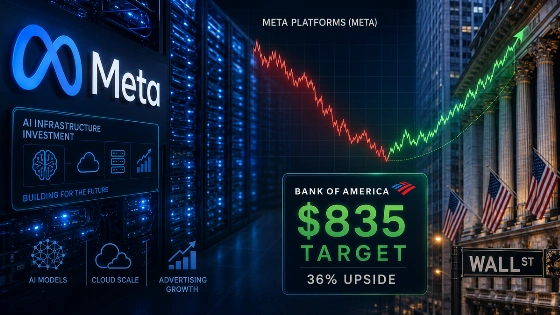
Bank of America has taken a decisive stance by adding Meta to its US 1 List, a designation reserved for the bank’s highest-conviction buy-rated stocks. This move, announced July 9, comes from analysts Justin Post and Nitin Bansal, who have closely tracked Meta’s performance and raised their price target twice in the past three months. Their current target is $835 per share, up from $820 after Meta’s Q1 results, and implies roughly 36% upside from the recent trading level near $612. The analysts’ thesis centers on two key milestones: Meta’s ability to deliver a frontier-level AI model within nine months and evidence that its new AI products are gaining real traction with users and advertisers.
Meta currently trades at about 18 times Bank of America’s revised 2027 earnings estimates, below its historical average of 21 times. For a company projected to generate $254.6 billion in revenue in 2026 and $311.3 billion in 2027, the analysts argue that the current valuation does not fully reflect Meta’s growth potential if its AI investments pay off.
AI Spending: Risk or Opportunity?
The scale of Meta’s capital expenditures has been the main drag on its stock in 2026. The company has repeatedly raised its infrastructure spending forecasts, unsettling investors who worry about the payback period and the risk of overbuilding. Bank of America’s analysts push back on these concerns, contending that Meta’s core advertising business remains strong enough to support the investment, and that AI-driven improvements could further boost revenue and margins over time.
Meta’s first-quarter 2026 results support this view. The company reported $56.31 billion in revenue, a 33% increase from the prior year, and earnings per share of $7.31, beating consensus estimates by $0.64. Meta has exceeded analyst expectations on both revenue and earnings for four consecutive quarters, according to reporting by TheStreet.
Bank of America also sees a longer-term opportunity for Meta to commercialize its AI infrastructure by offering cloud computing services to external customers. If Meta monetizes even half of its projected 19 gigawatts of computing capacity at prevailing market rates, the bank estimates this could generate $100 billion to $150 billion in additional annual revenue, supplementing its core advertising business.
Product Pipeline and Infrastructure Expansion
Meta has accelerated its AI product development in 2026. In late June, the company launched Muse Spark 1.1, a multimodal AI model designed for advanced coding applications, positioning Meta in direct competition with leading AI firms such as OpenAI and Anthropic. The same week, Meta introduced Muse Image, its first public image generation model, and began releasing research from its Meta Superintelligence Lab to the public.
On the infrastructure front, Meta announced a $9.1 billion data center in Alberta, Canada, on July 8—its first in the country and 33rd globally. The facility is designed to deliver 1 gigawatt of AI-optimized computing power. Meta is also developing its own MTIA processor, which could help reduce long-term infrastructure costs and improve efficiency.
Bank of America expects AI to become increasingly integrated into Meta’s advertising engine, enhancing content recommendations, user engagement, and ad targeting. The analysts also anticipate that platforms such as Threads, Meta AI, Marketplace, and messaging will evolve into additional revenue streams as AI capabilities mature.
Wall Street’s Broader View and Key Risks
Bank of America is not alone in its optimism. Of the 37 analysts covering Meta, 32 rate the stock a buy and five rate it a hold, with no sell ratings, according to TipRanks. The average price target among these analysts is $818.23, suggesting about 34% upside from current levels. Other firms, including Citizens, Mizuho, and Jefferies, have recently reiterated positive outlooks, with price targets clustered between $825 and $835. Jefferies has specifically compared Meta’s potential cloud strategy to Amazon’s early moves with AWS.
Despite this consensus, Bank of America’s US 1 List designation signals a higher level of conviction and a belief that Meta’s combination of valuation, product momentum, and new revenue opportunities makes it one of the most attractive large-cap AI plays at this stage. Still, the analysts emphasize two conditions for their thesis: Meta must deliver a frontier-level AI model within nine months and demonstrate real adoption of its new AI products. The company’s second-quarter earnings, scheduled for July 29, will be a key test of whether its AI initiatives are starting to impact the advertising business.
Building a profitable cloud business is a longer-term challenge. Meta would be entering a market dominated by established players, and the path to profitability could take years. The analysts acknowledge this risk but argue that the infrastructure is being built regardless, and the option to monetize it externally represents upside not currently reflected in the stock price.
Meta shares have rebounded 14% over the past month but remain down for the year. Bank of America’s move puts a spotlight on the company’s next steps, with investors watching closely for evidence that Meta’s AI investments are translating into tangible business gains.
In the first quarter of 2026, Meta reported $56.31 billion in revenue and $7.31 in earnings per share, both exceeding Wall Street expectations. The company’s capital expenditures have risen sharply, with guidance now projecting $850 billion in infrastructure investment between 2026 and 2030. Meta’s stock traded near $612 in early July, with Bank of America’s price target of $835 implying a potential 36% upside if the company meets key milestones.
Meta’s approach to AI investment highlights the trade-offs facing large technology companies as they balance near-term profitability with long-term innovation. While heavy capital spending can weigh on earnings and unsettle investors, it may also position a company to capture new markets and revenue streams if the technology delivers. For investors, the challenge is to assess whether the scale and timing of these bets align with their own risk tolerance and investment horizon, especially as competition in AI and cloud services intensifies.