Nvidia's next earnings report could hinge on the success of its Vera Rubin chip cycle, as Bank of America projects revenue and margin trends that challenge Wall Street's expectations and highlight new risks for shareholders
Every few months, the debate around Nvidia shifts. Not long ago, investors questioned whether artificial intelligence demand was sustainable. Then, attention turned to whether Nvidia's profit margins could withstand rising costs. Now, as the company approaches its August 26 earnings report, the focus is on whether Nvidia's next generation of chips can keep its rapid growth from stalling.
Bank of America is betting that Nvidia's momentum will continue. In a recent note, analyst Vivek Arya named Nvidia his top pick in the sector ahead of the company's fiscal Q2 2027 results. Arya expects Nvidia to report revenue between $94 billion and $95 billion, which would outpace the company's own $91 billion guidance and surpass Wall Street's consensus. This forecast excludes any potential revenue from China's data center market, which could provide an additional boost if shipments resume. For the third quarter, Arya projects guidance of $107 billion to $108 billion, well above the roughly $104 billion currently modeled by analysts.
For context, Nvidia reported $81.6 billion in revenue for Q1 2027, an 85% increase from the previous year, with $75.2 billion coming from its data center segment. The company's Q2 guidance already implied continued sequential growth, but Bank of America's estimates suggest even stronger momentum. Arya's $350 price target for Nvidia shares represents a 56% upside from the stock's price at the time of the note, and he points out that Nvidia is trading at its lowest forward earnings multiple in a decade, despite its rising earnings trajectory.
Vera Rubin Cycle
The real story, according to Arya, is not just about beating the next quarter's numbers. Nvidia's Vera Rubin platform, which pairs new GPUs with the Vera CPU, has entered full production and is expected to be available from major cloud providers in the second half of 2026. Amazon Web Services, Google Cloud, Microsoft, and Oracle are preparing deployments, with early customers including OpenAI, Anthropic, and SpaceX. Nvidia is targeting enough capacity to require 2 gigawatts of power for the buildout, underscoring the scale of its ambitions.
Spot rental prices for Nvidia's GPUs remain near record highs, with the B200 renting for about $5.66 per hour, the H100 at $2.80, and the A100 at $1.64. These elevated rates suggest that customers are still able to generate returns from AI compute, supporting continued demand for next-generation hardware. Arya argues that as long as the rental market remains strong, concerns about return on investment for AI infrastructure are less pressing.
Bank of America sees the Vera CPU as a major growth driver beyond Nvidia's traditional GPU business. Arya projects Vera CPU sales could reach $20 billion in the second half of fiscal 2027, with an annual run rate of $50 billion or more by fiscal 2028. If realized, this would make Nvidia the largest server CPU vendor, further diversifying its revenue streams.
Margin Pressures
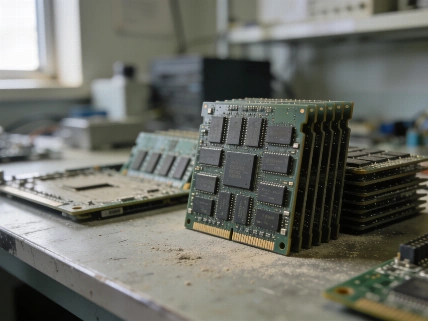
One of the main risks facing Nvidia is rising memory costs. DRAM now accounts for 40% to 50% of total production costs, up from 15% to 20% historically. As Nvidia moves to more memory-intensive architectures, some investors worry that these higher costs could erode the company's gross margins. Arya's analysis suggests that for Vera Rubin compute racks, the increase in memory costs would reduce gross margins by about 60 basis points compared to the previous Blackwell Ultra generation. He expects gross margins to settle at 73% to 74% over time, down slightly from the current 75%-a modest decline that does not fundamentally threaten Nvidia's investment case.
At the system level, complete AI pods that bundle more memory and storage could see up to 500 basis points of margin impact. However, Arya expects this product mix to remain small initially. Nvidia's long-term supply agreements with SK Hynix and its pricing power, supported by strong GPU rental rates, give the company flexibility to pass on higher costs rather than absorb them.
Capital Commitments
Nvidia has committed about $70 billion in direct equity stakes to ecosystem partners, including $30 billion to OpenAI, up to $10 billion to Anthropic, and $5 billion to Safe Superintelligence. Some investors have questioned whether these investments amount to circular financing-essentially funding the customers who buy Nvidia's chips. Arya addresses this by noting that Nvidia is expected to generate roughly $470 billion in free cash flow across 2026 and 2027, making the $70 billion commitment about 15% of projected cash flow. This leaves room for Nvidia to continue returning about half of its free cash flow to shareholders while supporting its ecosystem.
One high-profile commitment is a $250 billion backstop tied to an OpenAI and SB Energy campus in Ohio. This is not upfront cash, but a contingent guarantee that would only be triggered if OpenAI defaults on its lease, with exposure back-loaded to 2028 and beyond. By then, Nvidia is projected to be generating $300 billion to $500 billion per year in free cash flow, making the risk more manageable than the headline figure suggests.
Valuation and Risks
At 16 times forward earnings, Nvidia is trading at its lowest valuation in about a decade. Bank of America's projections put Nvidia's earnings per share at more than $13 by 2027 and over $25 by 2030, assuming the company maintains a dominant share of a data center AI market that could exceed $1.7 trillion. But risks remain. AMD is gaining ground in AI accelerators, major cloud providers are developing custom chips, and U.S. export restrictions to China continue to cast uncertainty over future growth. Capital spending by hyperscale cloud companies could also become more volatile if AI infrastructure returns disappoint.
For investors seeking to diversify away from concentrated tech holdings, some have looked to alternative ETF strategies. For example, Vanguard's small-cap and international ETFs may offer broader exposure and help reduce concentration risk, as discussed in this analysis of S&P 500 concentration risk.
Ultimately, Bank of America's bullish case for Nvidia rests on the success of the Vera Rubin cycle and the company's ability to manage margin pressures and capital commitments. Whether the upcoming earnings report confirms these expectations or not, the longer-term question is whether Nvidia can deliver on its ambitious roadmap in a rapidly evolving AI landscape.
According to Nvidia's most recent quarterly filing, the company's data center revenue reached $75.2 billion in Q1 2027, representing a year-over-year increase of 85%. The company's overall revenue for the quarter was $81.6 billion, with gross margins reported at approximately 75%. These figures highlight the scale of Nvidia's growth and the importance of its data center business to its overall financial performance.
Understanding gross margin is crucial for investors evaluating technology companies like Nvidia. Gross margin measures the percentage of revenue that remains after accounting for the direct costs of producing goods or services. For hardware companies, this includes the cost of components such as memory and processors. A high gross margin can signal pricing power and operational efficiency, but it can also be vulnerable to shifts in input costs or competitive pricing. As companies like Nvidia invest in new product cycles and expand into adjacent markets, maintaining healthy margins becomes a balancing act between innovation, supply chain management, and market demand.