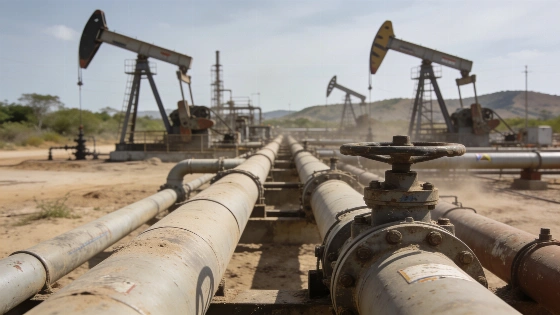
Chevron is committing $7 billion to Venezuela's Orinoco Belt, targeting a production surge and ultra-low costs as U.S. shale growth slows and global supply risks intensify. The move signals a strategic pivot with high rewards-and high geopolitical risk.
Chevron's $7 billion investment in Venezuela's Orinoco Belt marks a pivotal shift in the global oil landscape, as the U.S. energy giant aims to double output and secure barrels at sub-$20 production costs. With U.S. shale growth slowing and international supply chains under pressure, Chevron's expansion in the world's largest proven crude reserve represents a calculated bet on resource depth and cost discipline amid rising geopolitical uncertainty.
Chevron remains the only major U.S. oil company with an active presence in Venezuela, making its expansion especially significant for global supply chains and the geopolitical balance of energy markets.
Macro and Regulatory Catalysts
Chevron's expansion is enabled by a rare alignment of interests: Venezuela's urgent need for capital and technology has led to improved fiscal terms for foreign partners, while the U.S. Department of Energy and Secretary Wright have quietly signaled approval for Chevron's deeper involvement. The company's new rights to develop the Carabobo 1 and Carabobo 2 South A blocks, along with the Petropiar project's Ayacucho 8 expansion, are part of a broader strategy to secure long-term, low-cost production. According to Reuters, these assets are central to Chevron's five-year, $7 billion capital commitment, with the explicit goal of doubling output by 2028. The company is also on track to recover legacy debts from Venezuela, with full repayment expected by early 2027-a factor that could further enhance project economics once the new fiscal regime is fully implemented.
Balance Sheet Data and Hard Evidence
In late August 2026, Reuters reported that Chevron is working to migrate all its Venezuelan joint ventures into the country's new energy framework, a move designed to give the company greater operational control and streamline future field expansions. This transition is part of a broader package of final agreements involving several international firms in Venezuela.
Consumer and Investor Impact
For shareholders, Chevron's Venezuela strategy is a direct play for future free cash flow. Once legacy debts are cleared and the new fiscal terms take effect, the joint ventures are positioned to generate substantial cash even if oil prices soften. The willingness to commit billions in a politically volatile country underscores Chevron's confidence in both the resource and the evolving regulatory environment. However, Venezuela's instability and the potential for abrupt U.S. policy shifts remain significant risks. Investors have seen how quickly global policy changes can impact U.S. portfolios, as illustrated by the recent volatility in Micron's stock following Samsung's buyback delay-reported earlier.
Chevron's international ambitions extend beyond Venezuela, with active exploration in Guyana and the Eastern Mediterranean. Yet Venezuela's Orinoco Belt stands out for its scale and cost advantage. The company's capital allocation discipline means only the most competitive projects advance, and Venezuela's improved terms have restored its appeal after years of stagnation.
Venezuela's Orinoco Belt holds immense reserves, but monetizing them has always required a blend of technology, capital, and political will. The region's ultra-heavy crude demands specialized upgrading and blending, and production costs can fluctuate with infrastructure and regulatory changes. For U.S. investors, the key takeaway is that resource size alone does not guarantee returns-execution, cost control, and geopolitical risk management are equally critical.
Chevron's $7 billion Venezuela commitment is a high-stakes test of whether legacy assets in unstable jurisdictions can outperform the next generation of U.S. shale or deepwater megaprojects. If Chevron can convert investment into barrels and barrels into cash while navigating political hazards, it will have set a new standard for American oil majors. But the risks are real: should the political or regulatory ground shift, the cost of entry could quickly eclipse the promise of cheap crude. For now, Chevron's bold move has redefined the competitive landscape, and its outcome will shape the calculus for U.S. energy investors for years to come.