
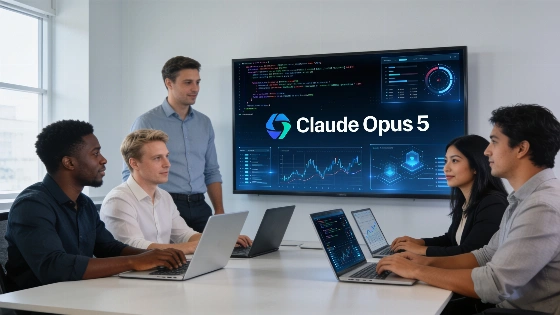
Claude Opus 5 debuts as the new default for Claude Max, offering advanced coding and knowledge work capabilities at half the price of Claude Fable 5, with improved safeguards and practical features for U.S. developers and businesses
Anthropic has released Claude Opus 5, a new artificial intelligence model positioned as the default for Claude Max and the most advanced option for Claude Pro users. The model is designed to deliver near-frontier intelligence for coding, research, and business automation tasks, while cutting costs compared to previous high-end offerings. At $5 per million input tokens and $25 per million output tokens-the same pricing as its predecessor, Opus 4.8-Opus 5 aims to make advanced AI more accessible for U.S. developers and companies seeking to optimize productivity and control expenses.
Opus 5's performance has been benchmarked against leading models on a range of technical and knowledge-based tasks. According to Anthropic, Opus 5 outperforms all competitors on software engineering benchmarks such as Frontier-Bench v0.1, more than doubling the task completion rate of Opus 4.8 at a lower cost per task. On CursorBench 3.2, Opus 5 achieves results within 0.5% of Claude Fable 5's peak score, but at half the cost. The model also leads on knowledge work and problem-solving evaluations, including ARC-AGI 3 and Zapier AutomationBench, where it demonstrates higher pass rates and efficiency at comparable or lower costs. In practical terms, this means businesses can automate more complex workflows and research tasks without a proportional increase in AI spending.
Technical Gains and Real-World Use
Opus 5 is engineered to verify its own outputs and iterate until it reaches a solution, a capability that has shown tangible benefits in early-access testing. For example, when tasked with reconstructing a machine part from a drawing without direct visual access, Opus 5 developed a computer vision pipeline to extract geometry from raw image data-an approach that competing models failed to replicate after multiple attempts. In another case, the model identified and fixed a subtle bug in an open-source package manager, addressing an edge case missed by the community's patch. These examples highlight Opus 5's ability to handle nuanced, multi-step technical challenges that often arise in software development and data analysis.
Scientific research applications have also seen measurable improvements. On internal life sciences benchmarks, Opus 5 outperformed Opus 4.8 across topics such as structural biology, organic chemistry, and bioinformatics. Notably, it scored 10.2 percentage points higher on organic chemistry tasks involving molecular structure inference and 7.7 points higher on protein function prediction. The model's enhanced visual output capabilities further expand its utility for research and engineering teams.
Cost Control and Customization
One of Opus 5's distinguishing features is its adjustable effort setting, which allows users to balance intelligence and cost by tuning the model's resource allocation. This flexibility is particularly relevant for organizations managing large-scale AI deployments, as it enables them to conserve tokens for routine tasks or maximize performance for complex projects. Opus 5 is also available in Fast mode, running at approximately 2.5 times the default speed for twice the base price-a trade-off that may appeal to users with time-sensitive workloads.
For U.S. businesses and developers, the ability to optimize AI spending is increasingly important as automation expands across industries. According to the Bureau of Labor Statistics, U.S. employment in computer and information technology occupations is projected to grow 15% from 2021 to 2031, much faster than the average for all occupations. As demand for technical talent rises, tools like Opus 5 that can automate coding, data analysis, and research tasks may help organizations bridge skill gaps and control labor costs.
Alignment, Safety, and Regulatory Considerations
Anthropic reports that Opus 5 is its most aligned and safety-focused model to date, with lower rates of deceptive behavior and reduced susceptibility to misuse compared to earlier versions. The model adheres more closely to Anthropic's internal guidelines, known as Claude's Constitution, and incorporates safeguards to prevent high-risk applications in cybersecurity and biology. While Opus 5 can identify vulnerabilities in source code, it blocks binary-based vulnerability scanning, penetration testing, and exploit generation. These restrictions are designed to allow beneficial use in security research while minimizing the risk of enabling malicious activity.
Opus 5 does not advance the state of the art in dual-use or offensive cybersecurity capabilities, remaining behind Anthropic's Mythos 5 model in these areas. The company has intentionally avoided training Opus 5 on cyber tasks, though general improvements in reasoning and problem-solving have led to some gains in vulnerability detection. For U.S. organizations subject to regulatory oversight, such as those in finance or healthcare, these built-in guardrails may help address compliance concerns related to AI deployment in sensitive environments.
Access and Practical Features
Claude Opus 5 is available immediately across all Anthropic platforms, including the Claude API. The model does not require data retention for general access, which may appeal to organizations with strict privacy or compliance requirements. Alongside the launch, Anthropic is introducing beta features such as mid-conversation tool changes and automatic API fallbacks, aimed at improving reliability and user experience for developers integrating AI into their workflows.
For those considering adoption, Anthropic provides a prompting guide to help users get the most out of Opus 5's capabilities. As AI models become more sophisticated and embedded in business operations, understanding how to tailor prompts and manage model settings will be increasingly important for maximizing return on investment and minimizing operational risks.
AI model pricing and performance are evolving rapidly, with providers competing to deliver more value at lower costs. For context, OpenAI's GPT-4 Turbo, a leading competitor, is priced at $10 per million input tokens and $30 per million output tokens as of early 2026, while Google's Gemini Ultra is offered at $8 per million input tokens and $28 per million output tokens. These figures highlight the competitive pressure to balance capability, safety, and affordability in the AI market.
As AI becomes more integrated into business and research, understanding the trade-offs between model performance, cost, and safety is critical. Advanced models like Claude Opus 5 offer new opportunities for automation and productivity, but their effectiveness depends on careful configuration and ongoing oversight. Organizations adopting these tools should evaluate not only headline performance metrics but also alignment safeguards, regulatory implications, and the practical realities of integrating AI into existing systems. The ability to fine-tune model effort and access robust safety features may become a key differentiator as the technology matures and regulatory scrutiny increases.