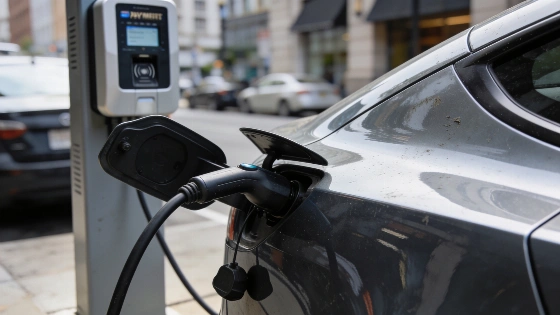
Major automakers and payment networks are building systems that let cars pay for charging, tolls, and parking automatically. The real risk is who gets stuck with the bill when something goes wrong
Imagine a scenario where your car pays for a charging session or parking spot without you ever reaching for your wallet or phone. This is no longer science fiction-it is becoming a reality, and the financial implications are about to affect U.S. drivers directly. The central issue is not whether the technology functions, but who bears responsibility when a car spends your money in unintended ways.
Mastercard's Agent Pay for Machines, launched in June 2026, is designed for extremely small and frequent transactions, even down to fractions of a cent, and is already being tested in real-world scenarios.
Mastercard and Visa are also advancing in this space. Mastercard introduced its Agent Pay for Machines platform in June 2026, targeting transactions executed at machine speed without human intervention. Launch materials indicate that 32 partners are actively validating key use cases for this network. Visa and the x402 Foundation are working on agent identity, a critical component that links every transaction to a verified owner and authorization. These initiatives are not distant pilot projects; they are operational or in the process of being deployed, as reported by TheStreet.
Technologically, the foundation is largely in place. Vehicles already communicate with networks for diagnostics, software updates, and navigation. Integrating payments into this data stream is a modest technical step, but it represents a significant shift in accountability. The core challenge is not whether a car can make payments, but whether it should-and who is accountable when it does.
Accountability on the Line
In July 2026, the Linux Foundation announced that 40 major organizations-including AWS, American Express, Cloudflare, Fiserv, Google, Mastercard, Shopify, Stripe, and Visa-joined a consortium to standardize agent-to-agent payments, reviving the HTTP 402 Payment Required protocol as a foundational layer.
Industry experts emphasize that a verifiable chain of authorization is essential. Each transaction must demonstrate, in real time, that the agent (the car or its software) is permitted to spend up to a defined limit, is acting on behalf of a verified individual or business, and that this party is not subject to sanctions. If any part of this chain fails, the transaction should not proceed. While forensic tools exist to investigate after the fact, the current focus is on preventing unauthorized transactions before they occur.
Concordium's Agent Registry, launched in May 2026, has already recorded more than 1,600 AI agents linked to verified owners. This indicates a transition from theoretical models to practical implementation. However, the true test will come as these systems are deployed at scale, beyond controlled pilots and into everyday use.
Policy Is the Real Bottleneck
Enabling a car to pay for charging or tolls may appear straightforward, but the complexity lies in the details. Does the car avoid the most expensive charging station? Does it adhere to time-of-day restrictions or network preferences? If the owner has not specified every rule, the car will make autonomous decisions, which may not reflect the owner's intentions.
This challenge is rooted in policy, not technology. Drafting rules that address every possible scenario is nearly impossible, especially as vehicles interact with an increasing number of networks and services. The risk is that a car, acting as an AI agent, could make a payment that is technically valid but practically undesired. Industry leaders maintain that users must have the ability to set and adjust their own policies, with manufacturers and regulators providing only essential defaults and standards.
Micropayments through agent-controlled wallets are already being tested in limited pilots, but scaling these systems requires policies that are effective in real-world conditions. The payment industry's focus has shifted from execution to trust, traceability, and enforceable responsibility. According to Mastercard Europe, the first AI agent-initiated payments in the Netherlands have progressed from demonstration to early practical testing, involving partners such as Worldline, ING, and Rabobank. Mastercard's official report confirms that these transactions are now being trialed in real-world environments.
Who Pays When the Car Gets It Wrong?
The financial risk is tangible. If a car makes a payment outside the owner's intent, the resulting cost must be absorbed by someone. Without a robust framework, the owner is the default party responsible. Industry specialists argue that liability should follow the chain of authorization and rest where control failed-whether with the owner, software provider, payment network, or merchant. Each party must define its role and liability before a transaction is approved, not after a dispute arises.
For U.S. consumers, the implications are clear: as vehicles become financial actors, the risk of unauthorized or mistaken payments increases. The primary means of protection is to demand transparency and control over vehicle spending policies. Without this, consumers may be held responsible for decisions they did not make.
The Federal Reserve's 2026 Consumer Payment Choice Survey reports that 82% of U.S. adults used digital wallets or contactless payments in the past year, up from 68% in 2024. As payment automation expands, the potential for unauthorized or disputed transactions grows, particularly when AI agents act on behalf of consumers without direct oversight.
Previous analysis of autonomous AI agents in finance, such as the Fidelity research, found that increased automation can shift value and risk in unpredictable ways. The key lesson for drivers is that convenience comes with a cost: unless accountability is embedded in every transaction, those most at risk may have the least ability to contest errors. The auto industry's move toward agentic payments assumes consumers will accept new risks for greater convenience. However, until rules are clarified and liability is shared, granting your car access to your wallet remains a significant risk, not merely a feature.
As vehicles become more connected and payments increasingly automated, distinguishing between a digital wallet and a blank check becomes critical. A digital wallet holds funds, but without strong authorization controls, it cannot prevent misuse or error. The future of machine-initiated payments will depend on real-time verification, enforceable policies, and clearly defined responsibility. Without these safeguards, the convenience of autonomous spending could quickly become a costly liability for consumers.