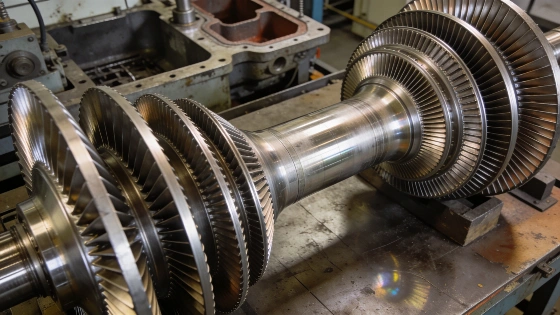
Elon Musk's SpaceX move to cast its own turbine blades erased billions from Howmet Aerospace's market cap in hours. Analysts and Jim Cramer now see a rare buying window, but warn that Howmet's lofty valuation leaves investors exposed to sharp reversals.
A sudden $4.2 billion drop in Howmet Aerospace's market value unsettled investors after Elon Musk revealed that SpaceX would manufacture its own turbine blades for a major AI data center project. The stock's 8% decline highlighted the market's sensitivity to competitive threats in the industrial gas turbine sector, where Howmet has long held a leading position. As panic selling swept the ticker, Wall Street analysts and Jim Cramer argued that the selloff was disconnected from Howmet's underlying fundamentals-and could present a rare entry point for those able to tolerate volatility.
On August 31, 2026, Howmet Aerospace shares fell as much as 7.7% intraday and closed down about 7.5%, marking their steepest slide in roughly 16 months.
Major banks quickly responded to the market's reaction. Bernstein's Douglas Harned and Citi's John Godyn reaffirmed their positive outlooks, raising price targets to $328 and $329, respectively. Their reasoning: casting advanced turbine blades requires decades of proprietary expertise and capital, and Howmet still controls over 50% of the global market with contracts secured through 2030. The analysts described the selloff as a temporary dislocation, not evidence of structural decline.
Howmet's stock, which traded near $265 before the news, rebounded to $256 but remains well below Wall Street's $340 consensus target. The company's price-to-earnings ratio is around 55-more than double the S&P 500 Industrials average of 23.7 as of June 2026, according to the Federal Reserve-reflecting high growth expectations and little margin for disappointment. As Reuters noted, the selloff was driven by SpaceX's announcement rather than any negative development from Howmet itself.
AI Power Demand Fuels Howmet's Core Business
After the SpaceX announcement, Howmet's stock closed at around $245.75, about 20.7% below its recent 52-week high of $310 reached on August 6, 2026. Notably, the selloff occurred without any new negative announcement from Howmet itself, suggesting the move was driven mainly by the SpaceX news and broader valuation concerns rather than a fundamentals shock.
With supply tight and demand rising, Howmet has raised prices without losing orders. The company is increasing capacity with six new projects expected to boost blade output by up to 38% from early 2025 levels. Competitors such as GE Vernova and Siemens Energy are also working to expand casting capacity, underscoring the acute industry shortage.
Howmet's reach extends beyond turbines. Its critical jet engine components benefit from steady demand for replacement parts and defense upgrades, even as aircraft manufacturers like Boeing face production delays. This dual exposure provides Howmet with two distinct growth drivers-an uncommon advantage in the sector.
Valuation Risks and Cramer's Playbook
Jim Cramer's "Mad Money" endorsement has attracted retail interest, but Howmet's premium valuation means the stock is priced for perfection. Any negative surprise-real or perceived-can trigger sharp moves, as the SpaceX episode demonstrated. For risk-averse investors, dollar-cost averaging (buying fixed amounts at regular intervals) can help manage volatility.
Analyst consensus remains strong: 12 of 14 analysts rate Howmet a Buy, according to TheStreet. Still, the company's elevated price tag requires conviction in both its growth prospects and its ability to withstand sudden shocks. As reported by Investing.com, Musk's move to bring blade casting in-house could accelerate turbine deployment by up to 18 months, but the technical and capital barriers remain significant.
Howmet's fundamentals are solid: contracts extend well into the next decade, and AI-driven power demand shows no sign of slowing. Yet with a P/E ratio more than twice the sector average, the stock offers little cushion against disappointment. Specialized manufacturing for gas turbines is capital-intensive, with high barriers to entry and rigorous certification requirements. While new entrants can disrupt some industries, rapid displacement in aerospace and power generation is unlikely. For investors, the recent selloff highlights both the durability of Howmet's competitive position and the risks of paying a premium for growth in a volatile sector. Those who believe in the long-term AI and aerospace infrastructure story may find the current dip attractive, but should be prepared for sharp swings and consider phased entry strategies to manage risk.