IBM's worst single-day loss in decades erased $68 billion in value and triggered a sharp rotation out of software stocks and into AI hardware makers like Micron, exposing new risks for investors betting on the software side of the AI boom
IBM spent years positioning itself as a key player in artificial intelligence, but on July 14, the market delivered a harsh verdict. IBM shares closed at $217.07, down 25.21% in a single session after the company warned that its second-quarter results would fall short of expectations. The drop wiped out roughly $68 billion in market value, marking IBM's steepest one-day decline since 1968-worse even than its losses on Black Monday in 1987.
The catalyst was a preliminary earnings update that revealed IBM's revenue for the quarter would be $17.2 billion, below the $17.86 billion analysts had forecast. Adjusted earnings per share came in at $2.93, missing the $3.01 consensus. While the shortfall was modest, the underlying reason was more troubling: IBM's customers shifted their technology budgets toward hardware-specifically servers, storage, and memory-at the expense of software and consulting contracts. This sudden reprioritization left IBM with large deals that failed to close on schedule, according to reporting by TheStreet.
Hardware Takes Priority
For chief information officers, the spike in hardware prices meant that limited budgets had to be reallocated. Many companies accelerated purchases of servers and memory to secure supply before further price increases, pushing software renewals and consulting projects into future quarters or canceling them altogether. Despite this, IBM's software segment still managed 5% growth, with Red Hat up 11%. Consulting revenue was flat, while infrastructure sales fell 7%.
The market's reaction was swift and broad. Investors didn't see IBM's warning as an isolated event. Instead, they anticipated similar pressures across the software sector. Microsoft fell 1.55%, Oracle dropped 2.74%, and Accenture lost 2.86% on the same day. Salesforce slid about 4% in early trading before recovering. Meanwhile, hardware-focused companies like Micron Technology and SanDisk saw their shares rise, with Micron up nearly 5% and SanDisk gaining almost 6%.
Micron's Moment
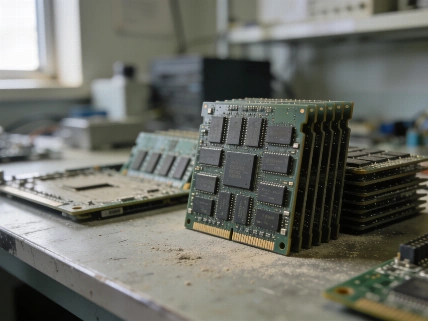
Micron Technology, which produces high-bandwidth memory (HBM) essential for AI servers, was a clear beneficiary. As IBM's customers scrambled to secure memory, Micron's order book filled up. The company's HBM is a stacked version of DRAM that sits next to AI processors, feeding them data at high speeds. With Samsung, SK Hynix, and Micron controlling over 95% of global DRAM production, supply is tight and pricing power is strong. Micron's memory capacity is reportedly sold out well into 2027, and the company has secured about $100 billion in long-term customer agreements.
On July 14, Micron shares traded around $980.55, up 4.7% from the prior close. KeyBanc analysts raised their price target to $1,750, reflecting expectations that the memory shortage will persist. Fiscal third-quarter revenue for Micron reached $41.46 billion, up 346% year over year, with gross margin at a record 84.9%.
Risks and Rotation
The sudden shift in spending from software to hardware highlights the zero-sum nature of many corporate technology budgets. As hardware prices rise and supply remains constrained, companies are forced to delay or cancel software investments. This dynamic is good for memory makers like Micron as long as the shortage lasts, but history shows that such cycles can reverse quickly when new manufacturing capacity comes online or demand slows.
There are also legal risks. A class action lawsuit filed in June accuses Micron, Samsung, and SK Hynix of restricting supply to inflate prices by as much as 700% since 2022. Meanwhile, some investors remain skeptical that the current cycle will last. Notably, Michael Burry shorted Micron at $1,051.87 on July 1, citing the stock's history of sharp drawdowns.
What to Watch Next
IBM's full quarterly results and conference call on July 22 will be a key test for both software and hardware investors. For IBM shareholders, the main question is whether delayed deals will eventually close or have been lost for good. For Micron holders, continued delays in software spending could signal that the hardware boom has further to run. Position sizing and risk management are critical, as even blue-chip stocks can see dramatic repricing in a single day.
For those tracking broader market trends, the rapid rotation from software to hardware in the AI sector echoes the kind of sector shifts seen in other high-growth industries. As highlighted in recent analysis of S&P 500 correction risks, sudden changes in investor sentiment can have outsized effects on both individual stocks and entire sectors.
Micron's continued strength depends on four key factors: supply staying tight, contract prices holding, AI capital spending remaining robust, and legal challenges not disrupting the market. If any of these change, the current advantage could quickly erode.
IBM's $68 billion loss is a reminder that even the most established companies are vulnerable when market priorities shift. For investors, understanding where the money is flowing-and why-remains essential in navigating the evolving AI landscape.
Micron's dominance in high-bandwidth memory illustrates how supply constraints can drive both pricing power and investor enthusiasm, but also how quickly fortunes can change when new capacity arrives or demand shifts. For those considering exposure to the AI hardware supply chain, it's crucial to monitor not just current shortages but also the pace of new factory construction, the durability of customer contracts, and the potential for regulatory intervention. As with any cyclical industry, timing and risk management are as important as the underlying technology.