
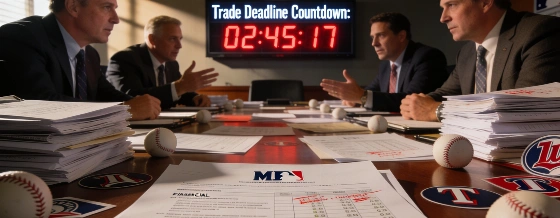
With the 2026 MLB trade deadline approaching, teams face tough choices on blockbuster deals involving stars like Tarik Skubal and Francisco Lindor, as front offices weigh immediate playoff impact against long-term financial and roster risks
As the 2026 MLB trade deadline nears, front offices across the league are under pressure to make moves that could define their seasons and reshape their financial outlooks. According to ESPN, several high-profile players-including Tarik Skubal, Mason Miller, and Francisco Lindor-are at the center of trade speculation, with teams weighing the cost of acquiring elite talent against the risk of depleting their farm systems or taking on significant salary commitments.
For the Milwaukee Brewers, the opportunity to end a decades-long World Series drought has prompted consideration of aggressive trades. One scenario involves sending a package of prospects-Logan Henderson, Josh Adamczewski, and Ricki Moneys-to the Detroit Tigers in exchange for Skubal, a move that would bolster Milwaukee's rotation alongside ace Jacob Misiorowski. While such a deal would require parting with valuable young talent, the Brewers' organizational depth makes it feasible, though it carries the risk of weakening future rosters if prospects develop elsewhere.
Other teams with smaller payrolls, like the Tampa Bay Rays, are also exploring ways to land impact arms. The Rays could offer a combination of Caden Bodine, Cooper Flemming, and Michael Forret to Detroit for Skubal, leveraging their farm system to compete in a tight American League race. These proposals highlight the financial calculus teams face: balancing the immediate benefit of a playoff push against the long-term cost of losing affordable, controllable players.
Relief Market Dynamics
The San Diego Padres, meanwhile, are positioned to move Mason Miller, one of baseball's most dominant relievers. The Brewers again emerge as a potential buyer, with a package centered on Josh Adamczewski, Braylon Payne, Bishop Letson, and Sal Frelick. Notably, this deal would allow Milwaukee to acquire Miller without surrendering any of their top five prospects, according to ESPN's prospect rankings. For the Padres, the return would help replenish a system depleted by previous trades, but the risk is that Miller's value could rise further if he continues to perform at an elite level.
The Chicago White Sox are also in the mix for Miller, with a possible deal involving infield prospects Billy Carlson or Caleb Bonemer. For Chicago, adding a high-leverage reliever under club control for multiple seasons could stabilize the bullpen and support a playoff run, but it would require giving up organizational depth at a time when the team is also seeking rotation help.
Star Batters and Rotation Needs
In a rare scenario, the New York Mets could send Francisco Lindor to the New York Yankees, addressing the Yankees' need for a shortstop and another impact bat as Aaron Judge recovers from injury. The financial implications are significant: Lindor's contract carries five years and $160 million after this season, and the Mets' willingness to absorb salary will determine the caliber of prospects they receive in return. The Yankees are unlikely to part with top prospect George Lombard Jr., but could offer Dax Kilby, a recent high draft pick, as part of a deal. For the Mets, moving Lindor would free up payroll and potentially reset the roster dynamic, but it would also mean parting with a marquee player in the midst of a challenging season.
Other teams are targeting starting pitching to shore up their rotations. The Chicago White Sox, for example, could pursue Brady Singer from the Cincinnati Reds, a move that would add a cost-controlled arm without the financial burden of pricier options like Robbie Ray. The White Sox are also linked to Clay Holmes of the Mets, who could fill multiple roles and bring playoff experience, though the cost would likely be a promising arm such as David Sandlin.
Financial Stakes and Market Context
Major League Baseball's competitive balance tax (CBT) threshold for 2026 is set at $241 million, according to the latest collective bargaining agreement. Teams exceeding this threshold face escalating tax rates, which can influence trade decisions, especially for clubs like the Yankees and Mets with high payrolls. In 2025, the average MLB team payroll was approximately $162 million, with the top five teams all exceeding $220 million. These figures underscore the financial pressure on front offices to manage both short-term competitiveness and long-term fiscal health as the deadline approaches.
Trade deadline activity often reflects broader market dynamics, as teams must weigh the cost of acquiring established stars against the value of retaining prospects and maintaining payroll flexibility. The risk of overcommitting to a single season is real, particularly for franchises that have not recently reached the postseason. This tension is not unique to baseball; similar strategic dilemmas have been observed in other industries, such as when Apple delayed the release of its entry-level iPhone 18, forcing consumers to consider higher-priced models and reshaping the company's revenue strategy during a critical sales window. For more on how major product decisions can impact financial outcomes, see this analysis of Apple's iPhone launch strategy.
As the trade deadline approaches, teams must navigate a complex landscape of player valuations, contract obligations, and competitive pressures. The decisions made in the coming days will not only affect playoff races but could also have lasting consequences for payroll structure, farm system depth, and long-term financial sustainability.
Trading for high-profile players at the deadline involves more than just talent evaluation. Teams must consider the impact of large contracts on future payrolls, the risk of prospects flourishing elsewhere, and the potential for injuries or underperformance to derail short-term plans. The competitive balance tax acts as a soft salary cap, incentivizing some clubs to avoid costly deals while others are willing to pay a premium for a shot at a championship. Ultimately, the most successful front offices are those that can balance immediate needs with a disciplined approach to long-term roster and financial management.