Nordson's 15 percent dividend boost extends a rare 63-year streak but arrives as shares hover just below all-time highs and sector risks mount for industrial machinery investors
Nordson Corporation's decision to raise its quarterly dividend by 15 percent comes as its stock trades just below its all-time high, prompting investors to weigh the significance of a historic payout streak against a market that has already priced in much of the company's optimism. The new dividend, set at $0.94 per share for the October 2, 2026 payment, marks the 63rd consecutive annual increase-an achievement that is nearly unmatched in the industrial machinery sector. However, with shares closing at $308.31 on September 14, 2026, still 9 percent below the August high of $339.12, the increase serves both to reinforce confidence and to reward long-term shareholders.
The annualized dividend now totals $3.76 per share, providing a tangible cash return at a time when the stock's one-year total return has reached 40.93 percent, according to Simply Wall St. While this performance outpaces the S&P 500, it also places Nordson's valuation under closer scrutiny. A discounted cash flow analysis estimates fair value at $319.13 per share, only slightly above the recent closing price, indicating that expectations for future growth are largely reflected in the current valuation. With a market capitalization of $17.2 billion and annual revenue of $2.98 billion, Nordson stands among the leaders in specialty industrial machinery, but the margin for error is narrowing.
Nordson's dividend increase was confirmed with a record date of September 10, 2026, and an ex-dividend date that saw shares trade lower by about 0.9 percent in the following session.
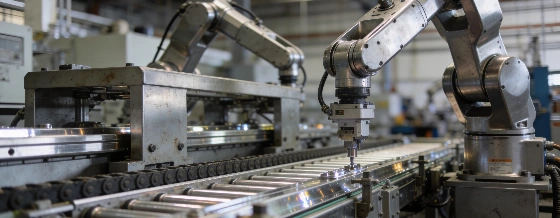
Sector headwinds are tangible. Demand in polymer processing and automotive lines has softened, and the integration of recent acquisitions remains an ongoing risk. Should these segments weaken further or integration challenges arise, Nordson's growth narrative could be undermined despite its strong dividend record. The company's involvement in automation and robotics is reflected in its 1.67 percent weighting in Charles Schwab's ROBO Global Robotics and Automation ETF, with approximately 107,200 shares held as of September 2026. This ETF exposure highlights Nordson's relevance in industrial automation, but also links its performance to cyclical capital spending trends that can shift rapidly.
On September 14, Nordson shares declined by 1.96 percent, underperforming both the S&P 500 and several sector peers. The stock remains in the upper part of its 52-week range, but the modest discount to its high does not provide a cushion if sector risks materialize. Investors recalling the rapid gains of companies like Marvell-whose data center surge was reported earlier-may question whether Nordson's steady approach can deliver comparable upside, or if the strongest returns are already past.
For current and prospective Nordson investors, the decision is clear: a 63-year dividend growth streak is exceptional, but it does not insulate against sector slowdowns or integration risks. The current payout is generous by industry standards, and the company's automation focus supports a long-term narrative. However, with the stock trading near fair value and recent returns already strong, new buyers face a familiar dilemma-pay a premium for stability, or wait for a more attractive entry point if the cycle turns. Nordson's management has a long record of delivery, but the coming period will test whether tradition alone can support today's valuation.
Nordson's dividend growth streak began in 1964, making this the 63rd consecutive year of increases-a record highlighted in recent financial press releases and market analyses.
As of September 2026, the S&P 500 index has posted a year-to-date gain of roughly 14 percent, while the industrials sector has delivered more muted returns. Dividend-paying stocks have drawn renewed interest as interest rates remain elevated, but investors are increasingly selective, favoring companies with both payout growth and resilient end markets. Nordson's performance and valuation must be considered in this context, where sector rotation and macroeconomic changes can quickly alter the risk-reward equation.
Dividend growth stocks like Nordson are valued for their ability to provide rising income streams through economic cycles. However, the sustainability of such streaks depends on operational execution and the health of the underlying industries. Investors should look beyond headline payout increases to determine whether earnings, cash flow, and market positioning can support continued growth-especially when valuations leave little room for disappointment.