Riot Platforms is leveraging its massive Texas power infrastructure to secure a $9.1 billion, 20-year AI data center contract with Anthropic, signaling a major business model shift and raising new questions for investors about future revenue stability
Riot Platforms, long known for its focus on Bitcoin mining, is making a dramatic pivot as artificial intelligence reshapes the value of its core assets. The company has signed a 20-year agreement with Anthropic, the AI firm behind Claude, to provide 191 megawatts of data center capacity at its Rockdale, Texas facility. The deal, valued at $9.1 billion over two decades, could reach $16.1 billion if two five-year extensions are exercised, according to Barron's. While Riot will not receive the full amount upfront, the contract represents a significant shift from the unpredictable revenue streams of cryptocurrency mining to the more stable, long-term cash flows associated with data center operations.
Riot's market capitalization stood at roughly $7.3 billion before the announcement, based on Business Insider data, meaning the headline value of the Anthropic deal exceeds the company's pre-deal equity value. In 2025, Riot reported $647.4 million in total revenue, highlighting the scale of the new contract relative to its existing business. Shares of Riot rose following the news, as investors reassessed the company's infrastructure and its potential to serve the rapidly growing AI sector.
AI Demand Transforms Bitcoin Mining Assets
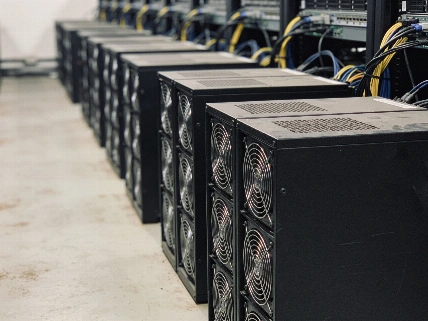
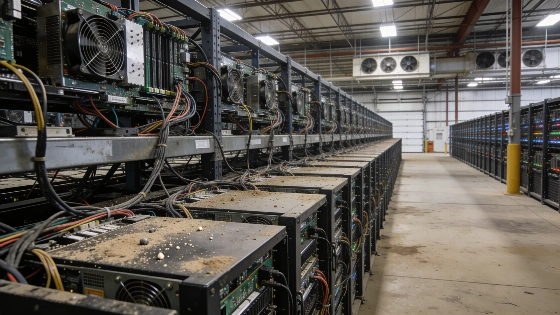
The core of Riot's appeal to Anthropic lies in its access to large-scale, reliable power. Bitcoin mining operations require vast amounts of electricity, leading Riot to develop facilities with significant power capacity-about 700 megawatts at Rockdale and another gigawatt at its Corsicana, Texas site. These assets, once built to support crypto mining, are now in high demand from AI companies that need both land and power to run advanced computing hardware. Riot claims nearly 2 gigawatts of fully certified power in its portfolio, positioning it as a key player in the emerging market for AI infrastructure.
Unlike the volatile economics of Bitcoin mining, where revenue depends on token prices, mining difficulty, and energy costs, long-term data center contracts can provide more predictable income. Yet, the transition is not as simple as repurposing old mining rigs. High-performance AI data centers require advanced cooling, networking, redundancy, and strict uptime standards. Riot will need to invest heavily and execute efficiently to meet Anthropic's requirements and turn its power assets into commercially viable computing capacity.
Proof of Concept and Scaling Up
Anthropic is not Riot's first major AI customer. The company previously secured a contract with Advanced Micro Devices (AMD) for 25 megawatts of IT capacity at Rockdale, later expanded to 50 megawatts. Riot reported $33.2 million in data center revenue in the first quarter, reflecting its growing presence as a data center operator. According to Barron's, AMD's successful experience with Riot helped facilitate the Anthropic deal, providing a proof of concept before scaling up to a much larger commitment.
The contrast with Riot's previous business model is stark. While the Anthropic contract's headline value is about 14 times Riot's 2025 annual revenue, the company will recognize this revenue gradually over the contract's life. The deal does not instantly transform Riot into a $16 billion revenue company, but it does force investors to reconsider how to value its infrastructure and future earnings potential.
Power as a Scarce Asset in the AI Era
Riot's evolution reflects a broader trend among former crypto miners, who have spent years securing cheap electricity and building facilities capable of supporting energy-intensive operations. As AI companies race to secure power and grid access, existing infrastructure like Riot's becomes increasingly valuable. Riot's "power-first" development strategy-building around major power installations rather than hoping for future grid access-has now been validated by a major AI player willing to commit billions over decades.
For investors, the key numbers are striking: $9.1 billion in estimated contract value over 20 years, 191 megawatts of capacity for Anthropic, and a potential $16.1 billion if extensions are exercised. Riot's Rockdale campus offers 700 megawatts of developed capacity, and its total approved power portfolio approaches 2 gigawatts. AMD's 50-megawatt contract and Riot's $647.4 million in 2025 revenue provide additional context for the company's scale and growth trajectory.
Yet, significant execution risk remains. Riot must deliver on its promises to Anthropic, manage construction costs, and maintain high reliability standards. If the economics of converting power into AI computing capacity do not hold up, the long-term value of these contracts could be at risk. The Anthropic deal is a test case for whether power-rich infrastructure can reliably support the next wave of AI growth.
Riot's shift mirrors a broader revaluation of digital infrastructure as AI demand surges. As other companies reposition their assets to serve AI workloads, the market is beginning to price power access and data center capacity as strategic assets in their own right, not just as tools for mining or cloud computing.
For years, Riot's value was tied to how much Bitcoin it could mine. Now, the question is shifting: how much is access to power-and the ability to convert it into AI-ready infrastructure-worth in a world where electricity is the new bottleneck?
Data from Riot's 2025 annual report shows the company generated $647.4 million in revenue, with a significant portion still coming from Bitcoin mining. The new Anthropic contract, if fully realized, would dwarf previous revenue streams and could reshape Riot's financial profile for years to come.
As AI continues to drive demand for power and computing resources, companies with existing infrastructure and grid access may find themselves in a stronger negotiating position. The ability to secure long-term contracts with major AI firms could provide more stable revenue and reduce exposure to the volatility of crypto markets. However, the capital requirements and operational challenges of running high-performance data centers remain substantial, and not every former crypto miner will be able to make the leap successfully.