SpaceX is preparing to enter the U.S. wireless market with a hybrid network that could reach areas long ignored by Verizon, AT&T, and T-Mobile, raising new questions about competition, pricing, and the future of rural connectivity
For decades, millions of Americans have lost cell service the moment they leave city limits. Despite billions spent on towers, Verizon, AT&T, and T-Mobile have never fully closed the coverage gap in rural and remote areas. Now, SpaceX is preparing to challenge the status quo with a new plan to combine its Starlink satellite network and ground-based small cells, aiming to reach customers where traditional carriers fall short, according to reporting by TheStreet.
Hybrid Network Ambitions
SpaceX, now a public company, outlined its strategy during its first earnings call. The company intends to build a hybrid wireless network that leverages Starlink satellites and small cellular base stations mounted on existing Starlink broadband hardware. Unlike traditional cell towers, these small cells could be deployed rapidly and at lower cost, especially in areas where building towers is impractical or uneconomical.
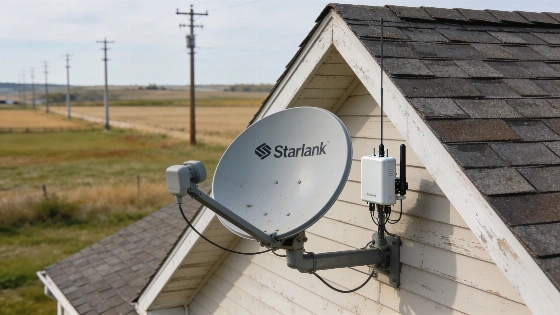
Starlink dishes are already installed on homes and businesses across the U.S., providing a ready-made platform for these new small cells. The satellite layer, meanwhile, allows for direct-to-device connectivity in places with no terrestrial signal. SpaceX plans to launch next-generation Starlink Mobile V2 satellites in 2027, which are expected to offer much greater capacity than current models.
SpaceX President Gwynne Shotwell has stated that the upgraded service could be "100 times better" than the current direct-to-device offering once the new satellites and recently acquired EchoStar spectrum are operational. The company's goal is to compete directly with the Big Three carriers, starting in the regions where they have the weakest presence.
Coverage, Competition, and Consumer Impact
While Verizon, AT&T, and T-Mobile claim near-universal coverage on their maps, more than 500,000 square miles of the U.S. remain without any cell service, based on data from the Federal Communications Commission. Starlink Mobile's satellite component already reaches many of these dead zones, enabling basic messaging and data access where no tower signal exists.
SpaceX says its combined satellite and small cell network could eventually deliver coverage and bandwidth that rivals or exceeds what's available from established carriers. Yet, matching the speed, reliability, and capacity of dense urban networks remains a significant technical challenge. The Big Three have spent decades building out urban infrastructure to handle high traffic volumes, something SpaceX has yet to demonstrate at scale.
Pricing details for Starlink Mobile remain undisclosed. The major carriers compete aggressively on price, bundling family plans, device trade-ins, and promotional offers. SpaceX has not said how its service will be priced or whether it will offer similar incentives to attract customers.
Spectrum and Infrastructure Hurdles
SpaceX recently acquired 65 megahertz of wireless spectrum from EchoStar, a critical asset for its terrestrial ambitions. This is a substantial increase from the roughly 5 megahertz it currently operates through a partnership with T-Mobile. However, Verizon, AT&T, and T-Mobile each control far more spectrum, which directly affects network capacity and performance.
Building a nationwide wireless network also requires customer-facing infrastructure-billing systems, retail channels, customer support, and device compatibility. These are areas where SpaceX has little experience compared to the established carriers. The company's ability to scale up quickly will depend on how it addresses these operational gaps.
During the earnings call, Shotwell expressed confidence that SpaceX could win over a significant share of the $600 billion U.S. wireless market. She described a deployment model where small cellular base stations, or femtocells, are attached to Starlink dishes across the country, allowing for flexible and targeted expansion.
What to Watch in 2027
With Starlink dishes already on rooftops nationwide, SpaceX has a unique physical platform for deploying small cells. But to compete beyond rural and suburban areas, the company will need to secure additional spectrum and build out robust customer service and retail operations. The launch of the V2 satellites in 2027, the first consumer pricing announcement, and early subscriber numbers will be key milestones to watch.
Investors are closely monitoring SpaceX's capital spending and cash flow as it pursues this ambitious expansion. For context, Bank of America recently raised its target for SpaceX despite concerns about heavy investment and near-term financial risks, citing the company's AI-driven growth potential.
According to the FCC's most recent Mobile Deployment Report, as of 2025, approximately 97% of the U.S. population has access to 4G LTE coverage, but only about 83% of the country's land area is covered. This leaves millions of Americans-especially in rural and remote regions-without reliable wireless service, highlighting the persistent digital divide that SpaceX aims to address.
Wireless spectrum is a finite resource that determines how much data a network can handle and how fast it can deliver service. Carriers pay billions at FCC auctions to secure spectrum licenses, and the amount of spectrum held often dictates a provider's ability to offer high-speed, reliable coverage. For new entrants like SpaceX, acquiring enough spectrum to compete in urban markets is a major barrier. Even with advanced satellite technology, the economics of network buildout, customer acquisition, and ongoing support will shape whether SpaceX can become a true rival to the Big Three or remain a niche provider for underserved areas.