Frontier and four other low-cost carriers will equip over 1,000 planes with SpaceX's Starlink internet, but most passengers should expect to pay for in-flight Wi-Fi as the era of free connectivity fades
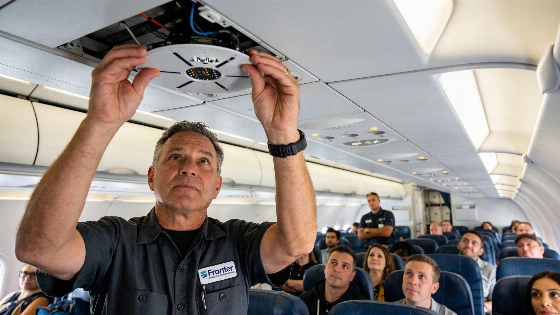
For years, flying on a budget airline often meant going offline for hours, with spotty or nonexistent Wi-Fi the norm. That's about to change for millions of travelers, as five low-cost carriers-Frontier Airlines, Wizz Air, Volaris, JetSmart, and Cebu Pacific-plan to install SpaceX's Starlink satellite internet across more than 1,000 aircraft starting in early 2027, according to CNBC and FlightGlobal. The move signals a major shift in how budget airlines approach in-flight connectivity, but it also marks the end of an era: most passengers will likely have to pay for access.
What sets this rollout apart is the coordinated approach. All five airlines are controlled by Indigo Partners, a private equity firm led by Bill Franke. Rather than negotiating individually, Indigo leveraged its collective buying power to secure a portfolio-wide deal with SpaceX, giving it more influence than any single carrier could wield alone. Frontier, for example, will equip its entire 183-plane Airbus fleet with Starlink, a spokesperson confirmed to FlightGlobal.
Indigo's Strategy and Market Impact
Indigo Partners' model is built on treating its airlines as a connected system, not just a collection of independent bets. By negotiating as a bloc, Indigo can extract better terms on everything from aircraft orders to technology upgrades. This approach is increasingly shaping the global budget airline sector, allowing smaller carriers to punch above their weight without merging. As more private equity firms build multi-airline portfolios, this kind of group procurement could become the norm.
For investors, the move highlights how Indigo's centralized strategy can drive operational changes across its holdings. Franke and other Indigo-linked investors remain among Frontier's largest shareholders, and the firm continues to control the airline's board. This structure helps explain why the five airlines acted in unison, rather than pursuing separate Wi-Fi deals.
Passengers Face New Costs as Free Wi-Fi Fades
While Starlink's arrival promises faster, more reliable internet in the air, the days of complimentary access appear to be over. Earlier Starlink airline deals emphasized free Wi-Fi for all passengers, but recent announcements-including Wizz Air's-make no mention of free service. According to PaxEx.Aero, this signals a shift in SpaceX's strategy, treating in-flight internet as a revenue-generating product rather than a loss leader. Frontier has not confirmed pricing, but most travelers should expect to pay for connectivity once the service launches.
This change could affect passenger expectations across the industry. As more airlines adopt Starlink, the competitive advantage of offering free Wi-Fi may diminish, and carriers could use pricing to segment customers or offset installation costs. For SpaceX, the pivot reflects a broader push to monetize its satellite network as it expands into commercial aviation.
Frontier's Broader Turnaround Effort
The Wi-Fi upgrade is part of a larger transformation at Frontier. The airline is also introducing its first true first-class cabin, aiming to pair premium features with its low base fares. New CEO Jimmy Dempsey has tied these moves to a strategy of attracting higher-spending customers while maintaining Frontier's ultra-low-cost model. Wall Street has taken notice: Susquehanna recently raised its price target on Frontier Group Holdings (ULCC) to $7 from $4.50, though it kept a neutral rating, according to Yahoo Finance. Shares closed near $6.48 on July 14, up from a 52-week low of $3.02, but the company remains unprofitable, posting a trailing 12-month net loss of about $137 million even as revenue has grown.
Frontier's approach echoes a broader trend among U.S. airlines to blend premium offerings with budget pricing. For example, Delta's focus on premium cabins and loyalty programs has helped it weather high fuel costs, as discussed in this analysis of Delta's evolving financial strategy. The competitive landscape is shifting as airlines seek new ways to differentiate and drive profitability.
What This Means for Travelers and Investors
For travelers, the main takeaway is that reliable in-flight Wi-Fi is becoming standard even on budget carriers-but free access is likely to be the exception, not the rule. For investors, the Indigo-Starlink deal illustrates how ownership structure and scale can shape operational decisions and financial outcomes. As the airline industry continues to consolidate purchasing power through private equity and alliances, similar group deals could reshape everything from technology adoption to fare structures.
According to data from the Bureau of Transportation Statistics, U.S. airlines carried over 850 million passengers in 2023, with low-cost carriers accounting for a growing share of domestic travel. As Wi-Fi becomes a baseline expectation, the ability to monetize connectivity could become a key lever for revenue growth, especially for airlines operating on thin margins.
Satellite internet technology like Starlink relies on a network of low-Earth orbit satellites to deliver high-speed, low-latency connectivity to aircraft in flight. Unlike traditional ground-based systems, these satellites can provide coverage over oceans and remote regions, making them attractive for airlines with international routes. However, installation adds weight and complexity to aircraft, and the economics depend on passenger uptake and willingness to pay. As more airlines adopt satellite Wi-Fi, the balance between cost, pricing, and customer experience will remain a central challenge for the industry.