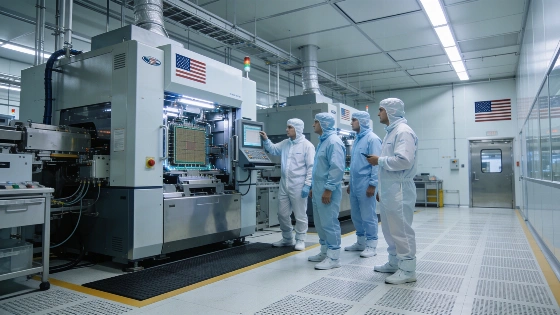
TSMC raised its 2026 revenue and spending forecasts amid surging AI chip demand, but investors punished the stock over concerns that higher capital expenditures could squeeze margins and delay returns
Investors hoping for another AI-fueled rally in semiconductor stocks got a reality check this week as Taiwan Semiconductor Manufacturing (TSMC) raised its 2026 outlook for both revenue and capital spending, only to see its shares fall sharply in premarket trading. The move came just a day after ASML Holding, TSMC's key supplier of advanced chipmaking equipment, also lifted its full-year sales guidance for the second time this year, reinforcing the sense that the AI infrastructure buildout is still accelerating. Yet the market's reaction to TSMC's results was notably more cautious, highlighting growing concerns about the cost of keeping up with runaway demand.
TSMC reported second-quarter revenue of $40.2 billion, a 33.7% increase from the same period last year, and earnings per American Depositary Receipt (ADR) surged 74% to $4.31, according to a report from Seeking Alpha. Both figures beat Wall Street expectations and marked the company's fifth consecutive record quarter, based on data from Benzinga. Despite these headline numbers, investors focused on the company's decision to raise its 2026 capital expenditure forecast to a range of $60 billion to $64 billion, up roughly 15% from its previous estimate. CFO Wendell Huang told analysts that TSMC's capital spending over the next three years will rise significantly compared to the prior three-year period, signaling a long-term commitment to expanding capacity.
The market's skepticism centers on the timing and payoff of these investments. While the AI boom has created unprecedented demand for advanced chips, the massive upfront costs of building new fabrication plants-especially overseas-could weigh on margins and delay the free cash flow that growth investors expect. This dynamic echoes the experience of other tech giants, such as Microsoft, whose shares have also come under pressure as heavy AI and cloud investments have squeezed near-term profitability. For more on how rising capital expenditures are affecting major tech stocks, see this analysis of Microsoft's recent price target cuts.
Industrywide Expansion
TSMC's increased spending plans mirror those of ASML, which raised its own full-year sales guidance to 43 billion to 45 billion euros, up from 36 billion to 40 billion euros, according to Bloomberg. Both companies are responding to the same surge in AI-driven demand for advanced chipmaking and packaging technologies. When the world's largest contract chipmaker and its most important equipment supplier both boost their outlooks in the same week, it signals that the entire semiconductor supply chain is bracing for sustained, capital-intensive growth.
But the risk for investors is that the benefits of this spending may take years to materialize. New fabrication plants, especially those built outside Taiwan, often face higher costs and longer ramp-up periods. TSMC's announcement of an additional $100 billion investment in Arizona, bringing its total U.S. commitment to $265 billion, underscores the scale of its bet on U.S.-based production. The new funds are earmarked for 2-nanometer and below manufacturing and advanced packaging-technologies critical to the next generation of AI chips. At the same time, TSMC's revenue from China fell to 6% of total sales in the second quarter, down from 9% a year earlier, reflecting a strategic shift toward U.S. customers and away from geopolitical risk.
Broader AI Demand
TSMC's management highlighted that the rise of agentic AI-AI systems capable of autonomous decision-making-is driving renewed demand for CPUs in data centers, not just the AI accelerators that have dominated headlines. This broadening of demand means TSMC's growth is no longer tied solely to Nvidia's GPU roadmap. According to Wedbush analysts, companies like Broadcom, AMD, MediaTek, and Marvell Technology could also benefit as demand for custom silicon and CPUs expands beyond a single vendor.
Despite the positive long-term outlook, the market is increasingly focused on the gap between TSMC's free cash flow and its capital expenditures. As spending rises to meet AI demand, investors are watching closely to see whether the company can generate value faster than it consumes cash. The risk is that, even as revenue and profit hit new highs, the returns to shareholders could be diluted if margins are squeezed by the cost of new capacity.
Key Numbers and Market Context
For the second quarter of 2026, TSMC's $40.2 billion in revenue and $4.31 in earnings per ADR both exceeded consensus estimates, according to Seeking Alpha. The company's new capital expenditure guidance of $60 billion to $64 billion for 2026 represents a roughly 15% increase from its previous range. ASML's updated full-year sales forecast of 43 billion to 45 billion euros also reflects the industry's aggressive response to AI-driven demand. TSMC's U.S. investment now totals $265 billion, with a focus on leading-edge manufacturing and packaging technologies.
TSMC's decision to shift more high-value production to the U.S. and reduce its exposure to China reflects a broader trend among global chipmakers seeking to diversify supply chains and reduce geopolitical risk. For U.S. tech giants like Nvidia and Apple, this shift could mean greater supply security and less vulnerability to disruptions in Asia. But for TSMC, the challenge will be to manage the higher costs and operational complexities of overseas expansion while maintaining profitability and shareholder returns.
As the AI buildout continues, investors will need to look beyond headline revenue growth and focus on the balance between capital spending and free cash flow. The semiconductor industry's ability to turn massive investments into sustainable profits will be a key test for both companies and shareholders in the years ahead.
Capital expenditures (capex) are a critical metric for evaluating companies in capital-intensive industries like semiconductors. While high capex can signal confidence in future demand and support long-term growth, it also ties up cash and can pressure margins if returns are delayed or costs overrun. Investors often track the ratio of free cash flow to capex to assess whether a company is generating enough cash from operations to fund its investments without eroding shareholder value. In periods of rapid technological change, such as the current AI boom, this balance becomes even more important as companies race to build capacity while managing financial risk.