Vertiv shares plunged after the company's Q2 revenue fell short of Wall Street targets, despite strong earnings and a raised outlook. Investors are weighing whether the setback is a short-term blip or a sign of deeper challenges
Vertiv, a key supplier of power and cooling systems for AI data centers, saw its stock tumble nearly 17% on July 29 after reporting second-quarter results that rattled investors. While the company's adjusted earnings per share of $1.52 exceeded analyst expectations, revenue came in at $3.27 billion-about 3% below the $3.38 billion consensus forecast. The shortfall, though modest in percentage terms, was enough to spark a sharp selloff in a stock that had been trading at roughly 40 times its updated full-year profit guidance.
Vertiv's management attributed the revenue miss to temporary supply-chain congestion and the complex, multi-phase rollout of large AI infrastructure projects. According to the company, some sales expected in the second quarter were pushed into the back half of the year as customers staged deployments. Despite the setback, Vertiv raised its full-year outlook, signaling confidence that demand remains robust and that the revenue will be recovered in upcoming quarters.
Market Reaction and Analyst Response
The market's reaction was swift, reflecting the high expectations built into Vertiv's valuation. For stocks priced for near-perfect execution, even a small miss can trigger outsized moves. Analysts largely maintained their positive ratings on Vertiv but trimmed price targets to reflect the near-term uncertainty. Evercore ISI, for example, lowered its target to $375 from $425 while keeping an Outperform rating, and other firms such as Citi, Baird, and Goldman Sachs also reduced their targets. The consensus among analysts is that the revenue miss is more about timing than a fundamental drop in demand, but the next quarter will be critical for confirming that view.
Vertiv's updated 2026 guidance now calls for net sales between $13.8 billion and $14.2 billion, up from a prior range of $13.5 billion to $14 billion. Adjusted earnings are projected at $6.65 to $6.75 per share, and free cash flow is expected to reach $2.4 billion to $2.6 billion. The company also guided third-quarter revenue to $3.65 billion to $3.85 billion, roughly in line with analyst estimates. Operating margin expanded to 22.6% in the latest quarter, and Vertiv ended the period with $5.6 billion in liquidity.
AI Infrastructure and Competitive Position
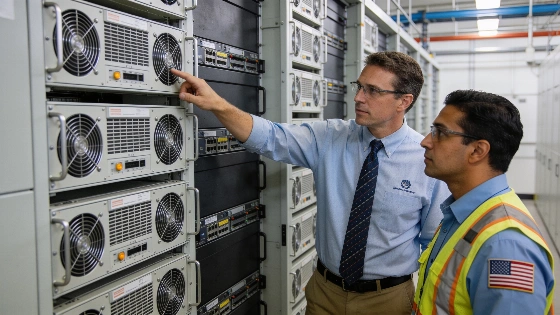
Vertiv's central role in the AI infrastructure buildout has made it one of the market's standout performers, with shares up about 42% in 2025 and another 27% in 2026 even after the recent drop, according to CNBC. The company's products are essential for keeping high-density AI data centers running efficiently, and Vertiv has continued to invest in capacity, including a new manufacturing facility in Johor, Malaysia, to serve the growing Asian market. Vertiv also collaborates closely with Nvidia to develop next-generation power and cooling solutions for advanced AI systems.
For investors, the key question is whether Vertiv's explanation for the revenue miss holds up in the coming quarters. If the company delivers on its raised guidance and third-quarter sales fall within the projected range, the recent selloff may prove to be an overreaction. But if revenue disappoints again, concerns could shift from timing issues to deeper challenges in executing large, complex AI projects-a risk for any stock trading at a premium valuation.
What to Watch Next
Vertiv's performance in the next quarter will be closely watched for signs that supply-chain bottlenecks and project delays are easing. Investors should monitor whether third-quarter revenue lands within the $3.65 billion to $3.85 billion range, whether the company's backlog continues to grow, and whether management's optimism about demand is reflected in actual sales. The stock, now trading near $234, offers a lower entry point for those who believe in the company's long-term prospects, but also carries the risk that execution challenges could persist.
Vertiv's experience is not unique among companies riding the AI wave. As seen with other high-profile names in the sector, such as Micron Technology, even strong demand can be overshadowed by questions about timing, supply chains, and the complexity of scaling up new technologies. For a deeper look at how investor sentiment can shift quickly in the AI space, see this analysis of hedge fund bets against Micron amid AI demand scrutiny.
For now, Vertiv's raised guidance and strong backlog suggest management remains confident, but the next earnings report will be a key test of whether the company can deliver on its promises and reassure investors that the long-term growth story is intact.
Vertiv's situation highlights the risks and rewards of investing in companies at the center of major technology shifts. Stocks tied to AI infrastructure can experience rapid gains when demand is strong, but they are also vulnerable to sharp corrections if execution falters or expectations get ahead of reality. Investors should weigh not just the growth potential, but also the operational complexity and timing risks that come with large-scale deployments in a fast-evolving sector.