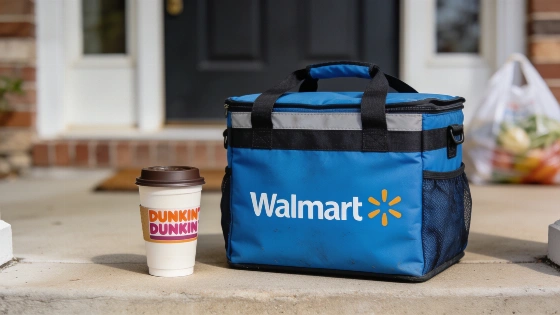
Walmart is integrating Dunkin orders into its delivery app, letting shoppers add coffee and donuts to their grocery haul. The move targets DoorDash and Uber Eats as Walmart expands its last-mile ambitions
Walmart is expanding beyond groceries and household essentials by adding Dunkin' coffee and donuts to its delivery app. This initiative is designed to encourage more shoppers to choose Walmart over food delivery competitors and to increase repeat usage across its broader retail offerings.
Walmart clarified that the Dunkin' delivery rollout is happening in phases, with no exact date for full national coverage, but the company aims to expand as quickly as possible.
This move builds on Walmart's earlier restaurant delivery efforts. In June 2026, the company began piloting Subway meal delivery in select markets. The positive response to that pilot accelerated the rollout to Dunkin', a brand with a significant national presence and a customer base that closely aligns with Walmart's own. Walmart is utilizing its existing last-mile delivery network-already in place for grocery orders-to deliver restaurant meals, relying on its own drivers and infrastructure rather than third-party platforms. As reported by CNBC, Dunkin' joins Subway as an initial partner in Walmart's new Restaurant Delivery service, underscoring the retailer's strategy to develop its own restaurant delivery platform instead of depending on external apps.
Competitive pressure
Walmart's entry into restaurant delivery directly challenges DoorDash and Uber Eats, both of which already deliver for Dunkin'. Walmart is leveraging its scale and logistics capabilities to offer a combined restaurant and retail order with a flat delivery fee, in contrast to the surge pricing that can frustrate customers on other platforms. With a store within 10 miles of 90% of the U.S. population and millions of app users, Walmart aims to make restaurant delivery a core component of its ecosystem.
According to Reuters, Dunkin' delivery will also be available from locations outside Walmart stores, but only for customers in eligible delivery zones where the address makes Dunkin' visible in the app. Walmart also offers a Dunkin' locator to help users find in-store cafes.
Financial mechanics
Walmart's delivery model is distinguished by its flat fee structure, which contrasts with the variable and sometimes unpredictable pricing of food delivery apps. By using its own drivers and logistics, Walmart maintains control over costs and consistency for customers. The ability to bundle restaurant orders with groceries or household goods may also increase average order values and operational efficiency.
According to TheStreet, Walmart positions itself as a rapidly growing player in restaurant delivery. Senior vice president Greg Cathey highlighted that expanding restaurant delivery beyond Walmart stores offers a value and convenience proposition that competitors find difficult to match. The company's strategy is to make the Walmart app the default destination for a wide range of purchases, from coffee to cleaning supplies.
DoorDash and Uber Eats have long dominated the U.S. food delivery market, but both rely on surge pricing and third-party drivers, which can result in higher costs and inconsistent service. Walmart's approach-using its own infrastructure-aims to deliver a more predictable experience and potentially undercut rivals on both price and reliability. The company frames this initiative as a direct expansion of its restaurant delivery ambitions and a competitive response to DoorDash and Uber Eats, offering the ability to combine food and regular purchases in a single order with a fixed delivery fee, as detailed in CNBC reporting.
Consumer impact
For households, the main benefits are convenience and potential cost savings. Shoppers can consolidate orders and avoid managing multiple apps and delivery fees, as well as the unpredictability of surge pricing. The integration also introduces Dunkin' fans to the Walmart app, potentially encouraging them to add other essentials to their orders.
Whether this strategy will significantly shift market share from DoorDash and Uber Eats remains uncertain, but Walmart's scale and logistics infrastructure provide a strong foundation for influencing consumer behavior. The company is betting that increasing the reasons for customers to use its app will lead to broader adoption for a variety of purchases.
Walmart's integration of restaurant delivery into its core business reflects a broader trend among major retailers to expand into adjacent services and capture a greater share of consumer spending. As previously reported, even companies outside traditional retail are rethinking distribution and partnership strategies to drive growth and loyalty.
Walmart's annual revenue is nearing $750 billion, and while coffee and donuts represent a small portion of that total, the greater value lies in deepening customer engagement and making the Walmart app indispensable. The company's willingness to compete directly with established delivery giants signals a new phase in the contest for U.S. consumer loyalty. If Walmart succeeds in delivering on its promises of speed, value, and convenience, it could prompt competitors to reconsider their own models and give shoppers a compelling reason to consolidate spending within a single digital platform.
Walmart Inc. (NYSE: WMT) reported global revenue of $648.1 billion for the fiscal year ended January 31, 2026, with U.S. e-commerce sales representing a growing share of total revenue. The company operates more than 4,600 stores in the United States and has invested significantly in last-mile delivery infrastructure, aiming to reach 90% of the U.S. population within a 10-mile radius of a store. DoorDash and Uber Eats remain the largest food delivery platforms in the U.S., but both face increasing costs and regulatory scrutiny related to driver classification and pricing practices.
Food delivery in the U.S. has evolved rapidly over the past decade, shifting from a niche service to a mainstream convenience. Delivery economics depend on order volume, delivery distance, and the ability to bundle multiple purchases. Flat-fee models can benefit frequent users but may not always offer the lowest cost for small or infrequent orders. For retailers like Walmart, integrating restaurant delivery is primarily about building a platform that keeps customers engaged and spending across categories, rather than immediate profit.