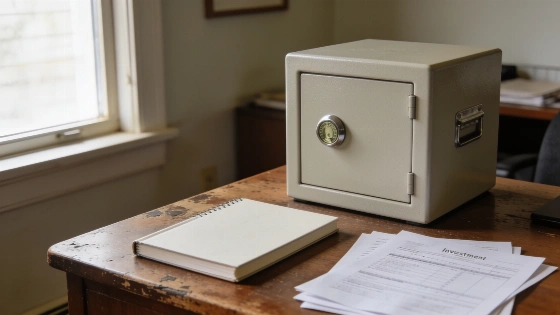
Buffett's crash playbook starts with cash, not forecasts. A reserve can keep household bills from forcing stock sales, while a downturn may bring lower prices for businesses investors already value.
Berkshire Hathaway announced on September 18, 2026, that Warren Buffett would step down immediately as chairman after more than 60 years. He would become chairman emeritus, Howard G. Buffett would take the chair, and Greg Abel would continue as CEO, according to a succession handoff report. Buffett's advice for a market crash is less about predicting the next one than being ready for it.
A stock loss on paper can become real if an investor has to sell to pay an unexpected bill. Cash set aside for emergencies can ease that pressure. It can also give long-term investors room to assess a downturn without treating every market drop as a reason to sell.
Howard G. Buffett has served on Berkshire Hathaway's board of directors since 1993.
Cash before forecasts
Buffett's familiar ark metaphor makes a simple point: predicting a market storm is not the same as preparing for one. Short-term market moves are hard to predict. Trying to time a crash can turn investing into speculation, and no forecast guarantees a household will have cash when an expense arrives.
The article suggests rough reserve targets: at least three months of expenses for younger adults and at least six months for families. These are guideposts, not rules for every household. The right amount depends on income stability, essential bills, dependents, debt obligations and access to other resources.
Avoid forced selling
An emergency reserve can give investments more time to recover. It makes a stock sale to cover a bill during a decline less likely. Selling after prices fall may lock in a loss. Selling shares that have risen may also bring a capital-gains tax bill, depending on the investment and the investor's tax situation.
Cash does not remove market risk. It can reduce the chance that a short-term need dictates a long-term investment decision. But money held for emergencies is not invested in stocks, and inflation can erode its purchasing power.
Access comes first.
The reserve is there for access and stability, not market growth. The right balance depends on a household's circumstances. Money needed for near-term expenses generally should not be treated as if it can withstand stock-market volatility.
History is not a guarantee
Since 1980, the S&P 500 has gone through seven crashes and risen more than 7,000% overall, according to the figures cited in the article. That describes the index's past performance. It does not mean every stock recovered, every investor stayed invested, or future declines will follow the same path.
Results also depend on what investors own and when they need the money. Buffett's record as a value investor is closely tied to buying when others are fearful. A selloff can make shares of strong businesses cheaper, but a lower price alone does not make a stock a bargain.
A company's prospects can worsen. Investors who buy during a decline may face further losses before conditions improve. The point is to assess value and risk, not assume every falling share is an opportunity.
Preparedness beats panic
As earlier Buffett coverage explains, staying invested and putting more money in are separate decisions. A household may have a long time horizon for retirement savings and still need liquid funds for an immediate expense. Those needs call for separate decisions, not one market-timing call.
Cash reserves and investments have different jobs. An emergency fund covers disruptions without forcing a sale. A stock portfolio takes on price swings in pursuit of longer-term growth.
Keep those roles clear.
That separation can help investors judge a downturn without confusing a market loss with a household cash shortage. Buffett's lesson is not that crashes are easy to profit from. Preparation gives investors more choices as prices fall. They may hold rather than sell under pressure, or consider buying only if the purchase fits their finances and their view of the company.
A cash cushion cannot prevent losses. It can keep panic and an urgent bill from making the decision. As Fortune reported, Buffett said Abel "runs the company," while Howard Buffett would "guard its culture and values." Reuters also reported that Buffett would remain on Berkshire's board as chairman emeritus and Howard Buffett would serve as non-executive chairman. A report on the leadership transition also covered the governance change.