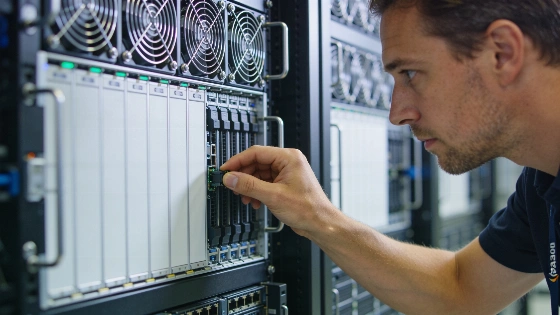
Amazon's in-house chip business is now generating over $25 billion in annual revenue, positioning it alongside AWS, Prime, and Marketplace as a core pillar. The move signals a major shift in the tech giant's long-term growth strategy
In a move that could reshape the company's future, Amazon is elevating its custom chip division to the same strategic level as its most successful businesses. According to Fortune, Jeff Bezos recently identified Amazon's silicon operations as the company's next foundational pillar, joining AWS, Marketplace, and Prime. This shift comes as Amazon's chip business, which includes the Graviton, Trainium, and Nitro product lines, has surpassed a $25 billion annual revenue run rate, based on the company's latest earnings disclosures.
The timing is notable. Bezos's comments surfaced just as Amazon overtook Walmart to claim the top spot on the Fortune Global 500, with annual sales exceeding $700 billion. While Bezos stepped down as CEO in 2021, he remains executive chair and a major shareholder, and his strategic pronouncements continue to influence Wall Street's view of Amazon's long-term prospects.
Silicon as a Strategic Asset
Amazon's chip ambitions are rooted in its 2015 acquisition of Annapurna Labs, an Israeli startup that now designs the company's AI-focused Trainium and Inferentia chips. These chips are positioned as lower-cost, high-performance alternatives to Nvidia's dominant GPUs, a critical advantage as demand for AI computing power strains global supply chains. AWS customers-including Apple, OpenAI, and Meta-are already testing or deploying Amazon's chips for their own AI workloads, signaling growing industry acceptance.
Amazon first disclosed revenue from its data center chips during its Q1 2026 earnings call, revealing that the combined chip lineup had reached a $20 billion annualized run rate, with growth of roughly 40% quarter over quarter and triple digits year over year. By Q2 2026, CEO Andy Jassy reported that both the AI and custom chip units had each exceeded $25 billion in annual revenue, with more than $225 billion in multi-year customer commitments. The company has deployed about 1.4 million Trainium chips across three generations, including a 500,000-chip cluster known as Project Rainier that went live in late 2025.
Capital Spending and Competitive Stakes
Amazon's aggressive investment in silicon is driving a surge in capital expenditures. The company raised its 2026 capex guidance to $220 billion, up from $200 billion, with AI, chips, and data center infrastructure accounting for most of the increase. This level of spending has drawn scrutiny from investors, especially as Amazon continues to sell Nvidia GPU instances on AWS while simultaneously building out its own chip ecosystem.
Performance improvements have been rapid. Trainium2 chips delivered about 30% better price performance than comparable GPUs and largely sold out, according to Jassy. The latest generation, Trainium3, began shipping in early 2026 and is expected to deliver another 30% to 40% performance boost. Jassy has also stated that if Amazon sold its chips externally like traditional merchant chipmakers, annual revenue could approach $50 billion.
Amazon's chip strategy is not without risk. The company is betting that its in-house silicon can continue to close the performance gap with Nvidia and attract major AI customers. At the same time, Amazon is consolidating its AI model lineup to focus on a single flagship system, as detailed in a recent report on its AI business reset. This underscores the high stakes and rapid evolution in the AI infrastructure market.
Durability and Long-Term Vision
Bezos's framing of "pillars" dates back to his 2014 shareholder letter, where he described the traits of a business that can endure for decades: customer love, massive scale, strong returns on capital, and long-term durability. AWS, Marketplace, and Prime have long met those criteria. Now, Amazon's chip business is being positioned to join that exclusive group, with the next-generation Trainium4 chip slated for launch in 2027.
The renewed focus on durability comes against the backdrop of a warning Bezos gave employees in 2018, when he predicted that Amazon would eventually fail if it lost its customer obsession. That remark resurfaced in July 2026, highlighting the tension between Amazon's relentless push for innovation and the risks of corporate complacency. Whether chips will truly become a pillar on par with AWS and Prime will depend on Amazon's ability to maintain its technological edge and deliver sustained financial returns in a fiercely competitive market.
For context, Amazon's Q2 2026 earnings showed the company's total revenue topping $700 billion for the first time, with AWS contributing more than $100 billion and the chip business now a significant driver of growth. The company's capital allocation decisions and ability to execute on its silicon roadmap will be closely watched by investors as the AI arms race accelerates.
Understanding Amazon's chip strategy requires a look at how custom silicon can reshape the economics of cloud computing. By designing its own processors, Amazon can optimize for specific workloads, reduce reliance on external suppliers, and potentially lower costs for itself and its customers. This approach also gives Amazon more control over its technology stack, which can be a competitive advantage as AI and machine learning become central to enterprise IT. For investors, the key questions are whether Amazon can sustain its pace of innovation and whether the chip business will deliver the kind of durable, high-margin growth that has defined its other pillars.