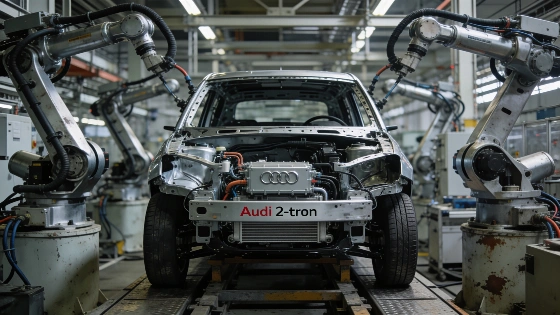
Audi is relaunching its A2 as a high-efficiency electric car with a $44,000 price tag while Chinese rivals dominate Europe's EV market with far cheaper models
German automaker Audi is resisting the ongoing price war as Chinese electric vehicles rapidly gain ground across Europe. Instead of lowering prices, Audi is introducing the new A2 e-tron with a starting price of approximately $44,000, relying on efficiency and brand reputation to support its premium positioning-even as Chinese competitors offer similar models at significantly lower prices.
Audi officially unveiled the A2 e-tron on September 7, 2026, with production set to begin at the Ingolstadt plant and first deliveries scheduled for December 2026.
Rather than competing on price, Audi is reviving the A2 nameplate, which previously struggled in the market. The original A2, launched in 1999, was technologically advanced but suffered from weak sales due to pricing that closely matched the larger A4, leading to its discontinuation in 2005. The new A2 e-tron returns as an electric hatchback, featuring energy consumption of just 12.8 kilowatt-hours per 100 kilometers and a range of up to 646 kilometers on the WLTP cycle. Audi states this is the most energy-efficient production model in its history, a claim confirmed in a Reuters financial review.
This efficiency, however, comes with a higher price. The A2 e-tron's base price in Germany is €38,200 (about $44,364), which is significantly above Chinese competitors such as BYD's Dolphin and Seagull that target the same segment at much lower prices. Audi is not targeting budget-conscious buyers. Instead, it offers four power outputs and battery capacities up to 84 kWh, aiming to attract customers who value performance and range and are willing to pay a premium. According to official Audi press materials, orders in Germany open on September 10, 2026, with three battery options-52, 61, and 84 kWh-available at launch.
Manufacturing and Margin Pressure
Audi confirmed that the A2 e-tron is built on the updated Volkswagen Group MEB+ platform and is primarily targeted at the European market. The original A2 was discontinued in 2005 after weak sales.
The restructuring announcement prompted an 8% rise in Volkswagen's Frankfurt-listed shares. However, Citi analysts cautioned that cost reductions alone will not resolve the group's competitive challenges in China or Europe, where high raw material costs and declining profits from Chinese joint ventures continue to weigh on results. Volkswagen's profit from its China joint ventures is expected to fall to as little as €200 million this year, down from €958 million in 2025.
China's Advance and Europe's Response
Chinese automakers are not only increasing sales but also acquiring European manufacturing capacity. Ford is negotiating to sell part of a Spanish plant to China's Geely, and BYD is in talks with Stellantis and others for unused European factory space. Established European brands are being forced to reevaluate their cost structures and product strategies as Chinese entrants set new standards for price and value.
For Audi, the A2 e-tron represents a calculated risk. The company is wagering that German engineering, efficiency, and a premium brand can still command higher prices, even as the market shifts toward more affordable, compact EVs. Early reservation figures, with orders opening in Germany on September 10, will provide the first indication of whether this strategy can succeed where the original A2 did not.
Recent events highlight the risks of market disruption. When Howmet Aerospace faced a sudden shock after SpaceX began producing its own turbine blades, the company's stock dropped sharply and investors had to reassess risk and reward, as previously reported. Audi's situation is less dramatic but carries similar implications: a premium brand seeking to protect its margins in a market where cost control and scale are increasingly critical.
Efficiency Versus Price
For U.S. investors and automakers, Audi's strategy serves as a warning. The company is not competing on price, but on efficiency and brand loyalty. If European consumers reject the premium, Audi risks repeating its earlier mistake-technical excellence that does not translate into sales. If successful, this approach could provide a model for legacy automakers facing pressure from Chinese competition and rising production costs.
According to the European Automobile Manufacturers' Association, Chinese-branded vehicles accounted for 16.5% of the EU passenger car market and 31% of the battery-electric segment by March 2026. This rapid shift is forcing established brands to choose between lowering prices, cutting costs, or focusing on their unique strengths. Audi's decision to avoid a price war and emphasize efficiency is a high-stakes strategy with little room for error. The coming quarters will determine whether buyers are willing to pay a premium for German engineering or if the future of Europe's EV market will be shaped by Chinese manufacturers.
Electric vehicle pricing is influenced by more than manufacturing costs alone. Battery prices, government incentives, tariffs, and consumer expectations all affect what automakers can charge and what buyers are willing to pay. As Chinese brands expand production and localize manufacturing in Europe, legacy automakers will face increasing pressure to deliver both value and innovation. For consumers, this could mean a broader range of choices-but also a sharper divide between budget and premium options as the market determines which companies will endure the next wave of disruption.