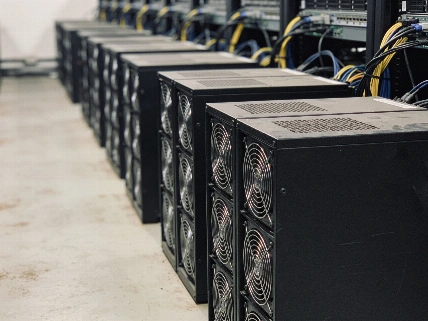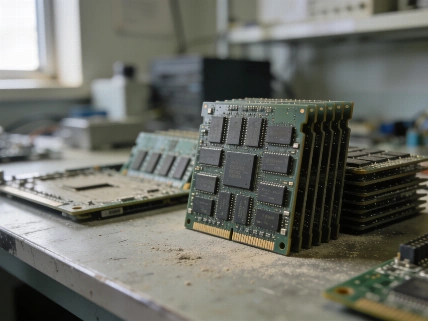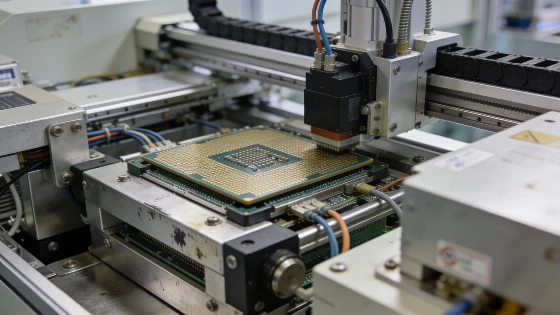
Micron stock has dropped sharply from its June highs, but Bank of America is sticking with its bullish long-term price target, arguing that AI-driven demand could reshape the memory chipmaker's earnings even in a downturn
Micron Technology has long been a bellwether for volatility in the semiconductor sector, with its stock price swinging sharply as memory chip cycles rise and fall. In 2026, that pattern has returned: Micron shares have fallen about 34% from their June peak, as investors brace for a potential downturn in memory prices. Yet Bank of America is not backing away from its bullish stance. The firm's analyst, Vivek Arya, reaffirmed a $1,550 price target for Micron, maintaining a Buy rating even as the stock traded near $830 in early August.
According to Arya, the current sell-off reflects investors' tendency to anticipate the next cyclical downturn before it arrives. But he argues that this time is different. The rise of artificial intelligence has fundamentally changed demand for high-bandwidth memory (HBM), a segment where Micron is a key supplier. Even in a scenario where memory prices drop 30% to 40%-in line with past industry slumps-Bank of America estimates Micron could still earn around $100 per share in 2028. That's a dramatic increase from the company's previous cycle peak of roughly $12 per share in 2018.
For investors, the implication is that Micron's downside risk may be less severe than in past cycles, thanks to the structural shift in demand from AI applications. Arya's analysis suggests that even the bear case for Micron's earnings is now far stronger than the best years of previous memory booms. The firm's base case assumes DRAM prices fall 10% and NAND prices drop 18% in 2028, yet Micron could still generate about $150 per share in earnings. If prices hold steady, that figure could reach $175 per share. At current levels, the stock trades at just 8 to 9 times the worst-case scenario earnings, a valuation that Arya believes fails to reflect the company's AI-driven growth potential.
Sum-of-Parts Valuation
Bank of America's approach values Micron as two distinct businesses: the traditional cyclical memory segment and the AI-focused HBM business. The legacy memory operation is valued at $1,040 per share, using a multiple of three times the estimated 2028 price-to-book ratio-toward the high end of Micron's historical range. The HBM business, meanwhile, is valued at 31 times projected 2028 earnings, in line with the median for AI compute peers. Combined, these components support the $1,550 price objective. Arya contends that the market is currently pricing Micron as if it were only a commodity memory company, ignoring the premium attached to its AI memory business.
Recent data supports the view that AI demand remains robust. As of August 2026, flagship Nvidia GPUs such as the A100, H100, and H200 are renting at near-record prices, indicating that customers are still willing to pay for the HBM memory integrated into these systems. TrendForce's Q3 2026 outlook shows server DRAM prices rising 13% to 18% quarter over quarter, while spot DRAM and NAND prices have been flat to slightly higher in recent weeks. None of the top four hyperscalers reported memory pricing as a constraint on AI deployments during their latest earnings calls, and AWS specifically noted increased capital spending on memory.
Industry Shifts and Competitive Threats
One notable change in the memory industry is the move toward long-term supply agreements. Historically, memory pricing was negotiated quarterly, leading to sharp swings in profitability. Now, both Samsung and Micron are shifting to multi-year contracts that could eventually cover 50% to 70% of industry capacity. While these agreements may not eliminate downturns, they could help moderate the impact of sudden supply increases on pricing.
Some investors are watching China's CXMT, a domestic memory manufacturer rapidly expanding its capacity, as a potential threat. Arya downplays this risk for Micron's AI business, noting that CXMT is focused on commodity DRAM for consumer markets and does not produce the advanced HBM3E or HBM4 memory required for AI accelerators. U.S. companies may also face regulatory hurdles in sourcing AI memory from Chinese suppliers, further limiting the competitive threat in this segment.
Concerns have also surfaced about Nvidia's upcoming Rubin Ultra GPU, which may feature fewer HBM stacks per package than initially planned. Arya argues that this change does not reduce total HBM demand, as the memory content per unit of AI compute remains unchanged. For now, the combination of strong GPU rental prices, rising server DRAM pricing, and continued hyperscaler investment suggests that AI-related memory demand is holding up.
Valuation Gap and Market Context
Despite these positive signals, Micron's stock valuation remains well below Bank of America's target. Arya attributes this gap to investors' focus on traditional memory cycles and skepticism about the durability of AI-driven demand. The firm's analysis suggests that the market is underestimating both the earnings power and the resilience of Micron's business in the AI era.
For context, Micron reported revenue of $30.8 billion for its fiscal year ended August 2025, up from $27.7 billion the prior year, according to company filings. The company's operating margin improved to 28%, reflecting both higher average selling prices and increased demand for advanced memory products. As of August 2026, Micron's market capitalization stood near $90 billion, with trading volume surging during periods of heightened volatility.
Bank of America's conviction in Micron's long-term prospects echoes its approach to other technology giants facing market skepticism over AI spending. For example, the firm recently reiterated its bullish stance on Meta Platforms despite concerns about the payoff from large-scale AI infrastructure investments, as discussed in this related analysis.
Ultimately, the debate over Micron's valuation centers on whether the AI-driven transformation of the memory market will prove durable enough to support higher earnings through the next cycle. While risks remain, including potential oversupply and new competition, Bank of America's analysis suggests that the company's earnings structure has fundamentally changed.
Memory chip cycles have historically been among the most volatile in technology, with sharp booms and busts driven by swings in supply and demand. For investors, understanding the mechanics of these cycles is critical. Unlike logic chips, memory is a commodity product, making it highly sensitive to pricing and inventory shifts. The rise of AI has introduced a new source of demand that may help smooth out some of the extreme volatility, but it also raises questions about how long this structural shift will last. As the industry adapts to new technologies and supply agreements, the balance between risk and opportunity for companies like Micron will continue to evolve.